MIM-8620 Low Alloy Steel for Metal Injection Molding
MIM-8620 occupies a unique position among MIM materials because it is optimized for case hardening rather than through-hardening. After carburizing and quenching, the surface reaches 58–62 HRC while the core stays soft and tough. This surface-core gradient is exactly what transmission gears, cam followers, and power-tool mechanisms need to survive impact and cyclic contact loads.
At Emitech, we process MIM-8620 from feedstock formulation through sintering, heat treatment, and final inspection on a single Nanjing site. Customers choose this grade when they need complex geometries that would be expensive to machine from wrought bar, combined with the fatigue resistance and wear performance of a carburized low-alloy steel.
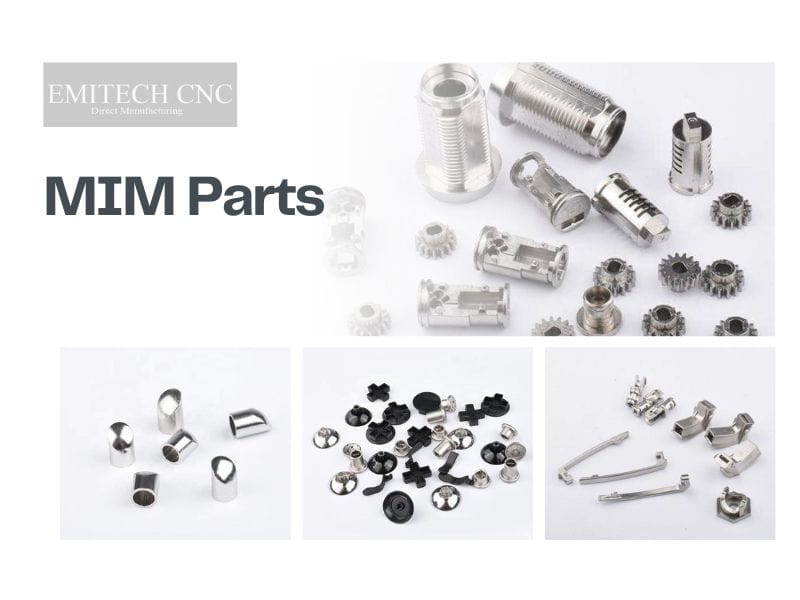
MIM 8620 Low-Alloy Steel Data
| Grade | Chemical Composition | Sintering Temperature (°C) | Density (g/cm³) | Yield Strength | Hardness | ASTM Specification | Typical Applications |
|---|---|---|---|---|---|---|---|
| 8620 | Fe/C0.18-0.23/Ni0.4-0.7/Cr0.4-0.6/Mo0.15-0.25 | 1,120–1,150 | 7.5 | 450–650 MPa as-sintered; 650–850 MPa carburized | 18–25 HRC as-sintered; 58–62 HRC case | AISI 8620, MPIF 35 | Gears, shafts, cam followers, power tools |
What Is MIM-8620?
MIM-8620 is the powder metallurgy equivalent of wrought AISI 8620, a classic carburizing steel. In metal injection molding, the alloy is atomized into fine spherical powder, mixed with a thermoplastic binder, injected into precision molds, debound, and sintered to near-full density. The resulting microstructure is fine and homogeneous, giving predictable heat treatment response and consistent properties from lot to lot.
The grade belongs to the low-alloy steel MIM family alongside MIM-4605 and MIM-4140. While 4605 is through-hardenable and 4140 is chosen for high-strength structural sections, 8620 is the specialist for case-hardened applications. Its lower carbon content keeps the core ductile, while nickel, chromium, and molybdenum improve hardenability for a meaningful hardened case even on small MIM cross-sections.
Chemical Composition
The performance of MIM-8620 is governed by its carefully balanced chemistry. Carbon is kept intentionally low so the core remains tough; nickel, chromium, and molybdenum are added to improve hardenability and refine the carburized case. The composition below conforms to typical MPIF Standard 35 and customer specifications for MIM 8620 powder:
| Element | Weight % (typical) | Role in MIM-8620 |
|---|---|---|
| Iron (Fe) | Balance | Matrix phase providing structural integrity |
| Carbon (C) | 0.18 – 0.23 | Base hardenability; carbon is enriched during carburizing |
| Nickel (Ni) | 0.40 – 0.70 | Improves toughness and impact resistance of the core |
| Chromium (Cr) | 0.40 – 0.60 | Enhances hardenability and wear resistance of the case |
| Molybdenum (Mo) | 0.15 – 0.25 | Reduces temper brittleness and improves high-temperature strength |
| Manganese (Mn) | 0.70 – 0.90 | Aids deoxidation and further improves hardenability |
| Silicon (Si) | 0.15 – 0.35 | Deoxidizer; contributes to strength |
| Sulfur (S) | ≤ 0.05 | Controlled for machinability without excessive brittleness |
| Phosphorus (P) | ≤ 0.05 | Controlled to avoid cold-shortness |
This composition makes MIM-8620 forgiving during heat treatment. Nickel keeps the core tough after quenching, while chromium and molybdenum help the carburized case transform to hard martensite without extreme quench severity. For thin-section MIM parts, this means less distortion and more predictable dimensional change.
Mechanical and Physical Properties
Mechanical properties depend strongly on whether the part is as-sintered or carburized. The table below summarizes typical values.
| Property | As-Sintered | Carburized & Quenched |
|---|---|---|
| Density | ≥ 7.5 g/cm³ | ≥ 7.5 g/cm³ |
| Tensile Strength | 650 – 850 MPa | 900 – 1,100 MPa |
| Yield Strength | 450 – 650 MPa | 650 – 850 MPa |
| Elongation | 12 – 18% | 8 – 12% |
| Hardness (HRC) | 18 – 25 | 58 – 62 (case); 25 – 35 (core) |
| Young's Modulus | 190 – 200 GPa | 190 – 200 GPa |
| Impact Resistance | Good | Very good (tough core) |
The key advantage is the hardness gradient: a 58–62 HRC surface resists wear and surface fatigue, while the 25–35 HRC core absorbs impact and prevents brittle fracture. This is difficult to achieve with through-hardened grades such as MIM-4140 or MIM-4605.
Dimensional stability is another strength. Typical MIM shrinkage of 14–16% is isotropic and repeatable, so net-shape features such as gear teeth and splines can be held to tight tolerances. For even tighter precision, Emitech provides CNC machining after sintering or heat treatment.
Heat Treatment and Carburizing
Heat treatment is where MIM-8620 differentiates itself. The standard route is carburizing followed by quenching and tempering, although carbonitriding or through-hardening are also possible. At Emitech, heat treatment is performed in-house, giving us full control over case depth, surface carbon content, core hardness, and distortion.
Carburizing diffuses carbon into the surface at 880–950°C in a controlled atmosphere or vacuum furnace. For MIM-8620 we typically target 0.3–1.2 mm case depth depending on load. After carburizing, parts are oil or gas quenched to form hard martensite, then tempered at 150–200°C to relieve stresses without significantly reducing surface hardness.
Carbonitriding adds nitrogen for a harder, more wear-resistant case with reduced distortion. Through-hardening of thin sections produces 35–45 HRC for shafts and brackets that do not need a deep wear case. Every batch is verified by metallography, hardness profiling, and microstructure examination in our quality inspection laboratory.
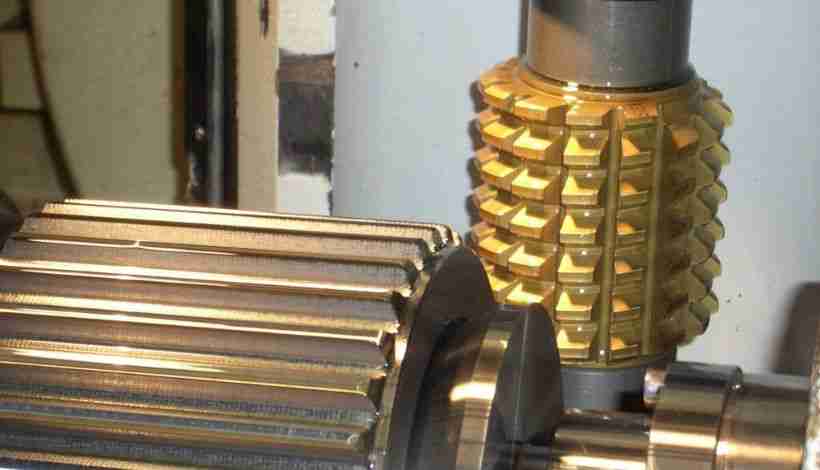
Applications of MIM-8620
MIM-8620 is chosen when designers need the wear resistance of a hardened surface, the toughness of a ductile core, and the geometric complexity of metal injection molding. Common application areas include:
Automotive Gears and Transmission Components
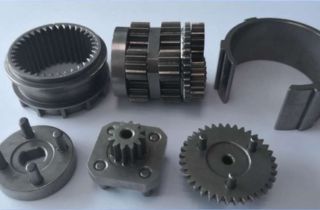
The automotive sector is the largest user of carburized low-alloy steels. Automotive MIM parts made from 8620 include small planetary gears, pinions, gear shift detents, and sensor trigger wheels. The hard case resists pitting and scuffing, while the tough core withstands impact loads during engagement. Near-net-shape MIM gear teeth reduce machining cost compared to wrought blanks.
Shafts, Splines, and Rotating Parts
Drive shafts, spline hubs, and cam followers benefit from the fatigue resistance of MIM-8620. The fine MIM microstructure reduces fatigue initiation sites, and the carburized surface increases bending fatigue life. CNC finishing is often used on bearing journals and seal diameters for tight tolerances.
Hand Tools and Industrial Mechanisms
Industrial hand tools such as ratchet mechanisms, driver-bit holders, locking pawls, and torque-tool inserts are excellent candidates for MIM-8620. These parts need wear resistance at contact surfaces, toughness when overloaded, and complex shapes that would be expensive to machine.
Other Wear-Resistant Precision Components
Beyond automotive and hand tools, MIM-8620 is used in locking hardware, firearm safety components, power-tool gears, pump valves, and agricultural equipment. Any small precision part subject to contact stress, sliding wear, or impact loading can benefit from this grade.
MIM-8620 vs MIM-4605 and MIM-4140
The table below compares the three most common low-alloy MIM grades:
| Feature | MIM-8620 | MIM-4605 | MIM-4140 |
|---|---|---|---|
| Carbon content | 0.18 – 0.23% | 0.40 – 0.60% | 0.38 – 0.43% |
| Primary hardening method | Carburizing / carbonitriding | Quench & temper | Quench & temper |
| Max surface hardness | 58 – 62 HRC | 50 – 52 HRC | 54 – 56 HRC |
| Core hardness | Soft and tough (25 – 35 HRC) | Uniformly hard | Uniformly hard |
| Impact resistance | Excellent | Moderate | Good |
| Wear resistance | Excellent at surface | Good throughout | Good throughout |
| Typical applications | Gears, shafts, pawls | Small gears, tools, locks | Structural, high-load parts |
| Relative cost | Moderate | Moderate | Moderate to high |
Choose MIM-8620 for very hard wear surfaces with a tough, impact-absorbing core. It is best for carburized gears, shafts under bending fatigue, and hand-tool mechanisms that may see overload.
Choose MIM-4605 when 50+ HRC through-hardness is sufficient and thin sections harden uniformly. It avoids carburizing, making it cost-effective for small gears and locking components.
Choose MIM-4140 for structural parts needing high strength across the entire cross-section, such as brackets and high-load fasteners. It is not normally carburized.
Surface Treatment and Finishing
After sintering and heat treatment, MIM-8620 parts can receive a wide range of surface treatments to improve corrosion resistance, appearance, or tribological performance.
- Electroless nickel plating — Uniform corrosion and wear protection, even on complex internal geometries (5–15 μm).
- Zinc plating with chromate — Cost-effective protection for indoor and mild outdoor environments.
- Phosphate conversion coatings — Improve paint adhesion and short-term corrosion protection.
- Black oxide — Decorative finish with minimal dimensional change.
- PVD / DLC coatings — Enhance surface hardness and reduce friction.
- Shot peening — Induces compressive stresses to improve fatigue life.
We recommend applying coatings after final heat treatment. For tight tolerances on coated surfaces, we calculate coating thickness into the final dimension and verify after finishing.
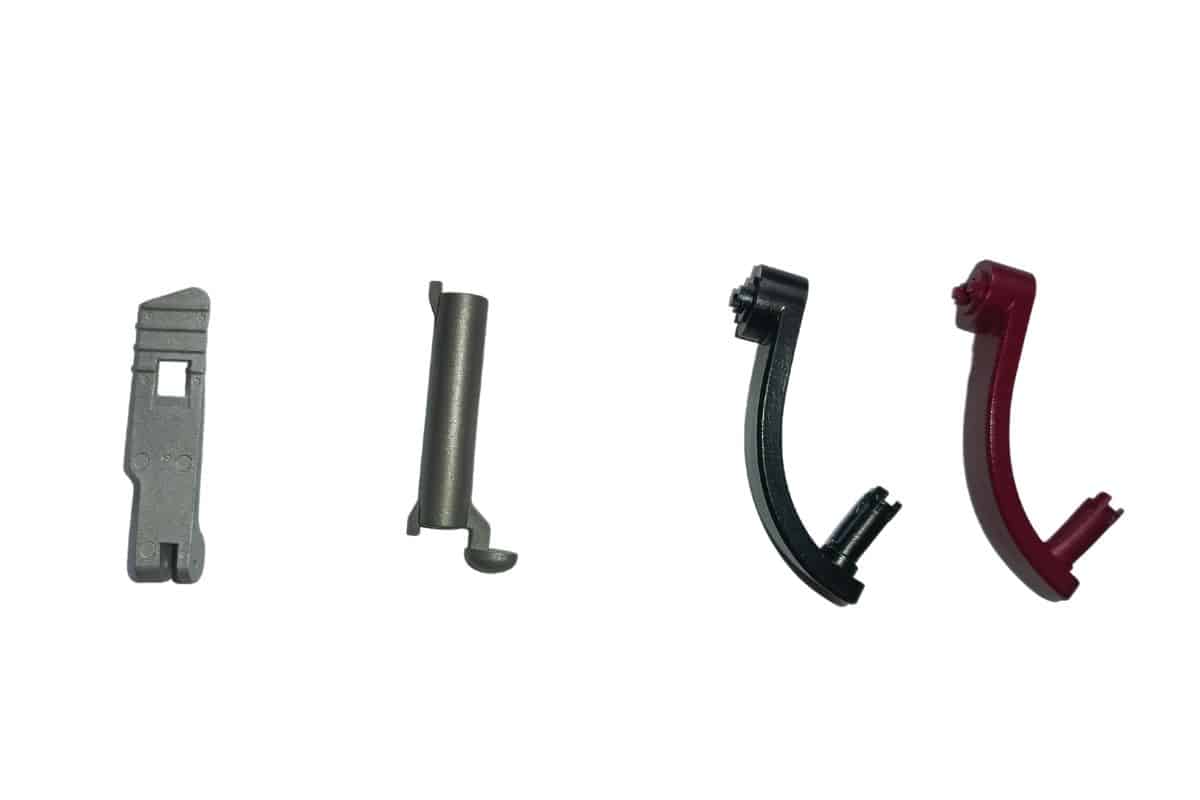
Manufacturing and Quality Control at Emitech
Our MIM-8620 production follows a controlled workflow from raw powder to shipped part. Feedstock is mixed in-house from certified lots, injected, debound, and sintered on site. Carburizing is performed immediately after sintering in the same facility, eliminating inter-factory transport and reducing lead time.
Quality control includes powder chemistry verification, green-part sampling, sintered density measurement, metallography, and mechanical testing. For every carburized batch we produce a case-depth profile and surface-hardness map. Documentation supports dimensional inspection reports and lot-level traceability requirements.
If tight tolerances cannot be held directly by MIM, our engineering team recommends a CNC secondary operation with appropriate machining stock.
Frequently Asked Questions
Q: What is MIM-8620 best used for?
A: MIM-8620 is best for small, complex parts needing a hard wear surface and a tough core. Typical uses include automotive gears, shafts, hand-tool mechanisms, locking components, and industrial wear parts.
Q: How hard can MIM-8620 get after carburizing?
A: The surface typically reaches 58–62 HRC after carburizing, quenching, and tempering. The core remains 25–35 HRC, preserving toughness. Case depth is usually specified between 0.3 mm and 1.2 mm.
Q: How does MIM-8620 compare to wrought 8620 steel?
A: Fully sintered MIM-8620 reaches ≥95% of wrought density and comparable properties after heat treatment. The fine, homogeneous MIM microstructure often gives more consistent fatigue life and heat treatment response.
Q: Can MIM-8620 parts be plated or coated?
A: Yes. It accepts electroless nickel, zinc plating, phosphate, black oxide, PVD, DLC, and paint. Coatings should generally be applied after final heat treatment.
Q: What tolerances can MIM-8620 hold?
A: As-sintered parts typically hold ±0.3% to ±0.5%. Critical features are often finish-machined or ground after heat treatment, achieving ±0.01 mm or tighter.
Q: Is MIM-8620 magnetic?
A: Yes, it is ferromagnetic. Its magnetic properties remain stable after heat treatment, making it suitable for sensor targets and actuator components.
Q: How does MIM-8620 compare to MIM-4605 for gears?
A: MIM-4605 is often preferred for small, thin gears because it through-hardens to 50–52 HRC with simpler treatment. MIM-8620 is better for gears under higher impact loads because it reaches 58–62 HRC at the surface after carburizing.
Source Custom MIM Parts from Emitech
Nanjing Emitech delivers MIM from tooling through sintering and finishing. Custom MIM parts · MIM services · Request a quote
Last updated: 2026-09-08