Surgical Forceps Jaws: A Typical MIM Application
Part type: Laparoscopic forceps jaw | Typical material: 17-4PH stainless (ASTM F899) | Typical route: MIM + secondary finishing
On this page: component overview · materials and standards · why machining is difficult · the MIM route · design guidelines · FAQ
Component Overview
This page breaks down a typical surgical forceps jaw application, based on published standard data and our general production experience — not a specific customer project.
Laparoscopic forceps jaws are among the most demanding small components in surgical instruments. A typical jaw combines a serrated gripping surface — tooth pitches around 0.3 mm across a curved profile — with a precision pivot bore and an actuation slot, all within a part commonly 15–30 mm long and weighing only a few grams. Because the jaw transmits the full closing force of the instrument, the material must deliver high yield strength and fatigue resistance; 17-4PH stainless steel to ASTM F899 is a widely used choice for reusable instruments of this type.
Typical requirements on drawings for this part family include:
- Micro-scale geometry: serrated gripping surface around 0.3 mm tooth pitch and 0.15 mm tooth depth across a curved profile
- Tight bores: pivot holes on the order of Ø2 mm with micron-level tolerance and controlled surface roughness on the gripping face
- Material: medical-grade 17-4PH (ASTM F899), H900 condition — 1,170 MPa minimum yield strength, ~40 HRC per published standard data
- Surface finish: electropolished to Ra ≤ 0.4 µm, free of burrs, pits and embedded particles
- Traceability: heat-number-to-finished-part traceability is commonly required by medical device OEMs
- Sterilization: reusable instruments are typically designed to withstand repeated steam autoclave cycles at 134°C
These parts are commonly produced in annual volumes from tens of thousands to several hundred thousand pieces across an instrument product family — squarely in the range where metal injection molding is generally considered an economical alternative to machining.
Materials and Standards for Surgical MIM
17-4PH dominates surgical MIM because it combines corrosion resistance with high aged strength: in the H900 condition, MIM-17-4PH per MPIF Standard 35 delivers a minimum yield strength of 1,170 MPa at roughly 40 HRC. Where higher hardness or cutting edges are required, 420 and 440C stainless grades are common alternatives; titanium alloys are used when weight or imaging compatibility drives material selection, at higher cost. Specifying the material by its ASTM F899 or MPIF Standard 35 designation keeps mechanical property expectations anchored to published standard data rather than project-specific testing.
Why Machining This Part Is Difficult
- Multiple setups: the gripping face, pivot bore and actuation slot usually cannot be machined in a single setup, so each jaw may need three or more CNC operations
- EDM-dependent serrations: fine teeth on a curved profile typically require EDM or micro-milling, with frequent electrode or tool changes
- Geometry drift: EDM electrode wear is a well-known source of gradual profile drift in machined production, forcing periodic requalification
- Material waste: machining a few-gram part from bar stock converts most of the billet into chips, while MIM is near-net-shape
- Cycle time at volume: micron-level bores and polished finishes are achievable by machining, but unit cost and scrap risk rise sharply as volumes grow into the tens of thousands
The MIM Manufacturing Route
A typical MIM workflow for a forceps jaw molds the serrations, actuation slot and outer profile directly in the tool, reserving secondary operations for features that exceed standard MIM tolerance capability. The sequence below reflects common industry practice for 17-4PH medical components of this size.
| Process Step | Typical Practice |
|---|---|
| Feedstock | 17-4PH water-atomized powder (D90 < 16 µm) with wax-polymer binder, supplied with lot-level certification |
| Tooling | Multi-cavity precision tool with conformal cooling and EDM-finished serration inserts; typically 3–5 weeks including first-article validation |
| Injection | All-electric machines with cavity pressure monitoring for consistent fill across micro-serrations |
| Debinding | Solvent debinding followed by thermal debinding in nitrogen, per established 17-4PH feedstock practice |
| Sintering | Vacuum sintering around 1,350°C, typically reaching 97%+ of theoretical density |
| Heat Treatment | Solution anneal plus H900 age hardening (per MPIF Standard 35 data: 1,170 MPa minimum yield strength, ~40 HRC) |
| Finishing | Electropolishing to Ra ≤ 0.4 µm where specified; pivot bores commonly reamed or honed as a secondary operation |
| QC & Traceability | CMM on critical bores, optical profile checks on serrations, hardness testing per lot, heat-number traceability from powder lot to finished part |
Typical Economics: MIM vs Machining
Exact figures always depend on geometry, volume and tolerances, but the general pattern for small, complex 17-4PH parts is well established across the MIM industry:
| Factor | Multi-setup CNC + EDM | MIM at Production Volume |
|---|---|---|
| Primary cost driver | Machine time, electrodes, setups | Amortized tooling plus cycle time |
| Economic crossover | Attractive for prototypes and low volume | Generally in the tens of thousands of pieces per year |
| Typical unit cost at volume | Baseline | Commonly significantly lower once tooling is amortized |
| Process steps | Commonly 5–7 operations per part | Commonly 2–3 (mold, sinter/finish, inspect) |
| Material utilization | Large share removed as chips | Near-net-shape, typically ~95%+ |
| Feature repeatability | Subject to electrode and tool wear drift | Mold replicates identical geometry across shots |
For buyers, the practical rule of thumb is to compare total cost at the expected annual volume — tooling amortization included — rather than piece price alone.
Design Guidelines for MIM Forceps Jaws
- Tolerance strategy: as-sintered MIM typically holds ±0.3–0.5% of dimension; specify secondary reaming or grinding only on features that need tighter control, such as pivot bores
- Draft on serrations: even ~0.5° of draft on tooth flanks significantly improves tool life and part release
- Uniform walls: keep wall thickness as uniform as possible to limit distortion during sintering
- Electropolish allowance: electropolishing removes a small surface layer — account for it on critical dimensions
- Material callout: reference ASTM F899 / MPIF Standard 35 (MIM-17-4PH) so mechanical properties are anchored to published standard data rather than custom testing
- Sterilization validation: autoclave resistance is application-specific; validate the required cycle count on finished, electropolished parts
Key Engineering Takeaway
For micro-featured surgical components, the decisive advantage of MIM is usually not raw piece price but geometric repeatability: once the mold is validated, every shot reproduces the same serration profile, eliminating the electrode-wear drift that complicates process control in EDM-based production. Combined with near-net-shape material usage, this is why MIM has become a standard production route for forceps jaws, grasper tips and stapler components across the surgical instrument industry.
Our production line
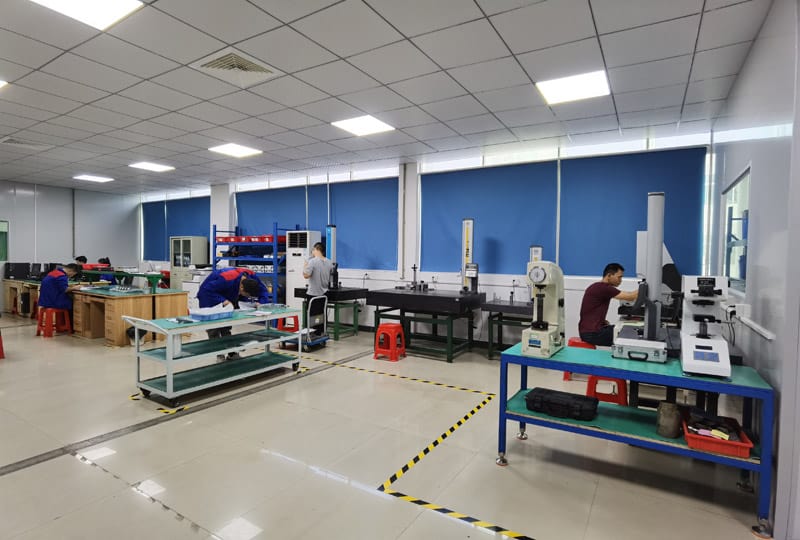
- 17 MIM injection machines and 22 sintering furnaces (4 continuous, 18 vacuum) at our Nanjing plant
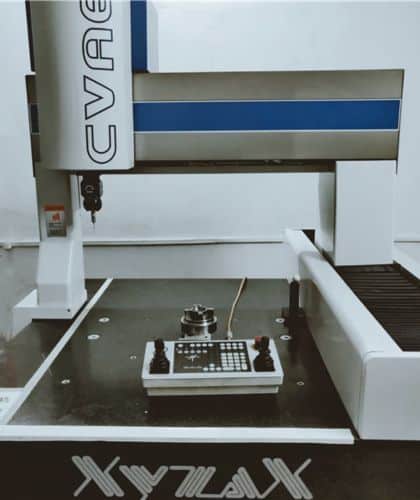
- In-house bridge CMM, optical profile projector, and Mitutoyo SJ-203 profilometer for dimensional and surface verification
- ISO 9001:2015 certified quality management system with lot-level traceability
References
- MPIF Standard 35, Materials Standards for PM/MIM — source of the MIM-17-4PH (H900) property data cited on this page
- ASTM F899 — the surgical instrument stainless steel specification cited on this page
Frequently Asked Questions
Q: Is MIM suitable for surgical instrument components?
Yes — MIM is widely used for forceps jaws, grasper tips and stapler components, most commonly in 17-4PH to ASTM F899 (H900 condition: 1,170 MPa minimum yield strength, ~40 HRC). See our surgical instruments MIM guide.
Q: Can MIM produce micro features like serrated gripping surfaces?
Yes. Fine serrations — tooth pitches around 0.3 mm — are molded directly from the tool, work that would otherwise require multiple CNC setups plus EDM on every part. Feature fidelity depends on powder size, tool finish and sintering control.
Q: What tolerances can MIM achieve on medical components?
As-sintered MIM typically holds ±0.3–0.5% of dimension. Tighter features, such as pivot bores, are commonly finished with a secondary reaming or grinding operation — details in our MIM tolerance guide.
Q: How is material traceability handled for MIM medical parts?
Emitech manufactures under a documented quality management system and provides heat-number-to-finished-part traceability with material certificates. Device-level regulatory documentation is normally maintained by the instrument OEM. See our quality inspection process.
Q: Are MIM medical parts sterilizable?
17-4PH in the H900 condition, electropolished free of burrs and embedded particles, is commonly used on instruments designed for repeated steam autoclave cycles. Sterilization validation is application-specific and should be confirmed on finished parts. More on medical MIM components.
Manufacturing a medical device component?
Send your drawing for a DFM review. Emitech provides full material traceability, in-house electropolishing and secondary CNC machining, under a documented quality management system.
New to qualifying MIM suppliers? Run the supplier qualification checklist before sending your RFQ.
Source Custom MIM Parts from Emitech
Nanjing Emitech delivers MIM from tooling through sintering and finishing, plus precision CNC machining for prototypes and secondary operations. Custom MIM parts · CNC machining services · MIM services · Request a quote
Last updated: 2026-09-08