
MIM Feedstock: Composition, Preparation & Quality Control
Quick Answer: MIM feedstock is the moldable raw material of metal injection molding: a homogeneous compound of fine metal powder (typically 55–65% by volume) and a multi-component polymer binder that lets metal flow like plastic inside the mold. Feedstock sits at the very first step of the MIM process chain, and its quality — powder particle size and shape, binder formulation, mixing homogeneity, and lot-to-lot consistency — directly determines debinding behavior, sintering shrinkage, and final part accuracy. This guide covers composition, preparation, quality metrics, and the make-vs-buy decision.
Every MIM part begins as feedstock. Before a single cavity is filled, the powder and binder have already fixed the ceiling on what the process can achieve: how cleanly the part fills thin walls, how uniformly it shrinks, and how close it comes to full density. Understanding feedstock is therefore the fastest way to understand why some MIM programs run at 98% yield and others fight warpage and blistering from the first shot.
What Is MIM Feedstock?
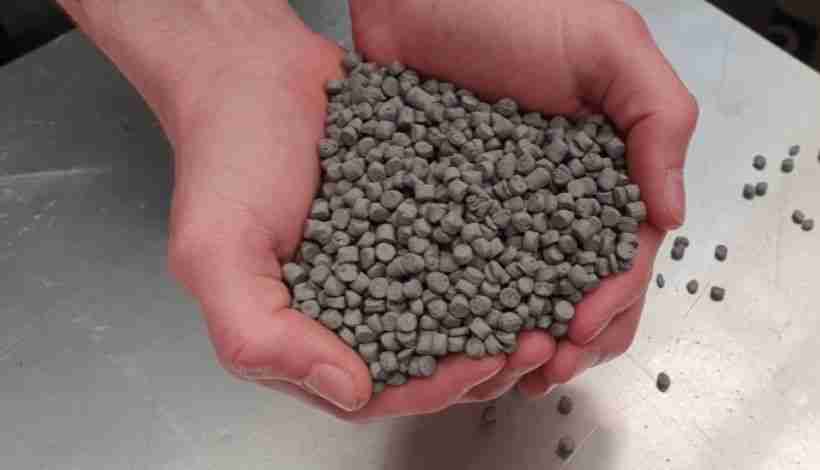
MIM feedstock is a pelletized composite of metal powder and binder. The metal provides the final part's properties; the binder is a temporary vehicle that gives the mixture thermoplastic flow behavior so it can be injected like a plastic. Once the green part is molded, the binder is removed during debinding and the powder skeleton is densified during sintering. A well-designed feedstock balances three competing demands: low enough viscosity to fill complex geometry, high enough powder loading to keep shrinkage predictable, and enough green strength to survive handling.
Feedstock Composition: The Metal Powder
MIM powders are much finer than conventional press-and-sinter powders, typically 2–20 µm with 90% of particles below 22 µm. Two attributes matter most:
- Particle size distribution: finer powders sinter faster and reach higher density, but they raise feedstock viscosity and cost. A controlled distribution, sometimes bimodal, improves packing density without sacrificing flow.
- Particle shape: spherical gas-atomized powder packs tightly and flows predictably, making it the default for high-volume MIM. Irregular water-atomized powder is cheaper and gives higher green strength, but lowers achievable solids loading and makes rheology less stable.
Powder loading — the volume fraction of metal in the feedstock — is usually 50–65%. Below the critical loading the part shrinks excessively and unevenly; above it, viscosity climbs until cavities no longer fill. Every alloy in our MIM materials portfolio (316L, 17-4 PH, low-alloy steels, titanium and more) has its own optimum loading window.
Binder Systems Used in MIM Feedstock
The binder is not a single polymer but a formulated system, normally built from a primary low-molecular-weight component, a backbone polymer, and a surfactant that couples powder to binder:
- Wax-polymer systems (paraffin wax + polyethylene/polypropylene + stearic acid): the most common family, removed by solvent extraction followed by thermal debinding. Versatile and tolerant of many alloys.
- Catalytic systems (polyacetal/POM based, e.g. Catamold-type): the backbone depolymerizes rapidly in an acid vapor atmosphere, giving very short debinding cycles and excellent shape retention.
- Water-soluble systems (PEG based): the primary component dissolves in water, attractive for stainless steels and operations avoiding solvents.
The binder must wet every particle, hold the green part together, and then leave in a controlled sequence — primary component first to open pore channels, backbone last so the part never slumps.
How MIM Feedstock Is Prepared
Preparation is a compounding operation, not simple stirring. Powder and binder are heated above the binder's softening point and worked under high shear until every particle is coated and all agglomerates are broken down. Industrial practice uses z-blade or planetary batch kneaders for development lots and twin-screw extruders for continuous production. The molten compound is then cooled and granulated into free-flowing pellets ready for the molding machine. Equipment selection, mixing temperature, torque endpoints and pelletizing practice are covered in detail in our feedstock mixing and granulation guide.
Feedstock Quality Control: The Key Metrics
Because nothing downstream can repair a bad feedstock lot, every batch should be qualified before it reaches the press:
- Density uniformity: pycnometer density across samples from the start, middle and end of a lot; variation beyond roughly ±0.05 g/cm³ signals segregation or binder drift.
- Melt flow index (MFI): a fast rheology gate test at a standardized temperature and load; lot-to-lot MFI drift translates directly into fill pressure and weight variation.
- Torque rheology curve: the mixing torque signature is compared against the qualified reference curve to confirm full dispersion and wetting.
- Binder content: TGA or ash testing verifies the actual solids loading matches the formulation.
- Moisture and contamination: absorbed moisture flashes to steam in the barrel and causes bubbles, splay and internal voids.
How Feedstock Quality Affects Debinding and Sintering
Feedstock defects propagate. Powder-binder separation during molding creates binder-rich and powder-rich regions; in debinding the binder-rich zones blister or crack, and the powder-rich zones lose shape. Density gradients in the feedstock become shrinkage gradients in the furnace, so a part that should shrink a uniform 15–20% warps instead. Residual agglomerates act as flaw initiation sites that survive sintering and cut fatigue life. In short: the tolerance, density and surface finish quoted for the MIM process steps all assume a qualified feedstock — without it, none of the downstream controls can compensate.
In-House vs Purchased Feedstock
Commercial feedstocks (BASF Catamold and similar) offer a fast, well-documented start: qualified shrinkage factors, published MFI windows, and no compounding investment. The trade-offs are a limited alloy menu, a fixed shrinkage factor that the mold must accept, and a higher cost per kilogram. Compounding in-house reverses that equation: any powder can be formulated, shrinkage can be tuned to the part family, material cost drops at scale, and proprietary alloys stay confidential — at the price of mixing equipment and a QC laboratory. At Emitech we compound and granulate feedstock in-house in Nanjing, qualify every lot for density, melt flow and rheology, and carry that traceability through debinding, sintering and final inspection.
Frequently Asked Questions About MIM Feedstock
Q: What is MIM feedstock made of?
MIM feedstock is made of fine metal powder — typically 2–20 µm, spherical gas-atomized particles — compounded with a multi-component polymer binder. The powder is about 55–65% of the volume; the binder (a wax-polymer, catalytic polyacetal, or water-soluble system) makes up the rest and is removed during debinding.
Q: How is MIM feedstock prepared?
The powder and binder are heated above the binder's softening point and kneaded under high shear — in z-blade or planetary batch mixers, or continuously in a twin-screw extruder — until the compound is homogeneous and every particle is coated. The molten compound is then cooled and granulated into pellets for the injection molding machine.
Q: What binders are used in MIM feedstock?
The three main binder families are wax-polymer systems (paraffin wax with polyethylene or polypropylene plus stearic acid), catalytic polyacetal (POM) systems that debind rapidly in acid vapor, and water-soluble PEG-based systems. Each is matched to a debinding route and to the alloy being molded.
Q: Why is feedstock quality important in MIM?
Because no later step can correct it. Inhomogeneous feedstock causes powder-binder separation, blistering in debinding, non-uniform sintering shrinkage, warpage, and density gradients that cut mechanical properties. Consistent feedstock is the foundation of MIM's ±0.3% tolerance capability.
Q: What is powder loading in MIM feedstock?
Powder loading is the volume fraction of metal powder in the feedstock, typically 50–65%. Loading below the critical value causes excessive, unpredictable shrinkage; loading above it makes the feedstock too viscous to fill the mold. Each alloy has an optimum window just below its critical solids loading.
Q: How is MIM feedstock tested for quality?
Standard lot qualification includes pycnometer density checks across the lot, melt flow index (MFI) at a standardized temperature and load, torque rheology comparison against a reference curve, binder content by TGA or ash testing, and moisture measurement. Lots that drift outside the qualified window are rejected before molding.
Q: Is it better to buy MIM feedstock or make it in-house?
Buying commercial feedstock is faster to start and comes with documented shrinkage factors, but limits alloy choice and costs more per kilogram. In-house compounding supports any alloy, tailored shrinkage, and lower cost at volume, but requires mixing equipment and a quality lab. High-volume MIM producers generally compound in-house.
Source Custom MIM Parts from Emitech
Nanjing Emitech runs the full chain from in-house feedstock compounding through sintering and finishing. Custom MIM parts · MIM services · Request a quote
Last updated: 2026-09-08