
MIM Debinding Methods & Defects
Quick Answer
Metal injection molding (MIM) debinding removes the polymer binder from the molded green part and converts it into a porous brown part ready for sintering. The three main methods are solvent, catalytic, and thermal debinding. Selection depends on binder chemistry, part geometry, wall thickness, and production volume. Controlled debinding prevents cracking, warping, carbon contamination, and incomplete densification.
Debinding is often the longest and most technically sensitive stage of the MIM process. After injection molding, the green part can contain 30–50% binder by volume. This binder gave the metal powder the flow properties needed to fill intricate mold cavities, but it must be almost entirely removed before sintering. The remaining metal skeleton is lightly bonded and fragile, so every heating ramp, atmosphere change, and handling step must protect the part.
At Emitech, we treat debinding as a bridge between tooling quality and final metallurgy. A well-designed mold produces green parts with uniform density and no internal stress. A well-run debinding cycle preserves those qualities and leaves a clean, open pore network for gas escape during sintering.
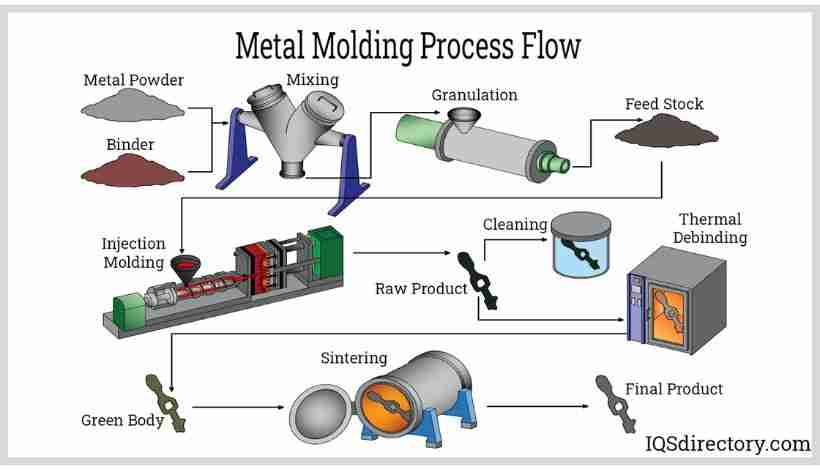
The four-stage MIM workflow: feedstock preparation, injection molding, debinding, and sintering.
What Is Debinding in Metal Injection Molding?
Debinding extracts the organic binder system from the green part. The binder is typically a blend of a low-molecular-weight primary binder such as paraffin wax and a high-molecular-weight backbone polymer such as polypropylene or polyethylene. The primary binder controls flow and moldability, while the backbone polymer holds the powder together once the primary binder is gone.
During debinding, the primary binder is removed first, leaving an interconnected network of open pores that allows gases to escape during the later thermal stage. The backbone polymer remains until the final thermal debinding or early sintering step, giving the brown part enough strength to survive transfer into the sintering furnace. By the end of the cycle, binder residue is typically reduced to well below 1% of the original amount.
Binder systems are not universal. A formulation optimized for stainless steel may not be suitable for titanium or low-alloy steel because powder morphology, oxide sensitivity, and sintering temperature differ. Emitech selects feedstock from qualified suppliers for each MIM material grade and validates debinding behavior before production.
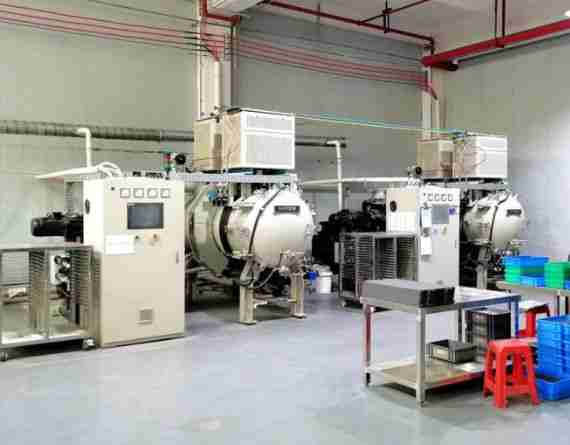
Debinding removes the binder and creates the porous brown part needed for sintering.
Solvent Debinding
Solvent debinding dissolves the primary binder by immersing green parts in a heated organic solvent such as heptane, hexane, or acetone. The solvent penetrates the surface, dissolves the wax, and carries it out by diffusion. Because the backbone polymer is insoluble, it remains intact and holds the metal powder in place.
The bath is usually held between 40 °C and 60 °C, well below the softening point of the backbone polymer. This low-temperature exposure makes solvent debinding ideal for thin-walled, delicate, or large flat parts that are prone to thermal distortion. It also opens pore channels early, which shortens the subsequent thermal cycle. After the solvent step, parts are drained, dried, and weighed to confirm complete primary binder removal.
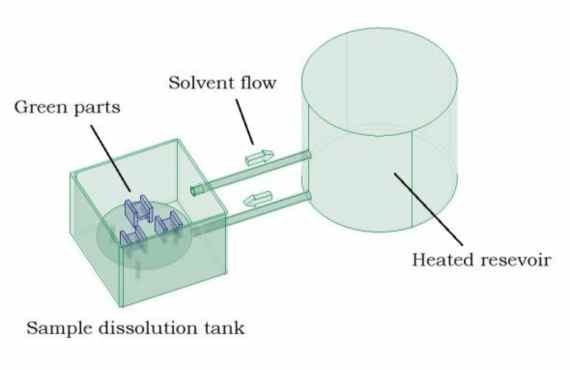
Solvent debinding tanks dissolve the primary wax binder at low temperature.
Catalytic Debinding
Catalytic debinding uses a gaseous acid catalyst, usually nitric or oxalic acid vapor, to break down a polyoxymethylene (POM) backbone polymer at around 120 °C. The POM depolymerizes into formaldehyde gas, which is converted to harmless gases in an exhaust scrubber. Because the reaction occurs at a low, uniform temperature, catalytic debinding is fast and produces very little thermal stress.
This method is typically 10 to 40 times faster than pure thermal debinding. It avoids long liquid-solvent handling and is attractive for high-volume production. However, it requires a specialized acid-resistant furnace, corrosion-resistant exhaust systems, and a POM-based binder system. Safety controls for acid vapor are mandatory.
Thermal Debinding
Thermal debinding removes binder by heating the green or brown part in a controlled atmosphere according to a precise temperature profile. The profile usually includes preheating, a slow ramp through the binder melting and evaporation range, a hold stage for backbone polymer decomposition, and a controlled cool-down or transition into sintering.
Heating rates are conservative, often 1–5 °C per minute, to prevent the binder from melting faster than vapors can escape. Hold steps are placed at the temperatures where the largest fractions of binder decompose, giving gases time to diffuse out through the open pore network. The atmosphere is just as important as the temperature: inert nitrogen is common, stainless steels often use a reducing hydrogen-nitrogen mixture, and reactive metals such as titanium require vacuum or high-purity argon.
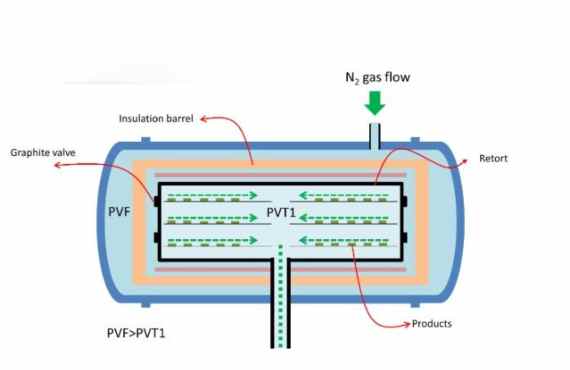
Thermal debinding furnaces rely on precise temperature profiles and controlled gas flow.
Comparing Debinding Methods
| Method | Mechanism | Speed | Part Suitability | Main Considerations |
|---|---|---|---|---|
| Solvent Debinding | Dissolves primary wax binder in heated solvent bath | Medium | Thin walls, delicate features, large flat parts | Solvent handling, recovery, drying, environmental compliance |
| Catalytic Debinding | Acid vapor depolymerizes POM backbone at ~120 °C | Fast | Complex and thick parts, high volumes | Requires POM-based binder, acid-resistant furnace, safety controls |
| Thermal Debinding | Heat and controlled atmosphere burn out binder | Slow | General purpose, compatible with most binders | Long cycle, risk of warping, requires careful atmosphere control |
Many production lines combine methods to balance speed, cost, and quality. A common sequence is solvent debinding to remove the primary binder, followed by thermal debinding to remove the backbone and pre-sinter the brown part. Another option is catalytic debinding directly followed by sintering.
Debinding Sequence and Typical Profile
| Stage | Purpose | Typical Conditions |
|---|---|---|
| 1. Pre-drying | Remove moisture and trapped solvent | 60–100 °C, inert gas flow, 30–120 min |
| 2. Primary Debinding | Remove low-molecular-weight wax or POM backbone | Solvent 40–60 °C or catalytic 110–140 °C |
| 3. Thermal Burnout | Oxidize or pyrolyze remaining backbone polymer | 200–600 °C, slow ramp 1–5 °C/min, controlled atmosphere |
| 4. Pre-sinter / Hold | Strengthen brown part, open final pore network | 600–900 °C, short hold, hydrogen or vacuum |
| 5. Cool-down / Transfer | Safe extraction and movement to sintering furnace | Controlled cooling to handling temperature |
Weight loss is the primary indicator of progress. Engineers compare the actual weight-loss curve against a qualified master curve. Part orientation and fixture design also matter: flat parts need support to avoid warping, and thick sections require longer hold times than thin sections in the same load.
Debinding Equipment
Solvent debinding requires heated tanks with temperature control, solvent circulation, filtration, and vapor recovery. Catalytic debinding uses a furnace with acid-resistant interior walls, catalyst vapor injection, precise temperature uniformity, and a gas scrubber. Thermal debinding equipment ranges from simple batch ovens to continuous belt furnaces with multiple heating zones.
Support equipment includes gas panels, dew-point analyzers, oxygen sensors, exhaust scrubbers, and weight-loss measurement stations. Automation such as robotic loading, barcode tracking, and recipe management reduces operator variation. At Emitech, every debinding furnace is qualified with thermocouple uniformity surveys and binder residue validation before production release.
Equipment maintenance is equally important. Binder vapors condense on cold spots if exhaust flow is insufficient, forming carbon deposits that eventually flake off and contaminate later batches. Regular hot-zone cleaning, seal replacement, and scrubber maintenance keep contamination low and extend furnace life.
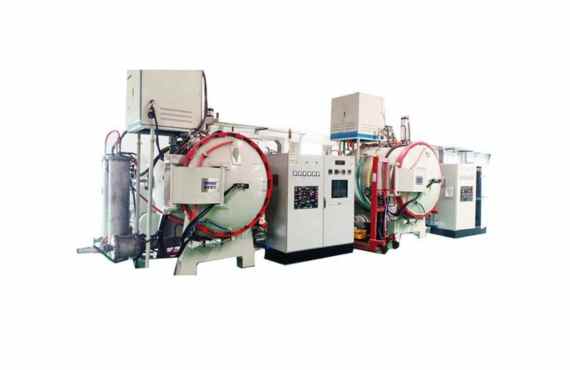
Vacuum and atmosphere-controlled furnaces support both debinding and thermal processing.
Atmosphere Control During Debinding
Atmosphere control protects both the part and the furnace. A steady gas flow keeps binder vapor concentration low and maintains consistent conditions throughout the load. For stainless and low-alloy steels, a hydrogen-nitrogen mixture provides a reducing environment that prevents oxidation. Titanium and reactive alloys require high vacuum or high-purity argon to avoid oxygen and nitrogen pickup.
Carbon control is critical for steels. An atmosphere too rich in hydrocarbon vapors can carburize the surface, while an overly oxidizing atmosphere can decarburize or scale it. Monitoring dew point and oxygen partial pressure keeps the process within its window. At Emitech, atmosphere recipes are documented per alloy and verified with quality inspection checks on first-article brown parts.
Modern furnaces also record atmosphere data for every batch. Logged dew point, oxygen level, and gas flow rate become part of the process record and support lot-level traceability and first-article dimensional inspection. If an atmosphere deviation occurs, the control system can alarm or abort the cycle before parts are damaged. This data-driven approach is especially valuable for automotive and medical customers who require documented evidence that every lot was processed within a validated window.
Brown Part Handling
Once debinding is complete, the brown part is extremely fragile. It may contain 30–40% porosity and is held together only by weak interparticle bonds and any remaining backbone polymer. Rough handling, vibration, or point contact can chip edges or crack thin sections. Clean handling procedures are therefore mandatory.
Operators use lint-free gloves, clean ceramic trays, or graphite fixtures when moving brown parts. Parts are never stacked directly on each other, and custom setters prevent sagging during the final thermal stage. Brown part dimensions are close to final sintered dimensions scaled up by the expected shrinkage factor.
Capturing brown part measurements against the scaled CAD model is especially important for parts with tight MIM tolerances. Any deviation at this stage usually indicates a molding or debinding problem that will become more obvious after sintering. Early data separates tooling errors from process drift, reduces downstream rework, and supports consistent lot-to-lot quality.
Common Debinding Defects and Troubleshooting
| Defect | Typical Cause | Solution |
|---|---|---|
| Cracking / Blistering | Binder vapor pressure builds faster than it can escape | Slow heating rate, add hold steps, improve gas flow and venting |
| Warping / Distortion | Uneven temperature distribution, unsupported flat sections | Improve furnace uniformity, use fixtures, reduce thermal gradients |
| Incomplete Debinding | Insufficient time, low temperature, poor solvent circulation | Extend cycle, verify catalyst concentration, check solvent purity |
| Carbon Residue / Contamination | Pyrolysis without adequate oxygen sweep, contaminated atmosphere | Increase gas flow, optimize burnout profile, inspect furnace cleanliness |
| Surface Oxidation / Discoloration | Incorrect atmosphere, air leak, high dew point | Use reducing or inert atmosphere, repair seals, monitor dew point |
Many defects can be traced back to feedstock or tooling issues. Powder-binder separation during molding creates density gradients that debind unevenly, and sharp internal corners or thick-to-thin transitions create stress concentrators that crack during heating. Following sound MIM design guidelines from the start improves first-pass yield.
From Brown Part to Sintered Component
Debinding ends where sintering begins. The brown part enters the sintering furnace as a porous metal skeleton and exits as a dense engineering component. The open pore network created during debinding allows reduction gases to penetrate and remove surface oxides, while also providing the diffusion paths through which metal atoms move to eliminate porosity.
Uniform debinding is essential for uniform shrinkage. If some regions retain binder longer than others, those regions will sinter more slowly and may end up with lower density or distorted dimensions. After sintering, parts may receive surface treatment, heat treatment, or CNC secondary operations to reach final specifications.
Frequently Asked Questions About Debinding in MIM
What is the purpose of debinding in MIM?
Debinding removes the polymer binder from the green part and creates a porous brown part. The open pores allow gases to escape during sintering and provide diffusion paths for densification. Without debinding, the part would blister, crack, or fail to reach near-full density.
What are the main debinding methods?
The three main methods are solvent debinding, catalytic debinding, and thermal debinding. Solvent debinding dissolves the primary binder, catalytic debinding uses acid vapor to decompose a POM backbone, and thermal debinding burns out binder with heat and controlled atmosphere.
How long does debinding take?
Thermal debinding can take several hours to more than a day for thick parts. Catalytic debinding is much faster, often measured in minutes to a few hours. Solvent debinding is intermediate and depends on part thickness and solvent temperature.
Why do MIM parts crack during debinding?
Cracking is usually caused by binder vapors building pressure faster than they can escape. Slowing the heating rate, adding hold steps, and improving gas flow solve most cracking problems.
Can debinding and sintering be done in the same furnace?
Yes. Many modern MIM furnaces combine a low-temperature debinding zone and a high-temperature sintering zone. The brown part is transferred internally without leaving the controlled atmosphere, which reduces contamination and handling damage.
How is debinding quality verified?
Quality is verified by weight-loss measurements, visual inspection, binder residue testing, and dimensional checks on brown parts. These results are compared to a qualified process window before parts are released to sintering.
What atmosphere is best for debinding stainless steel MIM parts?
Stainless steels usually debind in nitrogen or a hydrogen-nitrogen mixture. The reducing atmosphere prevents chromium oxidation and keeps the surface clean for sintering. Dew point and oxygen content are closely monitored.
Does Emitech offer debinding as part of its MIM service?
Yes. Emitech manages debinding, sintering, and post-processing under one roof. We select the debinding method, atmosphere, and profile based on your material, geometry, and tolerance requirements. Contact us through our contact page to discuss your project.
Source Custom MIM Parts from Emitech
Nanjing Emitech delivers MIM from tooling through sintering and finishing. Custom MIM parts · MIM services · Request a quote
Last updated: 2026-06-19
Continue reading
- Titanium MIM: The Precision Manufacturing Revolution Transforming High-Performance Industries
- Comprehensive Analysis of Tool Steel Metal Injection Molding (MIM) Technology
- Why Tungsten MIM Achieves 98% Density: The Science Behind High-Performance Metal Components
- Types of Sintering Processes: From Solid-State to Spark Plasma (SPS)