
7 Types of Sintering Processes
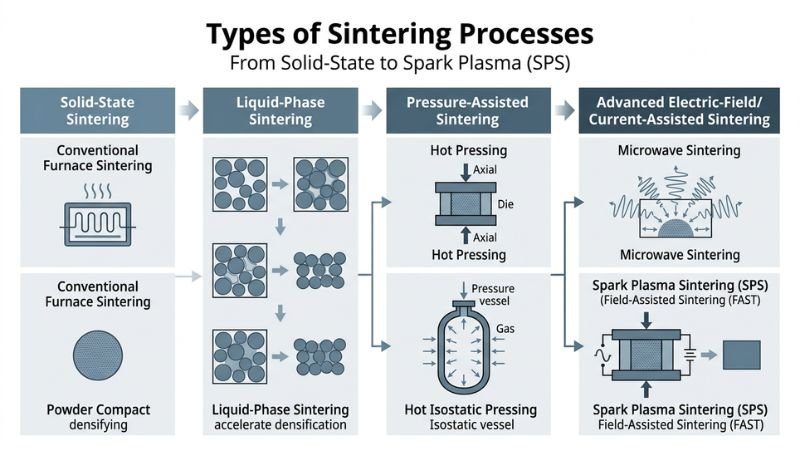
Understanding sintering process types enables you to achieve densities from 85% to near-full density while controlling costs and microstructures. Each of the seven major sintering methods delivers distinct density levels, processing speeds, and economic profiles. Your material characteristics and performance requirements determine which process achieves optimal results.
Quick Answer: The 7 Types of Sintering Processes
Sintering processes are classified into three main categories:
By mechanism:
- Solid-State Sintering (SSS)- Pure diffusion bonding, 85-96% density, cost-effective
- Liquid-Phase Sintering (LPS)- Capillary-enhanced densification, 95-99% density, faster processing
By pressure application:
- Hot Pressing (HP)- Uniaxial pressure, >99% density, simple geometries
- Hot Isostatic Pressing (HIP)- Isostatic pressure, near-full density, complex shapes
- Spark Plasma Sintering (SPS)- Electric field + pressure, near-full density in minutes, nanostructure retention
Specialized techniques:
- Microwave Sintering- Volumetric heating, rapid processing
- Rate-Controlled/Two-Step Sintering- Advanced thermal cycles for grain size control
Quick Process Comparison
| Process Type | Temperature Range | Pressure | Typical Time | Density Achieved | Relative Cost |
|---|---|---|---|---|---|
| Solid-State (SSS) | 0.5-0.8 Tm | Atmospheric | 3-12 hours | 85-96% | Low ($) |
| Liquid-Phase (LPS) | 0.85-0.95 Tm | Atmospheric | 1-4 hours | 95-99% | Low-Medium ($$) |
| Hot Pressing (HP) | 0.6-0.8 Tm | 20-50 MPa | 1-3 hours | 97-99.5% | Medium ($$$) |
| HIP | 0.7-0.9 Tm | 100-200 MPa | 2-6 hours | 99-99.7% | High ($$$$) |
| Spark Plasma (SPS) | 0.4-0.7 Tm | 30-100 MPa | 5-30 minutes | 97-99.5% | High ($$$$) |
Tm = melting temperature of the material
Professional animation illustrating the sintering process: watch how metal powder particles bond and densify under controlled heat to form solid components without melting.
Understanding the Foundation: Why Sintering Works
Before examining specific process types, you need to understand the fundamental driving force behind all sintering:surface energy reduction. Your powder particles have high surface area, representing high energy states. The system naturally seeks to minimize this energy by reducing the total surface area through particle bonding and pore elimination.
This energy reduction plays out through particle geometry—specifically, the curvature at contact points. Where particles touch, you have regions of different curvature: convex particle surfaces and concave neck regions. This curvature difference creates chemical potential gradients that drive atomic diffusion from high-energy regions (particle surfaces) to low-energy regions (neck areas and grain boundaries).
The rate and extent of this transformation depend on temperature (providing atomic mobility), time (allowing diffusion to occur), and—in some processes—applied pressure (adding mechanical driving force). Different sintering types manipulate these variables in distinct ways to achieve specific microstructural outcomes.
[caption id="attachment_14804" align="aligncenter" width="820"]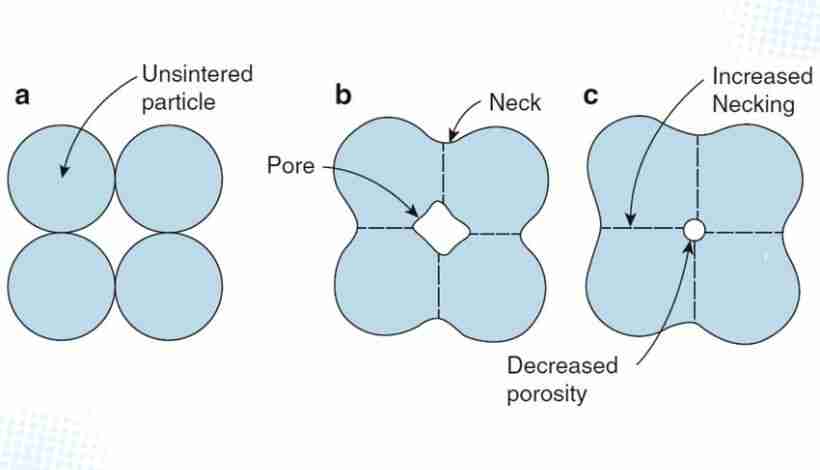 Progression of solid-state sintering: (a) loosely packed powder particles before heating, (b) neck formation and initial bonding, (c) advanced densification with reduced porosity.[/caption]
Why Multiple Classification Systems?
You'll encounter sintering processes classified by three different criteria because each perspective serves a distinct purpose:
Classification by material state(solid vs. liquid phase) tells you about the fundamental bonding mechanism and helps you predict microstructure development. This matters when you're controlling grain size or phase distribution.
Classification by pressure application(pressureless vs. pressure-assisted) indicates the equipment requirements, achievable density limits, and geometric constraints. This determines your capital investment and part complexity capabilities.
Classification by specialized technique(microwave, field-assisted, etc.) highlights unique process features that may solve specific challenges like rapid processing, selective heating, or nanostructure preservation.
Understanding all three classification dimensions allows you to match process capabilities to your application requirements systematically.
Solid-State Sintering (SSS): The Foundation Process
🔧 Best for:Cost-driven production, moderate density requirements
⚙️ Density achieved:85-96% of theoretical
💰 Cost level:Low (modest equipment investment)
⏱️ Cycle time:3-12 hours
Solid-state sintering represents the most straightforward and widely used sintering method. All material remains below melting temperature throughout the process. Densification occurs purely through solid-state diffusion mechanisms—no liquid phase forms.
How SSS Works: The Mechanism
You achieve densification through atomic diffusion along specific pathways. The dominant mechanisms include:
Grain boundary diffusionmoves atoms along the interfaces between grains. This pathway provides the fastest route for matter transport and contributes most significantly to densification. Atoms migrate from grain boundaries in regions of high curvature to areas where they can reduce the overall surface energy.
Surface diffusiontransports atoms across particle surfaces toward neck regions. While this mechanism rapidly forms strong necks between particles, it doesn't contribute to shrinkage—atoms simply rearrange on the surface without eliminating pore volume.
Volume diffusionthrough the crystal lattice occurs more slowly but becomes increasingly important at higher temperatures (typically above 0.7-0.8 Tm). This mechanism directly contributes to densification by moving atoms from the particle interior toward neck regions and grain boundaries.
[caption id="attachment_14805" align="aligncenter" width="820"]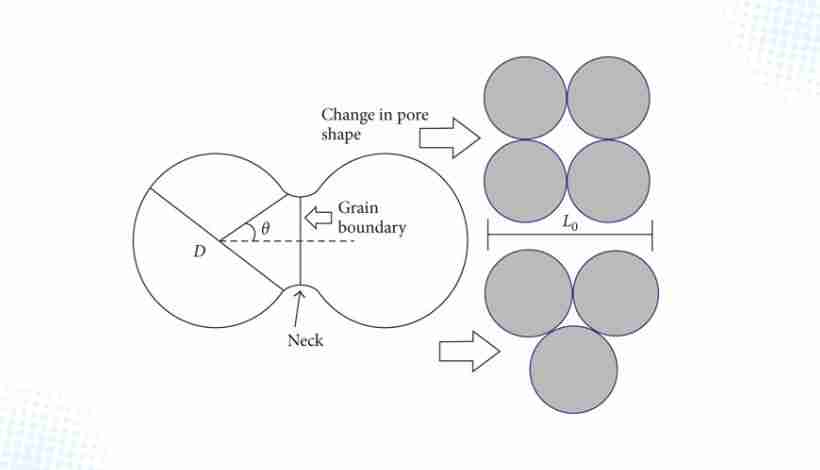 Detailed illustration of the sintering mechanism showing initial particle contact, neck formation through atomic diffusion, and progressive particle bonding at elevated temperatures.[/caption]
Three Distinct Stages
SSS progresses through three recognizable stages:
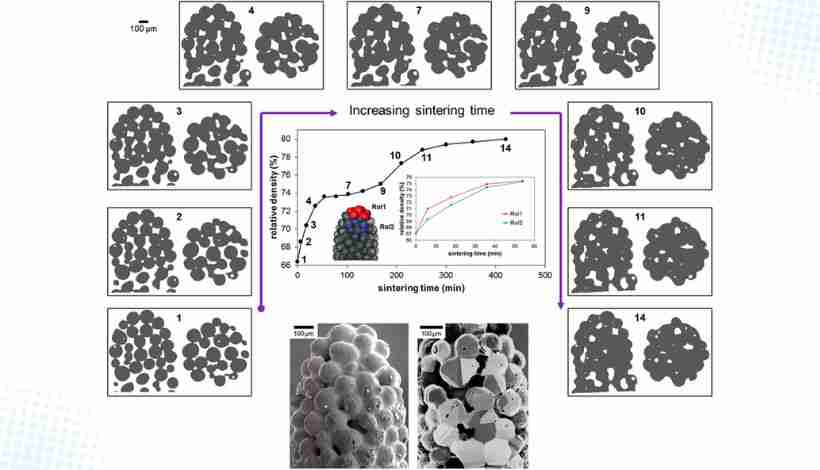
Initial stage(0-3 hours, relative density <90%): Neck formation dominates. Contact points between particles rapidly develop into substantial necks. You see significant strength development but minimal shrinkage. Surface diffusion contributes heavily during this phase.
Intermediate stage(3-8 hours, 90-95% density): Interconnected porosity becomes an open network of cylindrical channels along grain edges. Most densification occurs here. Grain boundary diffusion drives shrinkage as pore channels pinch closed.
Final stage(8+ hours, >95% density): Isolated spherical pores remain at grain corners or within grains. Further densification becomes increasingly difficult because you're working against pore stability. Grain growth accelerates, potentially trapping remaining porosity.
Critical Process Variables
You manipulate this densification-coarsening balance through five key variables:
Temperature:Typically 0.5-0.8 Tm for metals, 0.6-0.9 Tm for ceramics. Higher temperatures accelerate diffusion exponentially but also promote grain growth. You balance densification rate against grain size requirements.
Time:Longer holds improve density but coarsen microstructure. Most densification occurs in the first 60-70% of cycle time. Extended holds beyond this point mainly grow grains without significant additional densification.
Atmosphere:Reducing atmospheres (H₂, dissociated ammonia) for metals prevent oxidation. Inert atmospheres (Ar, N₂) work for oxidation-resistant materials. Vacuum removes volatile species and gases from pores.
Particle size:Finer powders (1-10 μm) provide higher driving force due to greater surface area per unit volume. Densification rate scales inversely with particle size squared. However, finer powders cost more and present handling challenges.
Green density:Higher compaction density (70-80% of theoretical) reduces the work needed during sintering. You achieve better final density and dimensional control. Low green density (<65%) leads to excessive shrinkage and poor dimensional tolerance.
Advantages of SSS
- Low equipment cost:Conventional furnaces require a modest to moderate capital investment depending on size and atmosphere control
- High throughput:Continuous belt furnaces process thousands of parts per hour
- Versatile:Works for virtually all metal and ceramic powder systems
- Dimensional control:Predictable shrinkage (15-20% linear) once process parameters are established
- Simple operation:Straightforward process control with minimal training requirements
Limitations You Should Know
- Residual porosity:You typically retain 5-15% porosity. near-full density is rare without pressure assistance
- Long cycle times:Multiple hours needed for adequate densification and uniform temperature distribution
- Grain growth:High temperatures and long times coarsen microstructure, reducing strength
- Atmosphere sensitivity:Oxidation, decarburization, or contamination can occur without proper atmosphere control
- Refractory materials:Very high melting point materials (W, Mo, ceramics >2000°C) require specialized furnace capabilities
Where to Apply SSS
You should select solid-state sintering for:
- Structural parts:Automotive connecting rods, gears, sprockets where 90-94% density provides sufficient properties
- Porous materials:Filters, bearings, battery electrodes where controlled porosity is desirable
- High-volume production:Consumer products requiring low per-part cost
- Stainless steels:316L, 17-4PH processed in reducing or vacuum atmospheres achieve 85-93% density
- Technical ceramics:Alumina, zirconia, silicon carbide for wear parts and cutting tools
🎯 Key Takeaway:SSS is your default choice for high-volume production where 90-96% density meets requirements. Control the temperature-time-atmosphere triangle to balance densification against grain growth. Accept that residual porosity is inherent to the process.
Liquid-Phase Sintering (LPS): Enhanced Densification
🔧 Best for:Rapid densification, improved properties, multi-phase systems
⚙️ Density achieved:95-99% of theoretical
💰 Cost level:Low-Medium (similar equipment, additive costs)
⏱️ Cycle time:1-4 hours
Liquid-phase sintering introduces a controlled amount of liquid during processing—typically 5-20 volume percent. This liquid dramatically accelerates densification while maintaining solid particle integrity. You're not melting the primary constituent; rather, you're adding a second phase that liquefies at the sintering temperature.
The Three-Step Mechanism
LPS proceeds through three distinct stages that you can observe and measure:
Stage 1 - Rearrangement(first minutes): As soon as liquid forms, capillary forces pull particles together. You see rapid initial densification—often 5-10% in the first few minutes—as particles slide and rearrange into more efficient packing. The liquid acts as a lubricant, eliminating friction between particles.
Stage 2 - Solution-reprecipitation(bulk of cycle): The liquid dissolves solid material from high-energy surfaces (particle contacts, fine particles) and redeposits it in low-energy locations (neck regions, flat surfaces). This matter transport is orders of magnitude faster than solid-state diffusion. You achieve most densification during this stage. Simultaneously, grain shape accommodation occurs—particles deform to fit together more efficiently.
Stage 3 - Final densification(last 20-40%): The liquid content decreases as it's gradually absorbed into the solid phase through solid-state back-diffusion. Remaining pores close slowly through solid-state mechanisms similar to SSS. You see minimal additional shrinkage but continued microstructure homogenization.
Critical Requirements for Success
You need to satisfy four conditions for effective LPS:
Liquid formation:The additive must form a liquid at your sintering temperature while the primary phase remains solid. You're looking for a eutectic temperature at least 50-100°C below the melting point of your main constituent. For tungsten carbide-cobalt (WC-Co), cobalt melts at 1495°C while WC remains solid until 2870°C—an ideal system.
Wetting:The liquid must wet the solid particles, spreading over surfaces and penetrating between particles. Contact angles below 60° indicate good wetting. Poor wetting leads to liquid pooling and failed densification. Surface chemistry, particularly oxide films, critically affects wetting behavior.
Solubility:The solid phase must dissolve appreciably in the liquid. You need at least 1-5% solubility for effective solution-reprecipitation. Too little solubility limits densification; excessive solubility can cause shape distortion or liquid exudation.
Limited liquid content:Typical range is 5-20 volume percent. Too little liquid (<3%) doesn't form continuous networks. Excessive liquid (>25%) causes part slumping and exaggerated grain growth.
To verify wetting: Measure the contact angle at sintering temperature. You need θ < 60° for successful LPS.
Process Parameters
Temperature:Must exceed the melting point of the additive but remain below the melting point of the primary phase. Typically 0.85-0.95 Tm of the main constituent. Higher temperatures within this range accelerate densification but may cause excessive liquid formation or undesired phase reactions.
Additive composition:Common systems include WC-Co (6-12 wt% Co), Fe-Cu (2-4% Cu), W-Ni-Fe heavy alloys (typically 90W-7Ni-3Fe). The additive must be evenly distributed in the powder mixture—poor mixing creates local variations in liquid content and non-uniform properties.
Atmosphere:Usually reducing or inert to prevent oxidation of the liquid phase. Hydrogen, dissociated ammonia, or vacuum for metal systems. The liquid phase is particularly sensitive to oxidation because it has high surface area when spread between particles.
Heating rate:Moderate rates (5-10°C/min) allow uniform liquid distribution. Rapid heating can cause uneven liquid formation and part distortion. Slow heating (<2°C/min) wastes energy without benefit.
Advantages Over SSS
- Higher density:Routinely achieve 95-99% density versus 85-93% for SSS
- Faster processing:Significant densification in 1-2 hours versus 8-12 hours
- Lower sintering temperature:Typically 100-200°C below SSS for equivalent systems
- Improved properties:Better strength, hardness, and toughness due to higher density
- Microstructure control:Liquid phase pinning can inhibit grain growth
Challenges and Limitations
- Composition control:You must maintain precise additive content. Variations of ±0.5% can significantly affect properties
- Distortion risk:Parts can slump or distort if liquid content is excessive or part geometry is unsuitable
- Additive segregation:Gravity can cause liquid to pool in thick sections or drain from thin sections
- Material restrictions:Requires compatible material systems with appropriate phase diagrams
- Rework difficulty:Failed parts with incorrect liquid content are typically scrap
Typical Applications
- Cemented carbides:WC-Co cutting tools, mining bits, wear parts (6-25% Co additions)
- Heavy alloys:W-Ni-Fe or W-Ni-Cu for radiation shielding, counterweights, kinetic penetrators
- Ferrous PM parts:Fe-Cu-C systems where copper infiltration enhances density and properties
- Diamond tools:Metal-bonded diamond composites for cutting and grinding
- Cermets:TiC-Ni, TiCN-Ni cutting tool materials
🎯 Key Takeaway:LPS delivers higher density and faster processing than SSS when you have a compatible material system. Success depends on achieving good liquid wetting and managing liquid content to prevent distortion. The 95-99% density range makes LPS suitable for applications requiring better mechanical properties than conventional SSS.
Pressure-Assisted Sintering: Achieving near-full density
When your application demands near-theoretical density, elimination of all porosity, or superior mechanical properties, pressure-assisted sintering becomes necessary. These methods combine temperature with mechanical force to overcome the fundamental limitation of pressureless sintering: residual porosity.
Three major pressure-assisted techniques dominate industrial practice, each with distinct characteristics, capabilities, and economic profiles.
Hot Pressing (HP): Direct Pressure Application
🔧 Best for:Simple geometries, development work, small production runs
⚙️ Density achieved:97-99.5% of theoretical
💰 Equipment cost:high capital investment
⏱️ Cycle time:1-3 hours
Hot pressing applies uniaxial pressure (20-50 MPa) directly to your powder compact while simultaneously heating. You load loose powder or a pre-compacted billet into a die, then apply pressure through rams while heating the die assembly.
The mechanism:Pressure adds a mechanical driving force (PΔV work) to the thermodynamic driving force from surface energy reduction. This additional force allows densification at lower temperatures (typically 100-200°C below pressureless sintering) or achieves near-full density where pressureless methods would plateau at 85-95%.
At grain boundaries and particle contacts, applied stress enhances diffusion rates and enables plastic deformation and grain boundary sliding. These deformation-controlled mechanisms allow pore collapse that wouldn't occur through diffusion alone.
Process parameters:
- Pressure:20-40 MPa for metals, 30-50 MPa for ceramics. Applied gradually during heating to prevent cracking
- Temperature:0.6-0.8 Tm, lower than equivalent pressureless sintering
- Time at temperature:1-2 hours typical; shorter than SSS due to pressure assistance
- Die materials:Graphite for temperatures up to 2200°C; refractory metals (Mo, W) for higher temperatures; steel for lower temperature pressing
Advantages:
- near-full density:Routinely achieve 99-99.5% theoretical density
- Lower temperatures:Process at 0.6-0.7 Tm versus 0.8 Tm for pressureless
- Finer microstructures:Lower temperatures and shorter times limit grain growth
- Difficult materials:Can process materials that resist pressureless sintering (some ceramics, intermetallics)
- Research flexibility:Easy to modify parameters for development work
Limitations:
- Geometry restrictions:Limited to simple shapes—cylinders, rectangles, plates
- Uniaxial pressure:Density gradients in complex shapes; pressure doesn't reach all surfaces equally
- Throughput:Batch process; one part (or small batch) per cycle
- Die costs:Graphite dies wear and require regular replacement
- Atmosphere limitations:Usually inert gas or vacuum; reactive atmospheres difficult
Applications:Advanced ceramics (Si₃N₄, SiC, Al₂O₃) for cutting tools and armor; intermetallics (TiAl, NiAl); composite materials; research and development; pre-production prototypes.
Hot Isostatic Pressing (HIP): Uniform Pressure from All Directions
🔧 Best for:Complex shapes, critical components, near-full density requirement
⚙️ Density achieved:99-99.7% of theoretical
💰 Equipment cost:very high capital investment
⏱️ Cycle time:2-6 hours
HIP applies isostatic pressure using high-pressure inert gas (typically argon) in a pressure vessel. Pressure reaches the workpiece uniformly from all directions, eliminating the density gradients inherent to uniaxial pressing.
The mechanism:Isostatic pressure of 100-200 MPa, combined with elevated temperature (0.7-0.9 Tm), provides sufficient driving force to collapse even isolated pores. The uniform pressure distribution allows complete densification regardless of part geometry complexity.
For powder consolidation, you must first encapsulate powder in a sealed container (glass, metal can, or ceramic shell). The container prevents gas penetration while transmitting external pressure to the powder. For post-sintering HIP of previously sintered parts with closed porosity, no container is needed—the gas pressure acts directly on the component surface.
Process parameters:
- Pressure:100-200 MPa typical; some applications up to 300 MPa
- Temperature:0.7-0.9 Tm depending on material and initial density
- Time:2-4 hours at pressure and temperature; total cycle 4-8 hours including heating/cooling
- Atmosphere:High-purity argon most common; nitrogen for some applications
Two HIP variants:
Powder HIP:Direct consolidation from powder. Requires hermetic encapsulation. Achieves near-full density in one step but involves container fabrication and removal costs.
Post-sinter HIP:Applied after conventional sintering has closed surface porosity (>92-94% density). Eliminates internal porosity without encapsulation. More economical for large parts but requires initial sintering step.
Advantages:
- Isostatic pressure:Uniform density regardless of geometry complexity
- near-full density:Eliminates virtually all porosity—critical for fatigue-sensitive applications
- Large capacity:Process multiple parts or very large components simultaneously
- Superior properties:Fatigue strength, fracture toughness approach wrought material levels
- Versatile:Process wide range of materials—metals, ceramics, composites
Limitations:
- High capital cost:Pressure vessels with 100-200 MPa capability and high-temperature heating cost very high capital investment
- Encapsulation cost:For powder HIP, container fabrication adds significant per-part cost
- Long cycle times:4-8 hours total including heating, hold, and controlled cooling
- Operating costs:High-purity argon consumption, energy costs substantial
- Size limits:Vessel dimensions constrain maximum part size
Applications:
- Aerospace turbine components:Nickel superalloy turbine disks, blades—post-sinter HIP eliminates casting porosity
- Orthopedic implants:Ti-6Al-4V hip and knee implants require near-full density for fatigue resistance and biocompatibility
- Tool steels:High-speed steel, powder metallurgy tool steels with carbide additions
- Armor ceramics:Silicon carbide, boron carbide armor tiles
- Nuclear fuel:Uranium dioxide pellets with controlled density and porosity distribution
Spark Plasma Sintering (SPS): Electric Field-Assisted Rapid Densification
🔧 Best for:Nanostructured materials, rapid processing, research, advanced materials
⚙️ Density achieved:97-99.5% of theoretical
💰 Equipment cost:high capital investment
⏱️ Cycle time:5-30 minutes
SPS (also called field-assisted sintering or pulsed electric current sintering) represents the most advanced and fastest sintering technology available. You pass high-amperage pulsed DC current (500-10,000 A) directly through an electrically conductive die and powder compact while simultaneously applying uniaxial pressure (30-100 MPa).
Real-world demonstration of Spark Plasma Sintering (SPS) equipment and process, showcasing how this advanced technique achieves rapid densification with pulsed DC current and pressure.
The mechanism—multiple effects working synergistically:
Joule heating:Current passing through the powder and die generates intense, localized heat at particle contacts. Heating rates of 100-1000°C/min are routine—orders of magnitude faster than conventional sintering. This rapid heating minimizes the time available for grain growth.
Electric field effects:The pulsed DC field may enhance diffusion rates through electromigration and create plasma or spark discharges at particle contacts (though the "spark" terminology is debated—you may not see actual sparks). These electrical effects appear to clean particle surfaces and activate sintering at lower temperatures.
Pressure assistance:Simultaneous mechanical pressure (30-100 MPa) provides additional driving force and enables plastic deformation at particle contacts.
The critical advantage:SPS opens a non-equilibrium processing window. You achieve full densification in minutes at relatively low temperatures (0.4-0.7 Tm versus 0.7-0.8 Tm for conventional sintering). This decouples densification from coarsening—you can fully densify materials while preserving nanostructures or metastable phases that would coarsen or transform during conventional processing.
Process parameters:
- Current:500-10,000 A depending on sample size and conductivity; pulsed at 10-50 Hz
- Pressure:30-100 MPa; applied before, during, or after heating depending on material
- Temperature:0.4-0.7 Tm—significantly lower than conventional sintering
- Heating rate:50-1000°C/min; typically 100-200°C/min for most materials
- Hold time:3-10 minutes at peak temperature sufficient for full densification
- Die material:Graphite standard; tungsten carbide for higher pressures
Unmatched advantages:
- Preservation of nanostructures:Grain sizes <100 nm maintained—impossible with conventional sintering
- Rapid processing:Complete cycle in 15-30 minutes versus hours
- Lower temperatures:Process at 0.4-0.6 Tm while achieving near-full density
- Metastable phases:Consolidate amorphous, nanocrystalline, or non-equilibrium materials
- Novel materials:Process material combinations impossible by other methods
- Energy efficiency:Short cycle times reduce energy consumption per part
Significant limitations:
- High equipment cost:high capital investment for capable systems
- Small sample size:Typical capacity 20-100 mm diameter, though larger systems exist
- Conductive die requirement:Usually graphite; can cause carbon contamination in some materials
- Geometry limitations:Simple shapes only—cylinders, disks, rectangles
- Scale-up challenges:Difficult to maintain uniformity in large components
- Process understanding:Mechanisms not fully understood; process development requires trial-and-error
Applications—primarily research and advanced materials:
- Nanostructured materials:Nanocrystalline metals, ceramics, composites for superior mechanical properties
- Thermoelectric materials:Bi₂Te₃, skutterudites, half-Heuslers requiring fine grain structure
- Functional ceramics:Piezoelectrics, ferroelectrics, solid electrolytes
- Hard materials:Tungsten carbide, cubic boron nitride cutting tools with nano-sized grains
- Transparent ceramics:Yttria, alumina, spinel optics and armor requiring near-full density and fine grains
- Biomaterials:Hydroxyapatite, bioactive glass-ceramics for implants
🎯 Key Takeaway:Pressure-assisted sintering eliminates the density limitations of pressureless methods. Choose Hot Pressing for simple shapes and development work, HIP for complex geometries and critical applications requiring near-full density, and SPS when you must preserve nanostructures or process materials impossible by conventional methods. The higher equipment and processing costs are justified when your application demands properties only achievable at near-theoretical density.
Process Variants: Rate-Controlled and Specialized Techniques
Beyond the five major sintering types, several specialized techniques offer unique capabilities for specific applications. These variants typically build upon solid-state sintering fundamentals while introducing controlled variations in heating profiles or energy delivery methods.
Rate-Controlled Sintering (RCS) and Two-Step Sintering (TSS)
These thermal cycle modifications address a fundamental challenge: how do you achieve high density without excessive grain growth?
Rate-Controlled Sinteringuses continuous, precisely controlled heating rates (typically 2-5°C/min) throughout the entire cycle. Instead of conventional heating to a plateau temperature followed by an isothermal hold, you maintain constant heating. This approach exploits the different temperature dependencies of densification and grain growth mechanisms. By avoiding the isothermal hold at peak temperature—where grain growth accelerates while densification slows—you achieve similar density with 20-40% finer grain size.
Two-Step Sinteringemploys a more radical approach: rapid heating to a high temperature (T1) where densification occurs quickly, followed immediately by cooling to a lower temperature (T2, typically 0.7-0.85 × T1) for an extended hold. At T2, grain boundary mobility is suppressed while sufficient diffusion continues to allow pore elimination. You can achieve >95% density with grain sizes 50-70% smaller than conventional sintering.
These techniques work particularly well for nanocrystalline ceramics (YSZ, alumina, zirconia) where grain growth resistance is critical. The trade-off is more complex process control and potentially longer total cycle times.
Microwave Sintering
Microwave sintering uses electromagnetic radiation (typically 2.45 GHz) to heat materials volumetrically rather than through surface conduction. Materials absorb microwave energy directly based on their dielectric properties, creating heat from within the entire volume simultaneously.
Key advantages:
- Rapid heating:Volumetric heating allows rates of 50-100°C/min in susceptible materials
- Energy efficiency:Direct coupling of energy into the workpiece reduces waste heat
- Temperature inversion:Core can heat faster than surface, potentially improving uniformity
- Selective heating:In composites, phases with different dielectric properties heat at different rates
Limitations:
- Material dependency:Only materials with appropriate dielectric loss work well
- Runaway heating:Dielectric properties change with temperature; control can be challenging
- Size limitations:Penetration depth limits maximum workpiece dimensions
- Equipment cost:Industrial microwave systems more expensive than conventional furnaces
Applications:Primarily advanced ceramics (alumina, zirconia, silicon carbide) and some metal powders. Most effective for materials that couple well with microwave energy and where rapid processing or unique microstructures justify equipment costs.
Process Selection Framework: Matching Type to Application
With seven sintering types available, how do you systematically select the optimal process? Consider these five decision criteria in sequence:
1. Density Requirements
Start here—this often eliminates several options immediately:
- 85-93% acceptable:SSS, potentially LPS
- 95-97% needed:LPS, Hot Pressing, or post-sinter HIP
- 99-99.5% required:Hot Pressing, HIP, or SPS only
- Controlled porosity desired:SSS with deliberate parameter selection
2. Material Characteristics
Your powder system constrains viable processes:
- Single-phase metals/ceramics:Any process works; economics drive choice
- Systems with liquid-forming additive:LPS if composition is favorable
- Refractory materials (Tm > 2000°C):Conventional SSS difficult; consider Hot Pressing or SPS
- Nanostructured powders:SPS or TSS to preserve nano-grain size
- Oxidation-sensitive:Vacuum or controlled atmosphere; limits some processes
3. Geometric Requirements
Part shape immediately rules out certain options:
- Complex 3D shapes:SSS, LPS, or post-sinter HIP only
- Simple shapes (cylinder, disk, rectangle):All processes viable
- Large parts (>300 mm):SSS, LPS, or large HIP vessels
- Thin walls or fine features:Avoid excessive liquid phase; consider controlled heating
4. Economic Considerations
Match process cost to production volume and part value:
- High volume (>10,000 parts/year):Amortize tooling costs; SSS or LPS
- Medium volume (100-10,000):Hot Pressing or HIP economically viable
- Low volume/R&D:Flexibility more important than throughput; Hot Pressing or SPS
- High part value (aerospace, medical):Premium processes (HIP, SPS) justified by performance requirements
5. Property Requirements
Critical performance specs may mandate specific processes:
- Fatigue-critical applications:near-full density required (HIP)
- Wear resistance:High density and fine grains (LPS, SPS)
- Thermal conductivity:Eliminate porosity (HIP, Hot Pressing)
- Transparency (ceramics):near-full density, no porosity (HIP, SPS)
- Dimensional precision:Minimize shrinkage variations (Hot Pressing, controlled SSS)
Common Decision Paths
Structural metal parts, moderate properties, high volume:
→ Solid-State Sintering (Fe, Cu, stainless steel automotive/industrial components)
Hard metals, high wear, complex shapes:
→ Liquid-Phase Sintering (WC-Co cutting tools, mining bits)
Aerospace components, fatigue-critical:
→ HIP after initial sintering (Ni superalloy turbine disks, Ti implants)
Advanced ceramics, near-full density, simple shapes:
→ Hot Pressing (Si₃N₄ cutting inserts, armor tiles)
Nanostructured materials, research:
→ SPS (nanocrystalline metals, thermoelectric materials)
Large, complex aluminum parts:
→ Solid-State Sintering or LPS with controlled atmosphere
🎯 Key Takeaway:Process selection is a multi-criteria decision. Start with density requirements to eliminate unsuitable options, then consider material compatibility, geometry, economics, and properties. In many cases, you'll identify 2-3 viable candidates—pilot testing determines which delivers the best combination of properties and cost for your specific application.
Emerging Sintering Technologies
While the five major sintering types dominate current practice, several emerging technologies show promise for specific applications or future development:
Flash Sintering
Flash sintering applies an electric field (typically 20-1000 V/cm) to a ceramic compact while heating. At a critical temperature and field strength combination, electrical conductivity suddenly increases, Joule heating intensifies dramatically, and densification occurs in seconds rather than hours.
This phenomenon enables full densification of ceramics (primarily ionic conductors like YSZ, ceria, titania) at furnace temperatures 200-400°C below conventional sintering temperatures. The actual local temperature at grain boundaries remains debated—thermally activated processes still drive densification, but the electric field dramatically lowers the apparent activation energy.
Flash sintering currently remains primarily a research curiosity due to process control challenges and limited understanding of mechanisms. However, the potential for energy savings and new processing capabilities drives continued investigation.
Cold Sintering
Cold sintering consolidates ceramic powders at temperatures below 300°C—far below conventional sintering temperatures of 1000-1600°C. The process uses transient aqueous or non-aqueous solutions at modest pressures (several hundred MPa) to enable low-temperature densification through dissolution-precipitation mechanisms.
At room temperature or slightly elevated temperatures, a small amount of solvent dissolves surface material from powder particles. Applied pressure brings particles into intimate contact where dissolved material precipitates, forming solid bridges. Subsequent drying and optional heat treatment remove residual solvent.
Cold sintering offers potential benefits for thermally sensitive materials, composite fabrication, and energy reduction. However, achievable density remains limited (typically 80-95%), residual porosity is common, and the range of processable materials is restricted. Current applications focus on battery materials, capacitor ceramics, and composite fabrication rather than structural components.
Frequently Asked Questions
Q: Why does solid-state sintering typically leave 5-8% residual porosity even with optimized parameters?
The fundamental issue is pore stability. Once isolated pores form during the final stage of sintering, their curvature decreases as they spheroidize. When pores reach equilibrium shape at grain corners or within grains, the chemical potential driving force for further densification diminishes. Simultaneously, grain growth accelerates at high temperatures, and growing grains can engulf and trap pores. These trapped pores become thermodynamically stable—their internal gas pressure balances the capillary pressure trying to shrink them. Without applied pressure to overcome this balance, residual porosity of 4-10% is typical for conventional solid-state sintering.
Q: When should I consider switching from Hot Pressing to HIP for my application?
Consider HIP when: (1) Your part geometry complexity increases beyond simple shapes—HIP accommodates complex 3D forms while Hot Pressing requires simple, uniaxially pressable geometries; (2) You need uniform density throughout the component—uniaxial pressing creates density gradients in non-uniform sections; (3) Production volume justifies capital investment—HIP processes multiple parts simultaneously despite higher equipment cost; and (4) You require post-processing of near-net-shape components—post-sinter HIP densifies pre-sintered parts without encapsulation if surface porosity is closed. The trade-off is significantly higher equipment cost (a much larger capital investment than Hot Pressing) and longer cycle times (4-8 hours versus 1-3 hours).
Q: For nanostructured materials, when can SPS justify its high cost compared to conventional sintering?
SPS justification requires that: (1) Maintaining nano-scale grain structure (<100 nm) is critical to your application properties—mechanical strength, thermal conductivity, thermoelectric performance, or optical transparency; and (2) Conventional sintering cannot achieve adequate density without grain growth to micron scale. Calculate the value proposition: if nanostructure preservation enables 50-200% property improvements, and your application can support a higher per-part processing cost, SPS becomes economically viable. Current commercial applications include thermoelectric modules, transparent armor ceramics, and nanostructured cutting tools where performance premiums justify processing costs.
Q: What causes cracking in large ceramic parts during sintering, and how do I prevent it?
Cracking stems from differential shrinkage—different regions densifying at different rates create stresses exceeding material strength. Common causes include: (1) Temperature gradients in large parts creating differential densification rates; (2) Density gradients from non-uniform powder packing; (3) Friction at die walls or setter plates restraining shrinkage; and (4) Rapid heating rates not allowing stress relaxation. Prevention strategies include using slower heating rates (<5°C/min through critical densification range), ensuring uniform green density (variation <2%), minimizing thermal gradients through furnace design or part placement, using low-friction setters (alumina, zirconia, or graphite depending on material), considering two-step heating with an intermediate hold to homogenize structure, and for large parts, running finite element analysis to predict stress development.
Q: How do I select the optimal atmosphere for sintering different materials?
Atmosphere selection depends on preventing unwanted reactions: (1) Reducing atmospheres (H₂, dissociated ammonia, H₂-N₂ blends) for iron, steel, and stainless steel to prevent oxidation and reduce surface oxides; (2) Vacuum for titanium, refractory metals (Ta, Nb, Mo, W), and materials sensitive to interstitial contamination to remove oxygen and adsorbed gases; (3) Inert atmospheres (Ar, N₂) for materials stable in an inert environment but requiring gas to prevent evaporation; and (4) Oxidizing or air for certain ceramics where maintaining stoichiometry requires oxygen partial pressure.
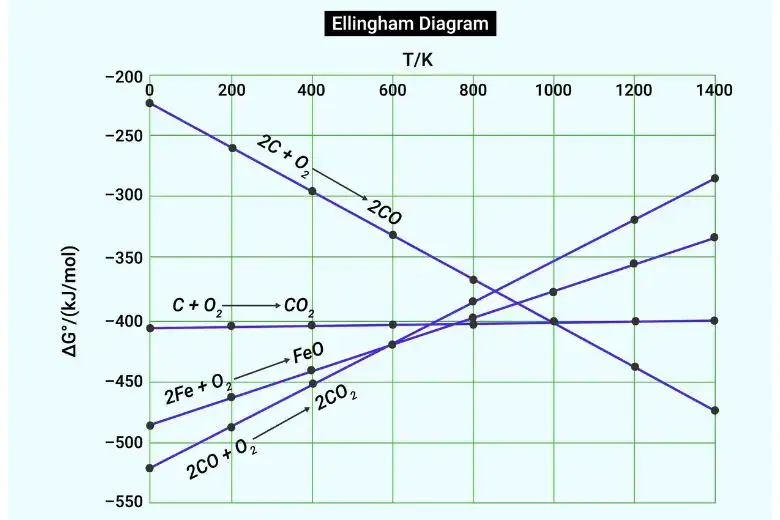 Key consideration: dew point control—even reducing atmospheres must maintain low moisture (<-40°C dew point) to prevent oxidation. For each material, verify atmosphere through thermodynamic calculations using Ellingham diagrams to ensure oxide stability conditions are avoided.
Q: In liquid-phase sintering, why do some parts expand rather than shrink?
Expansion during LPS occurs when liquid volume exceeds the available pore space, forcing particles apart rather than pulling them together. This happens due to: (1) Excessive liquid content (>20-25 vol%)—more liquid than pores can accommodate; (2) Poor initial compaction (<60% green density)—insufficient particle contact means liquid fills space without creating shrinkage; (3) Premature liquid formation during heating—if liquid forms before adequate pre-sintering creates particle necks; and (4) Excessive solubility—if solid dissolves too extensively in liquid, volume expansion can occur. Prevention requires controlling liquid-forming additive content precisely (typically 5-15 vol%), achieving adequate green density (>65-70%), using appropriate heating rates to allow pre-sintering before liquid formation, and selecting material systems with moderate (not excessive) solid solubility in the liquid phase.
Q: How do I determine if grain growth is limiting densification in my sintering process?
Diagnostic approach: (1) Measure density versus grain size at different processing conditions (temperature, time). If grain size increases significantly while density plateaus or improves only marginally, grain growth is outpacing densification. (2) Calculate the densification rate and grain growth rate separately. If grain growth rate exceeds densification rate beyond ~92-94% density, pores are being trapped by growing grains. (3) Microstructural examination—if you observe intragranular pores (pores within grains rather than at grain boundaries), grain growth has overtaken densification. Solutions: Lower temperature and extend time (trades kinetic advantage for better densification/growth ratio), use two-step sintering to densify at higher temperature then grain-stabilize at lower temperature, add grain growth inhibitors if applicable (MgO for alumina, Y₂O₃ for silicon nitride), or switch to a pressure-assisted method allowing lower temperature processing.
Q: What causes carbon contamination in SPS, and how critical is it for different applications?
Carbon pickup occurs through three mechanisms: (1) Direct contact with graphite die, punches, and foil; (2) Reaction of material with carbon monoxide formed by graphite oxidation (even trace oxygen creates CO); and (3) Diffusion of carbon through graphite tooling at high temperature. Contamination level depends on processing temperature, time, material reactivity, and protective measures. For applications, it is (1) Not critical for carbon-containing materials (carbides, carbon composites) or materials where small carbon additions are acceptable; (2) Moderately important for structural ceramics (alumina, zirconia) where 0.1-0.5 wt% carbon may affect properties but not catastrophically; and (3) Critical for biomedical materials (hydroxyapatite, titania), optical ceramics (requiring transparency), and materials where carbon affects electrical/electronic properties. Mitigation strategies include using alumina or boron nitride protective foils between sample and graphite tooling, minimizing processing time, using tungsten carbide dies for highly sensitive materials (though more expensive), or selecting an alternative process (Hot Pressing, HIP) for applications requiring zero carbon tolerance.
Conclusion: Selecting Your Optimal Sintering Process
The seven major sintering process types—from conventional solid-state to advanced spark plasma sintering—represent distinct combinations of mechanisms, equipment, economics, and capabilities. No single process is universally superior; each occupies a specific niche defined by density requirements, material characteristics, geometric complexity, production volume, and property demands.
Successful process selection requires systematic evaluation: Begin with density requirements to eliminate incompatible options. Assess material compatibility—does your powder system enable liquid-phase sintering or require pressure assistance? Consider geometric complexity and production scale—complex shapes and high volumes favor pressureless methods while simple geometries and critical properties justify pressure-assisted processes. Calculate total cost of ownership including equipment, throughput, yield, and post-processing rather than focusing solely on equipment price.
For most structural metal applications requiring 90-96% density in complex shapes at low cost, solid-state sintering remains the workhorse process. When you need 95-99% density and have compatible material systems, liquid-phase sintering offers faster processing at modest cost increase. Applications demanding near-full density—aerospace turbine components, orthopedic implants, armor ceramics—require the higher investment in Hot Isostatic Pressing or Hot Pressing. For research on nanostructured materials or processing of advanced ceramics, Spark Plasma Sintering provides unique capabilities despite high per-part costs and geometric limitations.
As powder metallurgy continues advancing, expect ongoing development in rapid sintering methods (flash sintering, advanced SPS variants), process modeling for first-time-right parameter selection, and hybrid approaches combining multiple techniques. However, the fundamental trade-offs between density, microstructure, geometry, and cost will persist—understanding these trade-offs and matching process capabilities to application requirements remains the key to successful implementation.
The sintering process you select today determines the properties, cost, and competitive position of your powder metallurgy components tomorrow. Invest the time to evaluate options systematically rather than defaulting to familiar methods—the optimal process for your application may differ from your current practice.
Precision Metal Parts from Emitech
Nanjing Emitech delivers MIM, CNC machining, and custom metal parts. MIM services · Request a quote
Last updated: 2026-06-24
Continue reading
- The Complete Guide to Angle Grinder Gears: How to Choose, Use, and Maintain for Maximum Performance
- How Strong Are MIM Parts? A Technical Analysis of Mechanical Performance
- Atomization in Powder Metallurgy: A Technical Guide to Metal Powder Production Methods
- Automotive MIM Parts: From Turbo Components to Sensor Housings