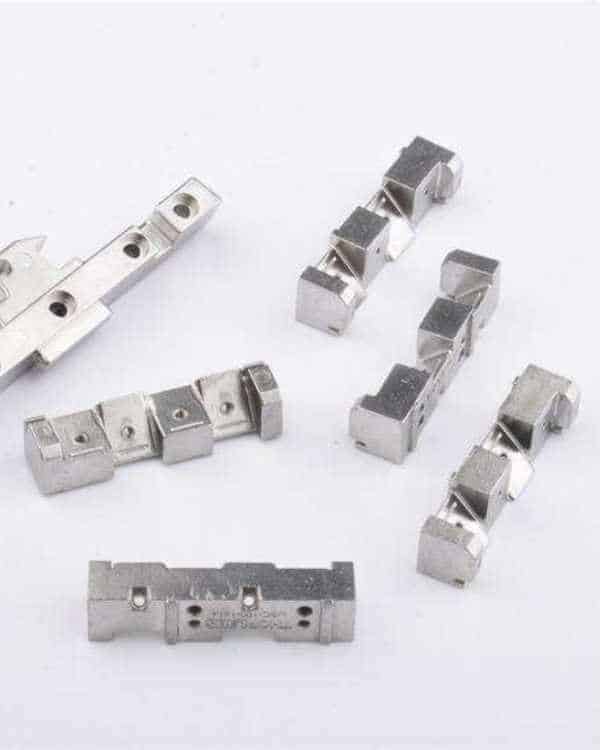
How strong are MIM parts?High-quality Metal Injection Molding components achieve 520-1,310 MPa tensile strength—typically 95-99% of wrought material properties—depending on alloy and heat treatment. This makes them suitable for demanding applications in automotive, aerospace, and medical devices where both complex geometry and reliable mechanical performance are critical.
Understanding MIM Strength Fundamentals
Metal Injection Molding produces parts through feedstock injection, debinding, and high-temperature sintering. The final mechanical properties depend critically on achieving near-theoretical density—typically 96-99% for commercial MIM parts.
The density-strength relationship:
- Each 1% reduction in density decreases tensile strength by 3-5%
- Parts at 95% density achieve ~80% of wrought strength
- Parts at 97% density achieve ~90% of wrought strength
- Parts at 99% density achieve ~98% of wrought strength
Microstructure and Strength
The sintering process creates metallurgical bonds between powder particles. Unlike cast parts with dendrites or machined parts with directional grain flow, MIM parts exhibitequiaxed grain structures. This isotropic microstructure provides uniform mechanical properties in all directions.
Residual porosity, even below 1%, acts as stress concentrators. Each pore becomes a potential crack initiation site under cyclic loading. Advanced sintering atmospheres (hydrogen, nitrogen, or vacuum) and precise thermal profiles minimize oxidation and promote densification.
Key sintering controls:
- Temperature precision: ±5°C ensures uniform densification
- Atmosphere purity: Dew point <-40°C prevents oxide formation
- Cooling rate: Balances grain size with residual stress
Mechanical Properties by Material System
Material Strength Comparison Table
| Material | Condition | Tensile Strength | Yield Strength | Elongation | Hardness | Typical Applications |
|---|---|---|---|---|---|---|
| 316L SS | As-sintered | 520-580 MPa | 205-275 MPa | 40-50% | 65-80 HRB | Corrosion resistance priority |
| 17-4 PH | As-sintered | 850-950 MPa | 550-650 MPa | 10-15% | 25-30 HRC | Moderate strength |
| 17-4 PH | H900 | 1,240-1,310 MPa | 1,070-1,170 MPa | 6-8% | 40-44 HRC | Maximum strength + corrosion |
| 17-4 PH | H1025 | 1,070-1,170 MPa | 930-1,050 MPa | 8-12% | 31-35 HRC | Balanced properties |
| Fe-2Ni | As-sintered | 380-450 MPa | 250-350 MPa | 15-25% | 70-85 HRB | Low cost structural |
| Fe-2Ni | Hardened | 1,200-1,400 MPa | 1,000-1,200 MPa | 8-12% | 40-45 HRC | Cost-effective high strength |
| M2 Tool Steel | Hardened | 1,800-2,200 MPa | 1,600-1,900 MPa | <5% | 60-65 HRC | Maximum hardness/wear |
| Ti-6Al-4V | As-sintered | 900-950 MPa | 830-900 MPa | 8-12% | 32-38 HRC | Biocompatibility + strength |
Key Material Insights
316L Stainless Steel:
- Most common MIM material for corrosion resistance
- Moderate strength, excellent ductility
- Not heat-treatable
- Best for medical instruments, food processing
17-4 PH Stainless Steel:
- Workhorse alloy for high-strength MIM
- H900 maximizes strength (1,240-1,310 MPa)
- H1025 balances strength with toughness
- Used in aerospace, firearms, medical devices
Low Alloy Steels (Fe-2Ni):
- Economical strength through heat treatment
- Can achieve 1,200-1,400 MPa after hardening
- Good for automotive gears, structural components
M2 Tool Steel:
- Highest MIM strength (1,800-2,200 MPa)
- Limited ductility (<5%)
- Only for wear resistance applications
Titanium Ti-6Al-4V:
- Best strength-to-weight ratio
- 95-100% of wrought titanium properties
- Medical implants and aerospace
Strength Comparison: MIM vs. Other Processes
Quick Reference Comparison
| Process | Strength Range | Density | MIM Relative Strength |
|---|---|---|---|
| MIM | 500-1,310 MPa | 96-99% | Reference (100%) |
| Wrought/Machined | Up to material limits | 100% | MIM achieves 95-99% |
| Investment Casting | 400-1,100 MPa | 92-96% | MIM +10-20% stronger |
| PM (Press & Sinter) | 300-600 MPa | 85-92% | MIM +30-50% stronger |
| Die Casting (Al) | 200-400 MPa | 98-99% | MIM 2-3× stronger (steel vs. Al) |
MIM vs. Wrought Materials
Direct Comparison: 17-4 PH Stainless Steel, H900 Condition
| Property | MIM | Wrought | MIM as % of Wrought |
|---|---|---|---|
| Tensile Strength | 1,240-1,310 MPa | 1,310-1,380 MPa | 95-100% |
| Yield Strength | 1,070-1,170 MPa | 1,170-1,240 MPa | 91-100% |
| Elongation | 6-8% | 10-15% | 60-80% |
| Fatigue Limit (10⁷ cycles) | 550-620 MPa | 620-690 MPa | 89-90% |
Key Takeaway:MIM achieves 95-100% of wrought tensile and yield strength. The primary difference is ductility (60-80% of wrought). For most applications with typical safety factors (1.5-2.5×), this 5% strength difference is negligible.
MIM vs. Investment Casting
| Material | MIM Strength | Cast Strength | MIM Advantage |
|---|---|---|---|
| 316L SS | 520-580 MPa | 480-515 MPa | +8-12% |
| 17-4 PH (H900) | 1,240 MPa | 1,030-1,100 MPa | +13-20% |
Why MIM is stronger:
- Higher density: 97-99% vs. 92-96%
- Finer microstructure: 2-15 μm powder vs. 50-150 μm grain size
- Better fatigue properties: 15-30% improvement
Critical Factors Affecting Strength
Density Achievement
Density is the single most important factor:
| Density | Tensile Strength (17-4 PH H900) | Relative Performance |
|---|---|---|
| 95% | 1,030-1,100 MPa | 80-85% of wrought |
| 97% | 1,150-1,210 MPa | 90-93% of wrought |
| 98% | 1,210-1,275 MPa | 93-96% of wrought |
| 99% | 1,270-1,310 MPa | 96-99% of wrought |
Porosity impact on fatigue:
- Each 1% porosity reduces fatigue limit by 8-12%
- Fatigue life at fixed stress can drop 50-70%
- HIP treatment (99.5% density) increases fatigue life by 100-300%
Sintering Parameters
Temperature Control:
| Deviation | Density | Strength Impact |
|---|---|---|
| -20°C | 94-96% | -10 to -15% |
| Optimal ±5°C | 97-99% | Reference (100%) |
| +20°C | 95-97% | -8 to -12% (grain coarsening) |
Atmosphere Requirements:
- Hydrogen or nitrogen: Dew point <-40°C
- Vacuum: <10⁻⁵ mbar for titanium
- Poor atmosphere control: 10-15% strength loss from grain boundary oxidation
Design Features
Wall Thickness:
- Optimal: 0.8-4.0 mm
- Variations >3:1 create density gradients (5-10% local strength reduction)
- Thick sections (>6mm) risk incomplete sintering
Stress Concentrations:
| Feature | Stress Factor (Kt) | Effective Strength |
|---|---|---|
| Sharp corner (R=0mm) | 3.0-4.0 | 25-33% of nominal |
| Small radius (R=0.5mm) | 1.8-2.2 | 45-55% reduction |
| Good radius (R≥1.0mm) | 1.2-1.4 | 83-85% of nominal |
Design Guidelines for Maximum Strength:
- All internal corners: R ≥1.0 mm
- Section transitions: <20° tapers
- Minimum wall in stressed areas: 0.8 mm
- Avoid blind holes >3× diameter
Heat Treatment for Strength Enhancement
Precipitation Hardening (17-4 PH)
| Condition | Temperature | Tensile Strength | Best For |
|---|---|---|---|
| H900 | 482°C, 1 hr | 1,240-1,310 MPa | Maximum strength |
| H1025 | 552°C, 4 hr | 1,070-1,170 MPa | Balanced properties |
| H1150 | 621°C, 4 hr | 930-1,030 MPa | Maximum toughness |
Selection Guide:
- H900:Static overload applications, maximum hardness needed
- H1025:Variable loading, good fatigue + corrosion resistance (most common)
- H1150:Impact loading, corrosive environments
Quenching and Tempering (Low Alloy Steels)
Fe-2Ni Heat Treatment Results:
| Tempering Temperature | Hardness | Tensile Strength | Applications |
|---|---|---|---|
| 180-200°C | 56-60 HRC | 1,500-1,650 MPa | Wear surfaces |
| 400-500°C | 42-46 HRC | 1,200-1,350 MPa | Gears, shafts |
| 550-650°C | 32-36 HRC | 950-1,100 MPa | Tough components |
Surface Treatments for Strength Enhancement
Shot Peening
Fatigue Strength Improvement:
| Material | Baseline | After Peening | Improvement |
|---|---|---|---|
| 316L SS | 215-260 MPa | 280-360 MPa | +30-40% |
| 17-4 PH (H900) | 550-620 MPa | 720-900 MPa | +30-45% |
| Fe-2Ni (hardened) | 480-560 MPa | 720-840 MPa | +50-60% |
Mechanism:Compressive residual stress (0.2-0.4mm depth) prevents fatigue crack initiation.
Nitriding
- Surface hardness: 800-1,200 HV (65-72 HRC equivalent)
- Case depth: 0.1-0.5 mm
- Fatigue strength increase: +20-40%
- Applications: Gears, surgical instruments, molds
Carburizing
- Surface hardness: 58-63 HRC
- Case depth: 0.2-1.5 mm
- Fatigue strength increase: +40-70%
- Applications: Gears with wear-resistant teeth
Hot Isostatic Pressing (HIP)
Property Improvements (17-4 PH H900):
| Property | Pre-HIP (97%) | Post-HIP (>99.5%) | Improvement |
|---|---|---|---|
| Tensile Strength | 1,240 MPa | 1,290-1,310 MPa | +4-6% |
| Elongation | 6-7% | 8-10% | +30-40% |
| Fatigue Limit | 550 MPa | 620-650 MPa | +12-18% |
| Fatigue Life | Baseline | 2-4× longer | +100-300% |
When to specify HIP:
- Fatigue-critical (>10⁶ cycles)
- Aerospace/medical (zero-defect requirement)
- Maximum ductility needed (>10% elongation)
Cost:HIP adds cost and lead time.
Testing Standards
Key ASTM/ISO Standards
Mechanical Testing:
- ASTM E8:Tensile testing (measures UTS, yield strength, elongation)
- ASTM E466:Fatigue testing (determines fatigue limits)
- ASTM E18/E92:Hardness testing (Rockwell/Vickers)
- ASTM B311:Density measurement (Archimedes method)
MIM-Specific:
- ISO 22068-1:General MIM requirements
- ISO 22068-2:Material specifications
Quality Control Requirements
Density Testing:
- Structural parts: ≥96% theoretical
- Critical applications: ≥97% theoretical
- Sampling: Minimum 1 per production lot
Mechanical Property Verification:
| Test Type | Frequency | Requirement |
|---|---|---|
| Tensile testing | 1 per 5,000 parts | Meet spec ±10% |
| Hardness | 100% feasible | Within range |
| Fatigue (when required) | 1 per lot | Minimum cycles |
Statistical Process Control:
- Target Cpk ≥1.33 for dimensions
- Target Cpk ≥1.67 for safety-critical features
Material Selection Guide
Quick Decision Matrix
| Application Priority | Material | Strength | Key Benefit |
|---|---|---|---|
| Maximum Strength + Corrosion | 17-4 PH (H900) | 1,240-1,310 MPa | Highest precipitation hardening |
| Balanced Properties | 17-4 PH (H1025) | 1,070-1,170 MPa | Strength + toughness |
| Cost-Effective Strength | Fe-2Ni (hardened) | 1,200-1,400 MPa | Low material cost |
| Maximum Hardness | M2 tool steel | 1,800-2,200 MPa | Wear resistance |
| Biocompatibility | Ti-6Al-4V | 900-950 MPa | Medical approved |
| Corrosion Priority | 316L SS | 520-580 MPa | Excellent corrosion resistance |
Failure Mode Selection
| Primary Failure Mode | Recommended Material/Condition |
|---|---|
| Static overload | 17-4 PH H900 (maximum UTS) |
| High-cycle fatigue | 17-4 PH H1025 + shot peening |
| Impact/shock | 17-4 PH H1150 (maximum toughness) |
| Wear resistance | M2 or surface treatment |
| Corrosion + stress | 17-4 PH H1150 (best SCC resistance) |
When MIM Strength Is Insufficient
Strength Limitations
MIM Maximum Capabilities:
- Practical limit: 1,500 MPa (Fe-8Ni fully hardened)
- Achievable with difficulty: 1,800-2,200 MPa (M2, limited ductility)
- Not feasible: >2,200 MPa
Better Alternatives When:
- UTS >2,000 MPa required → Wrought maraging steel
- Yield >1,500 MPa required → Powder forging + HIP
- Impact energy >150 J required → Forged low-alloy steel
- Extreme toughness needed → Wrought with controlled processing
Size and Volume Constraints
Size Limitations:
- Maximum weight: ~250 grams
- Maximum dimension: ~150 mm
- Thick sections (>8mm): Risk of incomplete sintering
Volume Economics:
| Part Complexity | Minimum Volume for MIM |
|---|---|
| Highly complex (5+ machining ops) | 5,000-10,000 units |
| Moderate complexity | 20,000-30,000 units |
| Simple geometry | 50,000-100,000 units |
Frequently Asked Questions
Q: What is the strongest commercially available MIM material?
M2 tool steel achieves 1,800-2,200 MPa tensile strength after hardening. However,17-4 PH stainless steel H900 (1,240-1,310 MPa)is more commonly used because it offers 94% of M2 strength with 3-4× better toughness and superior corrosion resistance.
Q: How does porosity quantitatively affect strength?
- Tensile strength:Each 1% porosity reduces strength by 3-5%
- Fatigue strength:Each 1% porosity reduces fatigue limit by 8-12%
- Fatigue life:Can be reduced by 50-70% at same stress level
- Solution:Specify ≥97% density for structural parts, HIP for critical fatigue applications
Q: Can MIM parts handle safety-critical applications?
Yes, with proper protocols:
- Density ≥97% minimum
- 100% non-destructive testing (X-ray CT or ultrasonic)
- Cpk ≥1.67 for critical features
- Full traceability from powder to finished part
Proven applications:Automotive airbag components, medical implants, and military firearms (M17/M18 pistols).
Q: What design features reduce strength most?
Priority fixes:
- Sharp corners:Change R=0 to R≥1.0mm (reduces stress concentration from 3× to 1.2×)
- Abrupt thickness changes:Use gradual tapers (<20°) to prevent density gradients
- Thin walls (<0.8mm) in stressed areas:Increase to 1.5mm minimum
- Poor gate placement:Relocate to avoid weld lines in high-stress regions
Q: How does MIM compare to 3D-printed metal parts?
| Property | MIM | LPBF (As-built) | MIM Advantage |
|---|---|---|---|
| Tensile Strength (17-4 PH) | 1,240-1,310 MPa | 1,000-1,150 MPa | +10-20% |
| Property uniformity | Isotropic | Anisotropic (10-15% variation) | Predictable |
| Surface finish | Ra 0.8-1.6 μm | Ra 6-12 μm | 4-8× smoother |
| Fatigue strength | 550-620 MPa | 380-450 MPa | +35-45% |
Use LPBF for:Prototypes, <1,000 units, extreme geometryUse MIM for:Production (>10,000 units), higher strength, lower cost
Q: What volume justifies MIM tooling?
- Complex parts (5+ machining ops): 5,000-10,000 units
- Moderate complexity: 20,000-30,000 units
- Simple geometry: 50,000-100,000 units
Break-even example:Tooling cost divided by expected volume gives the per-part tooling burden. If MIM saves enough per part versus machining, payback can be rapid.
Conclusion
Metal Injection Molding delivers1,240-1,310 MPa tensile strengthin 17-4 PH H900—representing95-99% of wrought material performance. This strength level, combined with complex geometry capability and production economics, makes MIM optimal for:
Choose MIM when:
- Strength requirement: 500-1,500 MPa
- Complex geometries (5+ machining operations eliminated)
- Production volume: >10,000-20,000 units annually
- Isotropic properties needed
- Material efficiency important (95%+ utilization)
Consider alternatives when:
- Strength requirement: >2,000 MPa (use wrought/forged)
- Volume: <10,000 units (machining may be economical)
- Maximum ductility: >15% elongation required
- 100% density mandatory without HIP
Key success factors:
- Target ≥97% density(each 1% = 3-5% strength gain)
- Optimize design:R≥1.0mm radii, uniform walls, <20° tapers
- Select appropriate heat treatment:H900 for max strength, H1025 for balance
- Consider surface treatments:Shot peening can substantially increase fatigue strength
- Specify HIP for critical applications:Can significantly increase fatigue life
When properly designed and manufactured, MIM parts perform successfully in strength-critical applications across firearms, automotive, and medical sectors. When properly designed and manufactured, MIM parts don't just meet strength requirements—they deliver reliable, cost-effective performance that rivals or exceeds traditional manufacturing methods.
Custom MIM Parts from Emitech
Nanjing Emitech delivers MIM 316L, 17-4PH, 4340 and other materials from tooling through sintering and finishing. Custom MIM parts · MIM services · Request a quote
Last updated: 2026-06-24