
Powder metallurgy press selection determines production capability, operating economics, and achievable part quality for decades. Equipment costs vary widely: basic mechanical presses are the most affordable option, while advanced servo-electric systems command a substantial capital premium. Total ownership costs over 10 years can reach several times the initial purchase price. Press technology—mechanical, hydraulic, or servo-electric—fundamentally constrains the part geometries you can manufacture and the production economics you can achieve.
Why Press Selection Has Long-Term Consequences
The compaction press is the central equipment investment in powder metallurgy operations—and the selection defines your capability ceiling for 15-25 years.
A mechanical press efficiently produces simple single-level parts at 25-60 strokes per minute but physically cannot achieve uniform density distribution in complex multi-level components requiring independent lower punch control. Hydraulic and servo-electric systems enable geometries impossible on mechanical presses through programmable force profiles and independent multi-axis motion.
Operating economics diverge substantially. A mechanical press costs substantially less than servo-electric capability. However, annual energy consumption and maintenance costs differ significantly between technologies. Over 10 years, that initial price advantage narrows or reverses entirely depending on production volume and electricity rates.
Positioning accuracy directly determines achievable tolerances:
- Mechanical:±0.02mm repeatability through mechanical linkages
- Servo-electric:±0.001mm precision—20× better—through CNC-grade ball screw drives
For precision applications requiring ±0.05mm as-pressed dimensions, only certain press technologies can meet specifications regardless of operator skill or powder characteristics.
Common Specification Errors
Selecting on capital cost alone.A low-cost mechanical press appears economical until production reveals it cannot achieve the required density uniformity in a 3-level part, requiring expensive secondary operations that eliminate projected savings.
Oversizing press capacity.Specifying a 400-ton press for parts requiring 180 tons maximum compaction force increases capital cost and energy consumption substantially. Operating a press well below rated capacity consumes a disproportionate share of full-capacity energy due to fixed losses in motors, pumps, and mechanical systems. Right-size to application with a reasonable margin for process variation.
Ignoring cycle time requirements.Hydraulic presses cycle at 5-15 strokes per minute versus 25-50 for mechanical. An application requiring 30 parts per minute cannot achieve target throughput on hydraulic equipment regardless of other merits.
Underestimating tooling costs.A press with complex multi-level tooling adds substantial tooling cost. Total system cost at launch can be significantly above press-only pricing. This capital requirement, not press cost alone, determines cash flow and payback period.
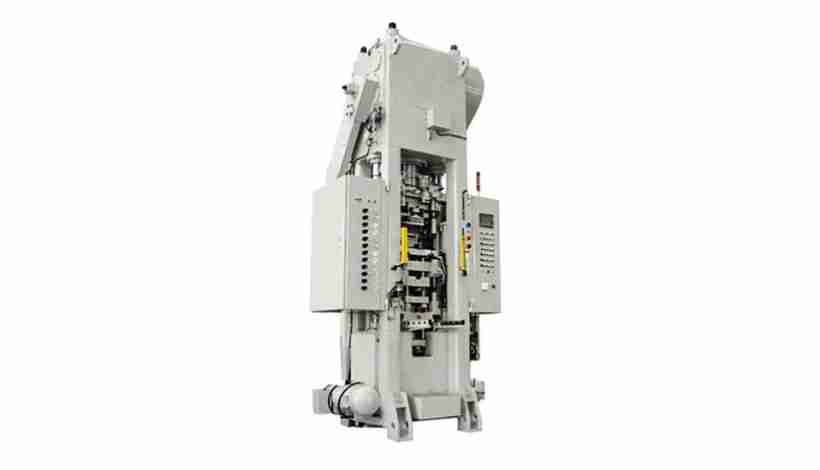
Mechanical Press Technology
Mechanical presses store energy in a continuously rotating flywheel (typically 500-2,000 kg at 200-400 RPM). A clutch engages on each cycle, transferring kinetic energy through a mechanical linkage converting rotary motion to vertical ram displacement. Once the linkage geometry is set, the force-displacement profile is fixed.
Key specifications:
- Tonnage: 10-400 tons (above 400 tons, flywheel mass becomes impractical)
- Stroke rate: 20-60 cycles/minute → 9,600-28,800 parts per 8-hour shift
- Positioning accuracy: ±0.02mm
- Energy consumption: 25-50 kWh per 1,000 parts
- Capital cost (200-ton): Lower capital investment
- Annual maintenance: 5-8% of capital
- Noise: 85-95 dBA (hearing protection required)
Limitations to know before specifying:
- Fixed force profile—cannot adjust during cycle or between products without 45-90 min mechanical changeover
- Maximum practical complexity: 2 thickness levels. Parts with 3+ levels develop excessive density gradients
- Shock loading accelerates tooling wear 25-40% versus hydraulic or servo systems
Best suited for:Simple single-level parts (bearings, bushings, washers), annual volumes above 500,000 where speed justifies investment, applications tolerating ±3-5% density variation, and limited capital budgets.
Hydraulic Press Technology
Hydraulic presses generate compaction force through high-pressure oil (150-350 bar) acting on large-diameter cylinders. Full rated tonnage is available at any stroke position—unlike mechanical presses where force varies with linkage geometry.
Key specifications:
- Tonnage: 50-2,000+ tons (no practical upper limit)
- Stroke rate: 5-20 cycles/minute
- Positioning accuracy: ±0.01mm via servo-proportional valve control
- Energy consumption: 45-75 kWh per 1,000 parts (highest among press types)
- Capital cost (200-ton): Moderate-to-high capital investment
- Annual maintenance: 8-12% of capital
- Maintenance items: Oil changes every 2,000-4,000 hours (moderate cost each), filter replacements every 500-1,000 hours
Key advantage—independent multi-axis control:Upper punch, 3-6 independent lower punches, die, and core rods all move independently with coordinated motion sequences. This enables powder redistribution during compaction—raising one lower punch while lowering another transfers powder between part levels, achieving uniform density in parts with 3:1 or greater thickness ratios. Mechanical presses cannot provide this.
Best suited for:Complex multi-level parts with 3-5 distinct thickness levels, large components above 400 tons, moderate volumes of 50,000-500,000 parts annually, and high-tonnage structural automotive or industrial parts.
Servo-Electric Press Technology
Servo-electric presses use high-torque AC servo motors driving press axes through precision ball screws. Each axis has a dedicated servo motor with integrated encoder. A CNC-type motion controller coordinates all axes with real-time position feedback at 0.001mm resolution and force feedback at 0.1% accuracy.
Key specifications:
- Tonnage: 10-800 tons (ball screw limitations above 800 tons)
- Stroke rate: 10-40 cycles/minute
- Positioning accuracy: ±0.001mm (10-20× better than mechanical or hydraulic)
- Energy consumption: 15-30 kWh per 1,000 parts (lowest among press types)
- Capital cost (200-ton): Higher capital investment
- Annual maintenance: 3-5% of capital (no hydraulic fluids, filters, or seals)
Key advantages:
- Motors draw power only during active motion—at rest, consumption drops to 200-500W versus continuous 5-15 kW for mechanical/hydraulic
- Adaptive pressing: if force rises faster than programmed, system slows compaction rate to prevent tooling damage
- Complete data logging at millisecond resolution for quality traceability
- Minimal maintenance: sealed bearings, no hydraulic system
Best suited for:Precision parts requiring ±0.03-0.05mm tolerances (aerospace, medical), complex geometry with 4+ thickness levels, high-value production where parts command premium unit values, high-utilization operations in high-electricity-cost regions, and regulated environments requiring comprehensive quality data.
Press Technology Comparison
| Selection Factor | Mechanical | Hydraulic | Servo-Electric |
|---|---|---|---|
| Part complexity | Single-level or simple 2-level | Multi-level (3-5 levels) | Most complex (5+ levels) |
| Annual volume sweet spot | >500,000 parts | 50,000-500,000 parts | >200,000 parts (typical payback threshold) |
| Tolerance capability | ±0.10-0.15mm | ±0.05-0.10mm | ±0.03-0.05mm |
| Maximum tonnage | <400 tons | 50-2,000+ tons | <800 tons |
| Capital cost (200-ton) | Lower | Moderate | Higher |
| Energy (kWh/1,000 parts) | 25-50 | 45-75 | 15-30 |
| Annual maintenance | 5-8% of capital | 8-12% of capital | 3-5% of capital |
| Stroke rate | 20-60/min | 5-20/min | 10-40/min |
Tonnage Requirement Calculation
Formula:
Required Force = Compaction Pressure × Projected Area × 1.25 (safety factor)
Step 1 — Determine compaction pressure by material:
| Material | Compaction Pressure | Target Green Density |
|---|---|---|
| Iron / low-alloy steel | 500-700 MPa | 7.0-7.2 g/cm³ |
| Stainless steel | 600-800 MPa | 6.5-7.0 g/cm³ |
| Aluminum alloys | 150-350 MPa | 2.5-2.7 g/cm³ |
| Copper / bronze | 200-450 MPa | 7.5-8.5 g/cm³ |
Step 2 — Calculate projected area(cross-section perpendicular to pressing direction). For a ring: π × (outer radius² - inner radius²). Include all features—gear teeth, splines, and other details that add to total area resisting compaction force are commonly underestimated.
Step 3 — Apply 1.25 safety factorto account for powder flow variation between batches, die wall friction consuming 20-30% of applied force in tall parts, and density variation requiring locally higher pressures.
Worked example — automotive synchronizer hub:
- Geometry: 65mm OD, 35mm ID annular section + 380mm² gear features
- Total projected area: π × (32.5² - 17.5²) + 380 = 2,735mm²
- Material: Fe-2Cu-0.8C at 600 MPa for 7.1 g/cm³
- Required force: 600 MPa × 0.002735m² × 1.25 =209 tons
- Specification: 250-ton press (next standard size, appropriate margin)
Stroke Length Determination
Formula:
Minimum Stroke = (2.5 × Part Height) + 20-50mm clearance
The 2.5× multiplier accounts for powder fill depth before compaction. Powders at 3.0-3.5 g/cm³ apparent density compress to 6.8-7.4 g/cm³ green density—approximately 2.0-2.5× volume reduction.
Example:30mm tall part → minimum stroke = (2.5 × 30) + 30mm clearance = 105mm. Specify 150mm stroke press for operational margin and flexibility for taller variants.
Cycle Time Requirements
Formula:
Required throughput (parts/hr) = Annual volume ÷ Effective production hoursMaximum cycle time (seconds) = 3,600 ÷ required parts/hr
Effective production hours= Total available hours × OEE (typically 75-85%)
Worked example — 750,000 parts annually:
- Available: 4,000 hours (2 shifts, 250 days) × 80% OEE = 3,200 effective hours
- Required throughput: 750,000 ÷ 3,200 = 234 parts/hr = 3.9 parts/min
- Maximum cycle time: 60 ÷ 3.9 =15.4 seconds
Press capability check:
- Mechanical at 30 strokes/min (2-second cycle): 7.7× margin ✅
- Hydraulic at 8 strokes/min (7.5-second cycle): 2.1× margin ✅ (adequate but tight)
- If volume increased 50% requiring 6 parts/min: hydraulic becomes marginal ⚠️
Total Cost of Ownership
Initial purchase price represents only 40-60% of total 10-year ownership costs. The complete picture:
10-year TCO comparison — 200-ton press, 500,000 steel parts/year:
| Cost Element | Mechanical | Hydraulic | Servo-Electric |
|---|---|---|---|
| Equipment | Lowest | Moderate | Highest |
| Installation | Lowest | Moderate | Higher |
| Initial tooling | Lowest | Highest | Moderate |
| Capital total | Lowest | Highest | Higher |
| Annual energy | Low | Highest | Lowest |
| Annual maintenance | Low | Highest | Low |
| Annual tooling | Low | Higher | Higher |
| Annual operating total | Lowest | Highest | Moderate |
| 10-year TCO | Lowest | Highest | Moderate |
| Cost per part | Lowest | Highest | Moderate |
For this simple part, mechanical delivers the lowest total cost. If part complexity eliminates mechanical as a technical option, servo-electric can yield lower total operating costs over time versus hydraulic—through lower energy and maintenance.
Energy Cost Analysis
At 500,000 annual parts, annual energy consumption and cost by press type:
| Press Type | kWh/1,000 parts | Relative Annual Energy Use |
|---|---|---|
| Mechanical | 25-50 | Moderate |
| Hydraulic | 45-75 | Highest |
| Servo-Electric | 15-30 | Lowest |
In high-electricity-cost regions, servo-electric's annual energy savings versus hydraulic can be substantial. Over 10 years, these savings can significantly offset the capital premium.
Tooling Cost Considerations
Tooling costs are frequently underestimated and represent a significant share of total manufacturing cost for complex parts.
Initial tooling cost by complexity:
| Part Complexity | Tool Steel | Carbide | Lead Time |
|---|---|---|---|
| Simple single-level | Lower cost | Moderate cost | 6-10 weeks |
| 2-level moderate | Moderate cost | Higher cost | 8-14 weeks |
| Complex 4+ level | Higher cost | Highest cost | 12-20 weeks |
Tool life by material:
| Pressed Material | Tool Steel Life | Carbide Life |
|---|---|---|
| Aluminum | 2-5 million parts | 10-20 million parts |
| Iron / low-alloy steel | 300,000-700,000 | 2-5 million |
| Stainless steel | 150,000-400,000 | 800,000-2 million |
At 70-80% of tool life, refurbishment at 20-30% of new cost recovers 70-90% of original life. Most production tooling undergoes 2-3 refurbishments before replacement.
Selection Decision Framework
Screen by part complexity first:
- Single-level or simple 2-level (thickness ratio below 2:1):
- >500,000 units/year → Mechanical
- 100,000-500,000 units/year → Mechanical or hydraulic (run TCO)
- <100,000 units/year → Consider used equipment; new press ROI difficult to justify
- Multi-level, 3-4 distinct levels, thickness ratio above 2:1:
- Below 400 tons → Compare hydraulic vs. servo-electric on TCO
- Above 400 tons → Hydraulic (servo-electric capacity exceeded)
- Tolerance ±0.08-0.15mm → Hydraulic acceptable
- Tolerance ±0.03-0.05mm → Servo-electric required
- Complex 5+ levels or precision geometry:
- Servo-electric only—no alternative achieves required density uniformity and precision
Frequently Asked Questions
Q: For simple parts, when does servo-electric justify its cost premium over mechanical?
Servo-electric justification for simple parts requires one of three conditions:
High electricity costs + high utilization:At high electricity rates, annual energy savings versus mechanical can accumulate over 10 years. Combined with reduced maintenance, total operating savings can recover a meaningful portion of the capital premium.
Tolerance demands:If ±0.05mm or tighter is required, servo-electric's ±0.001mm positioning becomes mandatory regardless of economics.
Corporate sustainability mandates:Energy reduction targets or carbon reporting can tip the decision even where pure economics don't justify it.
For most simple part applications at typical electricity rates, 10-year energy savings don't recover the capital premium. Start the analysis with the tolerance requirement—if mechanical can hold the spec, economics rarely favor servo-electric for simple parts.
Q: What are the consequences of substantially oversizing press tonnage?
Operating at 40-50% of rated capacity increases per-part energy consumption 15-30%:
- Mechanical:Flywheel motor runs continuously at constant speed regardless of pressing force—8-12 kW consumed even at light loads
- Hydraulic:Pump maintains system pressure with excess energy dissipated as heat through relief valves
- Servo-electric:Minimizes this penalty through torque control proportional to actual load, but capital increases 30-50% for 2× tonnage increase
Additional penalties: oversized presses occupy 2-3× more floor space, require deeper foundations, and complicate material handling due to increased height.
Correct specification: 20-30% above calculated maximum force—adequate safety margin without substantial overcapacity waste.
Q: How do changeover times affect multi-product press utilization economics?
Total changeover downtime per product change:
- Physical tooling swap: 20-90 minutes
- Parameter setup: 1-5 minutes (CNC press) vs. 30-60 minutes (mechanical)
- Trial production: 20-100 parts for quality verification
- Total: 45-180 minutes
Changeover cost (labor + scrap + lost production) affects minimum economical batch size depending on part margin. Higher-margin parts can justify smaller batches, while lower-margin parts need larger batches to absorb setup cost. Operating 3-5 different parts with quarterly production runs remains practical. However, 10+ parts requiring weekly changeovers creates meaningful capacity loss—justifying dedicated press consideration or product family grouping.
Q: When does used press equipment make economic sense?
Used equipment suits low-volume applications below 100,000 annual parts where new press ROI extends to 8-12 years. Pricing is substantially below new equivalent.
Risks by press type:
- Mechanical (pre-2010):Generally reliable for decades with proper maintenance. Inspect frame for cracks and ram alignment.
- Hydraulic (15-20+ years old):Often requires complete hydraulic system rebuild, a significant expense for pumps, valves, and cylinders.
- Early servo-electric (pre-2010):Discontinued servo drives and controllers create long-term parts availability risk. Avoid.
Budget for refurbishment and validation as part of total acquisition cost. For volumes justifying 3-5 year ROI on new equipment, used equipment risk typically doesn't provide adequate savings versus new equipment's warranty, modern controls, and energy efficiency.
Q: What foundation requirements do powder metallurgy presses impose?
| Press Type | Foundation Requirement | Foundation Cost | Total Installation Cost |
|---|---|---|---|
| Mechanical (200-ton) | Isolated reinforced concrete pad, 2-3m × 2-3m × 0.6-1.0m; soil bearing >150-250 kPa | Moderate | Moderate total |
| Hydraulic (standard) | Often direct floor mounting on industrial slab; 800+ ton may need reinforcement | Minimal-moderate | Moderate total |
| Servo-electric | Minimal vibration; floor mounting without special foundation typically acceptable | Minimal | Moderate-to-higher total |
Installation costs (foundation, electrical service, compressed air, rigging) add a meaningful share of press capital cost.
Q: How do press control system capabilities affect quality and efficiency?
Basic mechanical controls(start/stop, emergency stop, stroke counter): adequate for simple single-level parts in dedicated production.
Position monitoring upgrade (moderate cost):Enables part height verification, detecting fill variations or tool wear before producing scrap batches.
PLC control with recipe management (hydraulic/servo):Stores parameters for 50-200 part configurations, enabling 1-5 minute changeovers versus 30-60 minutes for manual entry.
Advanced servo-electric adaptive control:
- Real-time force-position curves for every cycle
- Curve-matching algorithms trigger alarms before dimensional variation exceeds specifications
- Reduces scrap rates 40-60% in precision applications
- Complete data logging at 1-10ms intervals for medical/aerospace traceability
- Additional cost: significant
Q: What safety systems are required for PM press operations?
Mandatory systems:
- Two-hand control:Forces operator positioning away from die area during press cycle
- Light curtains:Detect intrusion into danger zone, stopping ram within 10-50ms. Cost: moderate
- Emergency stops:Per OSHA and European machinery safety directives
Optional but recommended:
- Noise enclosures:Reduce mechanical press from 85-95 dBA to 70-80 dBA, eliminating hearing protection requirements. Cost: moderate-to-high
- Interlocked gates:Disable press during setup while preventing inadvertent actuation
Combustible dust safety:Aluminum and magnesium powders present explosion hazards when dispersed in air. Proper ventilation, dust collection, and ignition source elimination are required. Budget appropriately for basic versus comprehensive installations.
Conclusion
Press selection determines manufacturing capability and economic performance for 15-25 years. The decision logic follows a clear sequence:
- Part geometry screens technology:Simple single-level → mechanical viable. Multi-level (3-5 levels) → hydraulic or servo-electric required. Complex 5+ levels or ±0.05mm tolerance → servo-electric only.
- TCO analysis reveals true economics:A mechanical press versus servo-electric shows a significant initial cost advantage. Over 10 years with energy and maintenance, this gap narrows or reverses in high-electricity-cost regions at high utilization.
- Tonnage and stroke calculations prevent mis-sizing:Required force = compaction pressure × projected area × 1.25. Stroke = 2.5× part height + clearance. These calculations prevent undersizing that limits density or oversizing that wastes capital and energy.
- Supplier evaluation extends beyond specifications:Equipment noticeably cheaper from a distant supplier becomes expensive when parts delivery takes two weeks and service response takes four days instead of overnight.
Align press selection with business requirements—current production needs, anticipated growth, energy costs, and quality standards—and the technical and economic analysis converges on a clear answer.
Powder Metallurgy & MIM from Emitech
From compaction and sintering to finishing, Emitech produces complex PM and MIM parts in high volumes. Custom MIM parts · Get a quote
Last updated: 2026-06-24
Continue reading
- How to Choose the Right Metal Injection Molding Materials for Your Application
- Metal Injection Molding in Medical Devices: What You Need to Know
- Metal Injection Molding vs. 3D Printing: A Technical Comparison Guide
- Metal Injection Molding (MIM) vs. Investment Casting (IC)—Which Is Best for Your Manufacturing Needs?