
Metal Injection Molding vs. Stamping: Choosing the Best Process for Your Parts
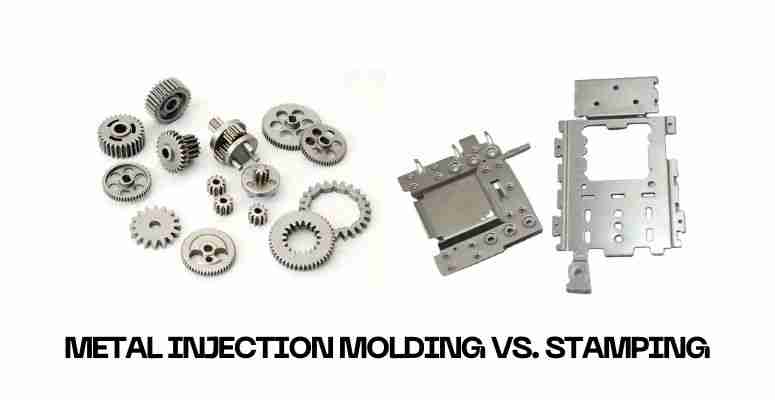
The core manufacturing decision betweenMetal Injection Moldingand stamping depends on part characteristics: MIM suits small, complex parts with 3D geometry while stamping excels at high-volume, simple 2D sheet metal parts. Selection depends on design requirements, production volume, and economic constraints.
Metal Injection Molding Process
Metal Injection Molding combines design flexibility of plastic molding with durability of powder metallurgy, providing cost-effective manufacturing for small, complex metal parts in medium to high volumes.
The process follows four sequential steps.Feedstock preparationmixes fine metal powders with polymer binders creating homogeneous feedstock.Injection moldingheats feedstock and injects into mold cavity under high pressure forming a "green" part.Debindingremoves binder chemically or thermally from green part, creating porous "brown" part.Sinteringheats brown part to 85-90% of base metal's melting point, fusing powder particles and achieving near-full densification.
MIM enables design freedom for complex shapes and features meeting tight tolerances impossible through other metalworking processes. Wide material selection processes almost all engineering metals including stainless steel, titanium alloys, copper, and tungsten. Excellent surface finish often eliminates secondary machining requirements. Cost-effectiveness exceeds machining or casting for high-volume production of small, complex parts.
Limitations include high tooling costs making MIM uneconomical for low-volume runs. Part size constraints limit MIM to components typically below 100 grams, as larger parts challenge debinding and sintering processes. Long lead times result from process duration, particularly debinding and sintering stages.
Metal Stamping Process
Metal stamping uses molds and presses to punch, bend, or stretch sheet metal creating desired shapes. The process achieves fast production speed and low unit costs in high-volume manufacturing.
The stamping process places sheet metal in coil or blank form into stamping press. Pressing forces sheet metal through die, shearing and forming into desired shape. Part ejection removes finished part from die and process repeats.
High productivity results from fast cycle times producing multiple parts per minute, ideal for high-volume production. Low unit cost for large production runs significantly undercuts casting or machining methods. Versatile forming options include blanking, punching, bending, flanging, and coining operations. Good dimensional accuracy from modern stamping presses and dies maintains tight tolerances ensuring part consistency.
Limitations include design constraints limiting stamping to parts with simple shapes, uniform thickness, and few undercuts or contours. High tooling costs for stamping dies, especially complex parts, make low-volume runs uneconomical. Material limitations favor sheet metals, struggling with very thick or hard materials. Scrap generation from stamping processes requires recycling or disposal.
MIM vs Stamping Comparison
| Factor | Metal Injection Molding (MIM) | Metal Stamping |
|---|---|---|
| Part Complexity | High, intricate details possible | Low to moderate, simpler geometry |
| Typical Size Range | Small, <100g | Larger parts possible |
| Typical Thickness | Thin tothick walls | Sheet metal thickness, uniform |
| Production Volume | Medium to high | Very high |
| Tooling Cost | High | High for complex tools |
| Unit Cost | Low to medium | Very low |
| Lead Time | Long (weeks) | Short (days) |
| Material Options | Most engineering metals | Sheet metals mainly |
| Dimensional Accuracy | Very high | High |
| Surface Finish | Excellent as-molded | May need additional finishing |
Typical Applications
MIM applications require small, complex, high-precision parts with excellent finish. Medical devices use MIM for surgical instruments, orthopedic implants, and dental tools. Firearms applications include triggers, safeties, magazines, and sights. Consumer electronics incorporate connectors, hinges, camera parts, and watch components. Automotive systems use fuel injectors, turbocharger parts, and steering components. Aerospace applications include fasteners, brackets, and sensor housings.
Stamping applications produce larger, flatter parts with simple shapes across industries. Automotive manufacturing uses stamping for body panels, frame components, brackets, and interior trim. Appliances require enclosures, mounting plates, and brackets. Electronics applications include heatsinks, shields, and cases. Construction uses roofing, siding, and structural components. Industrial machinery incorporates guards, covers, and frames.
Selection Criteria
Part geometrydetermines primary suitability. Small, complex parts with intricate features favor MIM. Larger, flatter, simpler designs suit stamping better.
Production volumeaffects economics significantly. Medium to high volumes above 10,000 parts annually make MIM cost-effective. Very high volumes exceeding 100,000 parts yearly favor stamping for unbeatable unit costs.
Material requirementsinfluence selection. Specific engineering metals or alloys require MIM's wide material selection. Standard sheet metal applications suit stamping well.
Precision and finishrequirements matter. Very tight tolerances and smooth as-molded surfaces favor MIM. Applications accepting some variation with secondary finishing options can use stamping.
Lead time and budgetconstraints affect decisions. Longer lead times and higher tooling costs may justify MIM for complex parts. Rapid turnaround with tight budgets favor stamping, especially for simple designs.
Frequently Asked Questions
Q: What is the typical break-even volume for MIM versus stamping?
Break-even volume depends on part complexity and size. For simple 2D parts, stamping remains economical from 1,000 units upward due to lower tooling costs and faster production. For complex 3D parts with features like internal channels or undercuts, MIM becomes cost-effective around 10,000-20,000 units annually. At volumes exceeding 100,000 units yearly, stamping typically offers lower unit costs for simple geometries while MIM maintains advantages for complex designs where stamping requires extensive secondary operations.Part design complexitysignificantly shifts this threshold.
Q: Can MIM achieve the same dimensional tolerances as stamping?
MIM achieves dimensional tolerances of ±0.3-0.5% of nominal dimension as-sintered, with tighter tolerances possible through secondary operations. Stamping achieves tolerances of ±0.05-0.2mm depending on material thickness and part size. For small parts under 20mm, MIM often provides comparable or tighter tolerances than stamping. For larger parts above 100mm, stamping typically maintains better dimensional control. Critical dimensions in MIM parts can be held to ±0.025mm through post-sintering sizing operations, approaching stamping precision.
Q: What materials are available for MIM compared to stamping?
MIM processes most engineering metals including stainless steels (316L, 17-4PH, 420), low-alloy steels, tool steels, titanium alloys (Ti-6Al-4V), cobalt-chromium alloys, nickel-based alloys, copper alloys, and tungsten-based materials. Stamping primarily works with sheet metals including carbon steel, stainless steel, aluminum alloys, copper alloys, and brass. MIM enables use of specialty alloys difficult to form through stamping, while stamping handles a wider range of material thicknesses from 0.1mm to 6mm+. Material selection often depends more on part geometry than process capability.
Q: How do tooling costs compare between MIM and stamping?
MIM tooling costs vary depending on part complexity and cavity count, with molds typically lasting 500,000-1,000,000 shots. Stamping die costs vary for progressive dies handling complex operations, with tool life exceeding 1,000,000 parts for simple operations. Initial tooling investment is comparable for moderately complex parts. However, stamping requires additional tooling for secondary operations that MIM integrates into the primary process. MIM often consolidates multiple stamped components into single parts, offsetting higher individual tool costs through reduced assembly requirements.
Q: What surface finishes can be achieved with each process?
MIM produces as-sintered surface finish of Ra 0.8–1.6 µm (32–63 μin) without additional processing, suitable for most applications. Post-processing through tumbling, vibratory finishing, or electropolishing achieves Ra 0.4-0.8 μm. Stamping produces surface finish matching input sheet metal, typically Ra 0.8-3.2 μm depending on material and tooling condition. Sharp edges and burrs from stamping require deburring operations. MIM eliminates parting lines and flash common in stamping, producing smoother cosmetic appearance for visible components.
Q: Can stamping produce the same complex geometries as MIM?
Stamping handles 2D and 2.5D geometries including bends, flanges, embossments, and drawn features. Progressive dies achieve moderate complexity through sequential forming operations. However, stamping cannot produce true 3D internal features such as internal channels, blind holes with complex angles, undercuts without secondary operations, or varying wall thicknesses within the same plane. MIM enables these features in single operations. For parts requiring multiple stamping operations plus extensive secondary machining to achieve MIM-level complexity, MIM often provides better economics and consistency above 10,000 units annually.
Q: How do lead times compare for initial production?
MIM development includes tool design and fabrication (8-12 weeks), process optimization and debinding/sintering development (4-6 weeks), and first article inspection (2-4 weeks), totaling 14-22 weeks for initial production. Stamping development includes die design and fabrication (6-10 weeks), press setup and tryout (2-3 weeks), and first article approval (1-2 weeks), totaling 9-15 weeks. Stamping provides faster time to production for simple parts. MIM requires longer development but often eliminates secondary operations reducing overall time to finished parts for complex designs.
Q: What are the environmental considerations for each process?
MIM achieves material utilization above 95% with scrap recyclable into new feedstock. Energy consumption includes sintering at high temperatures for extended periods. Binder systems require proper disposal or recycling. Water usage for solvent debinding requires treatment. Stamping generates 15-40% scrap depending on part nesting efficiency, though scrap metal is readily recyclable. Stamping press energy consumption is lower per part but lubrication oils require management. Overall environmental impact depends on part complexity, with MIM favoring complex parts requiring extensive machining through alternative methods, while stamping suits simple geometries minimizing material waste through efficient nesting.
Precision Metal Parts from Emitech
Nanjing Emitech delivers MIM, CNC machining, and custom metal parts. MIM services · Request a quote
Last updated: 2026-06-23
Continue reading
- Understanding MIM Materials Properties: Strength, Durability, and Performance Explained
- MIM Parts in Medical Devices: 12 Critical Applications You Should Know
- The Ultimate Guide to Metal Injection Molding (MIM): Process, Materials & Design
- MIM Metal Parts Strength: Why Sintered Components Match CNC Machined Performance