
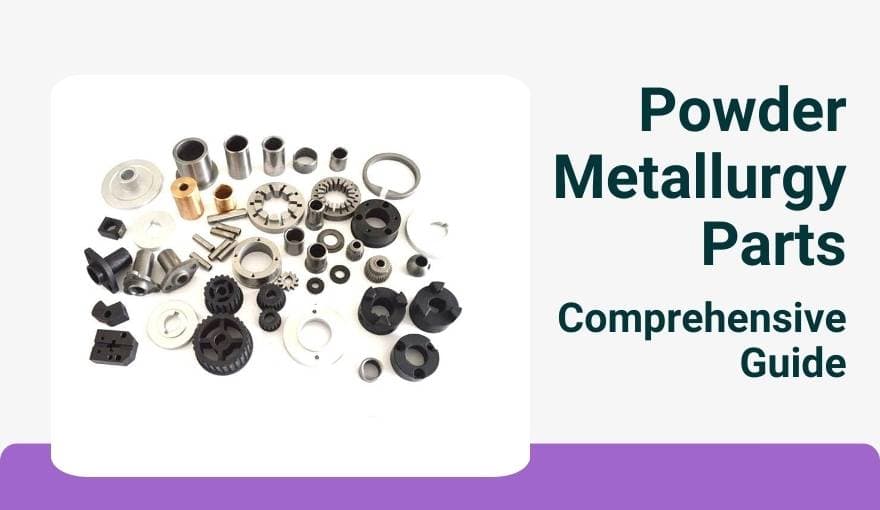
Powder metallurgy (PM) manufactures metal parts by compacting metal powders under high pressure and sintering below the melting point. The process achieves over97% material utilizationcompared to 20-40% for traditional machining, making it economical for high-volume production of complex geometries. Typical PM parts exhibit85-95% densityof wrought metals, with dimensional tolerances of±0.1-0.3%requiring minimal secondary machining.
PM Manufacturing Process
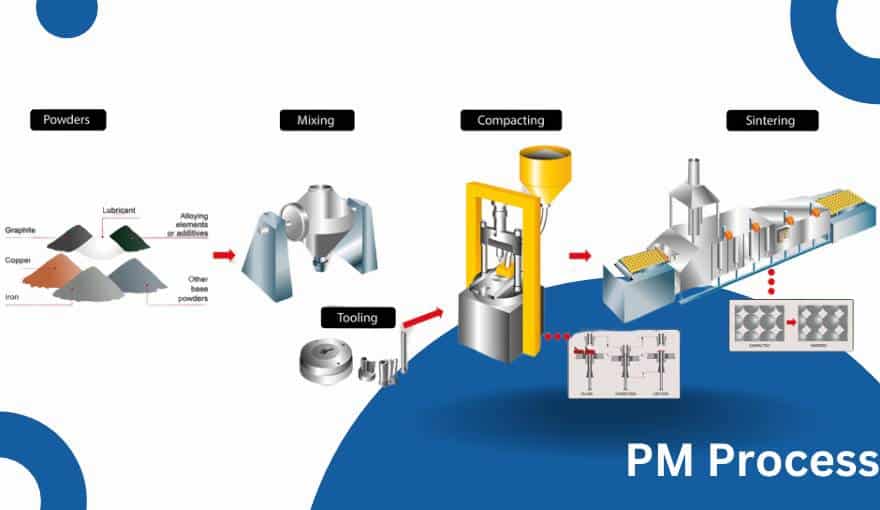
Powder metallurgy involves four essential stages that transform metal powders into finished components with controlled properties.
Powder Production
Metal powders are produced through atomization (gas or water jets break molten metal into droplets), solid-state reduction (reducing metal oxides with hydrogen or carbon at elevated temperatures), or electrolysis (electrochemical deposition). Atomization produces spherical particles with controlled size distribution, typically10-150 microns, while reduction methods create irregular particles suitable for pressing operations.
Powder Mixing and Compaction
Blend metal powders with lubricants (0.5-1.5% zinc stearate or similar) to reduce die friction and binders for green strength. Compact the mixture in precision steel dies under200-800 MPa pressure, forming "green" parts at approximately 80-90% of final density. Die design determines part geometry—PM cannot produce undercuts or re-entrant angles without multi-action tooling significantly increasing cost.
Sintering
Heat green compacts in controlled atmosphere furnaces (typically hydrogen, nitrogen, or dissociated ammonia to prevent oxidation) at70-90% of the metal's melting point. Sintering times range from 20-45 minutes depending on material and part size. During sintering, atomic diffusion bonds particles together, achieving 85-95% theoretical density. Final density depends on compaction pressure, powder characteristics, and sintering parameters.
Secondary Operations
Many PM parts require post-sintering treatments. Repressing or sizing operations improve dimensional accuracy and increase density to 92-98% for applications requiring higher strength. Heat treatment (hardening, tempering) develops mechanical properties comparable to wrought materials. Machining addresses features impossible to mold like threads, cross-holes, or precision bearing surfaces. Surface treatments include steam treatment for corrosion resistance or oil impregnation for self-lubricating bearings.
PM Compared to Other Manufacturing Methods
PM vs. Machining
PM uses over 97% of raw material versus 20-40% for machining from bar stock. For gears and complex shapes, PM eliminates multiple machining operations, offering significant per-part cost reductions at volumes above 20,000-50,000 units annually. However, machining offers tighter tolerances (±0.01mm vs. ±0.1mm for PM), no porosity, and full material density. Use PM for medium-complexity geometries in high volume; use machining for low volumes, ultra-tight tolerances, or when full density is critical.
PM vs. Casting
PM delivers tighter dimensional control (±0.1-0.3% vs. ±1-3% for casting) and better surface finish, often eliminating secondary machining. Casting handles larger parts and achieves full density without porosity. PM excels for small-to-medium parts (typically under 10kg) requiring dimensional consistency across high production volumes. Casting suits larger parts, low volumes, or when maximum strength is required.
PM vs. Metal Injection Molding (MIM)
MIM combines PM principles with plastic injection molding, achieving higher complexity in smaller parts (typically under 100 grams). MIM handles undercuts, threads, and intricate 3D features impossible for conventional PM but costs more per part. Conventional PM suits simpler geometries in larger sizes at lower piece prices. MIM becomes economical above 10,000-50,000 units for complex small parts; conventional PM works at 5,000-20,000 units for simpler geometries.
| Factor | Conventional PM | MIM | Machining | Casting |
|---|---|---|---|---|
| Part Size | 0.1-10 kg | 0.1-100 g | Any | 0.1-1000+ kg |
| Density | 85-95% | 96-99% | 100% | 100% |
| Tolerance | ±0.1-0.3% | ±0.3-0.5% | ±0.01mm | ±1-3% |
| Min. Volume | 5,000-20,000 | 10,000-50,000 | 1+ | 100-1,000 |
| Complexity | Moderate | High | Moderate | Moderate-High |
Common PM Applications
Automotive Structural Components
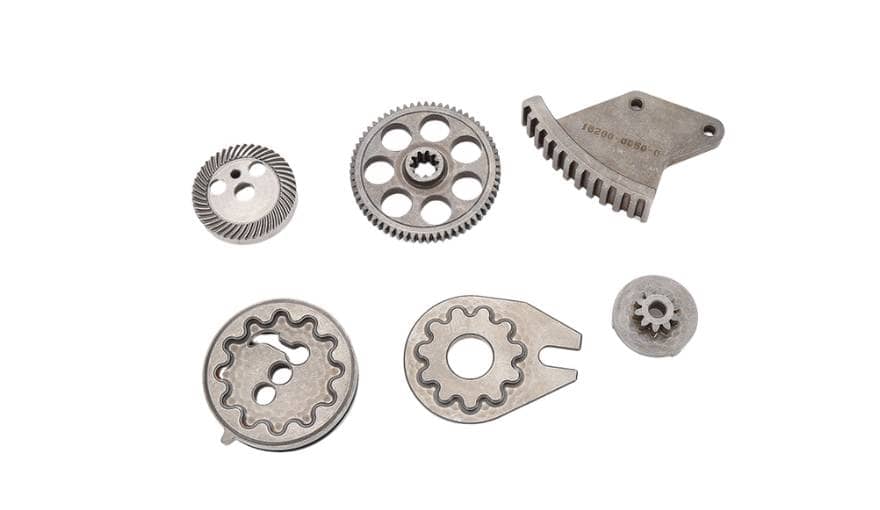
The automotive industry is one of the largest consumers of PM production. Transmission gears, synchronizer hubs, and connecting rods utilize PM's ability to produce near-net-shape components with controlled porosity for oil retention. A typical automatic transmission contains 15-25 PM components. Modern PM connecting rods achieve strength comparable to forged steel while reducing weight through optimized internal structure.
PM self-lubricating bearings and bushings incorporate controlled porosity (15-30% void volume) impregnated with oil, providing maintenance-free operation for applications like suspension linkages and starter motors. These parts eliminate the need for external lubrication systems, reducing warranty costs and maintenance requirements.
Industrial Tooling and Magnetic Components
Tungsten carbide cutting tools use PM to combine extremely hard tungsten carbide particles with cobalt binder, achieving hardness impossible through melting and casting. The process controls grain size and binder distribution, optimizing wear resistance for machining operations. PM magnetic components for motors and transformers use soft magnetic iron powders achieving high magnetic permeability while minimizing eddy current losses in high-frequency applications.
Filtration and Porous Products
Porous PM parts with controlled void structure filter fluids in hydraulic systems, chemical processing, and medical applications. Porosity ranges from 10-50% depending on requirements, with pore sizes controlled through powder selection and sintering parameters. These filters withstand high pressures and temperatures while providing consistent filtration performance impossible with paper or polymer filters.
Materials and Properties
PM processes handle ferrous and non-ferrous metals, with material selection based on mechanical properties, cost, and processing requirements.
Ferrous Materials (85% of PM Production)
Iron and low-alloy steel powders dominate PM due to low cost and good mechanical properties. Plain iron PM parts achieve tensile strengths of 250-400 MPa at 85-90% density. Adding copper (1-4%) and carbon (0.3-0.8%) increases strength to 400-700 MPa. Stainless steel PM parts (316L, 17-4PH) provide corrosion resistance for medical, food processing, and marine applications, achieving properties approaching wrought material after appropriate heat treatment.
Non-Ferrous Materials
Copper-based PM parts offer excellent electrical and thermal conductivity for electrical contacts, heat sinks, and welding electrodes. Bronze (copper-tin) PM bearings provide wear resistance and corrosion resistance in marine and chemical applications. Aluminum PM parts achieve strength-to-weight ratios suitable for aerospace components, though processing requires careful atmosphere control to prevent oxidation.
Specialty Materials
Tungsten carbide, titanium, and nickel-based superalloys suit specialized high-performance applications. Titanium PM parts find use in aerospace and medical implants where biocompatibility and strength-to-weight ratio justify premium costs. Tool steels processed through PM achieve uniform carbide distribution impossible through conventional melting, improving cutting tool performance.
When to Use Powder Metallurgy
PM becomes economically attractive when several factors align. Production volume must typically exceed 5,000-20,000 units annually to amortize tooling costs that vary widely depending on part complexity. Part geometry should be moderately complex—simple shapes may be cheaper to machine or cast, while extremely complex 3D features may require MIM instead.
Material utilization matters most for expensive alloys. PM using tungsten carbide, titanium, or tool steels can justify lower volumes due to 97% material usage versus 30-50% for machining. Parts requiring controlled porosity for filtration or self-lubrication specifically demand PM—no other process provides comparable pore structure control.
Avoid PM when full material density is critical for fatigue resistance or pressure containment. The inherent porosity (5-15% even after optimization) reduces fatigue strength by 20-40% compared to wrought material. Similarly, parts requiring extremely tight tolerances (±0.01mm) or smooth surface finishes (Ra < 1.6 μm) need secondary machining that negates PM's cost advantages.
Frequently Asked Questions
How does PM part density compare to wrought material and what does it affect?
Conventional PM parts achieve 85-95% theoretical density versus 100% for wrought materials. This 5-15% porosity reduces tensile strength by approximately 15-30% and fatigue strength by 20-40% compared to fully dense material. However, repressing or hot isostatic pressing (HIP) can increase PM density to 96-99%, achieving properties approaching wrought material. For applications where maximum strength is not critical, standard PM density provides adequate performance at lower cost. Self-lubricating bearings intentionally maintain 15-30% porosity for oil retention—a unique PM advantage impossible with other processes.
What production volume justifies PM tooling investment?
PM tooling costs vary widely depending on part size and complexity. Break-even typically occurs at 5,000-20,000 units annually for moderately complex parts competing against machining. For simple geometries, volumes above 20,000-50,000 units may be required. However, expensive alloys like tungsten carbide or titanium can justify PM at lower volumes (2,000-10,000 units) due to 97% material utilization versus 30-50% for machining. Calculate break-even by dividing tooling cost by per-part savings multiplied by annual volume. For volumes below economic threshold, consider machining or MIM for complex small parts.
What tolerances can PM achieve without secondary machining?
Standard PM delivers ±0.1-0.3% dimensional tolerance, meaning a 50mm dimension varies by ±0.05-0.15mm. Sizing operations after sintering improve this to ±0.05-0.10mm on critical dimensions. Surface finish typically ranges from Ra 3-6 μm as-sintered. For applications requiring tighter tolerances (±0.01-0.03mm) or better surface finish (Ra < 1.6 μm), budget for secondary machining on critical features. Design parts with PM-friendly tolerances on most features, reserving machining for bearing surfaces, seal grooves, or precision threads. This hybrid approach maximizes PM's cost advantages while meeting functional requirements.
Can PM process all metals and what are the limitations?
PM handles most metals including iron, steel, stainless steel, copper, bronze, aluminum, titanium, tungsten carbide, and nickel alloys. However, reactive metals like aluminum and titanium require careful atmosphere control to prevent oxidation, increasing processing cost. Very high melting point metals (tungsten, molybdenum) require specialized equipment. Some alloys with wide melting ranges or prone to oxidation may be difficult or uneconomical to process through PM. Metals that cannot be reduced from oxides or atomized into powders are unsuitable. Discuss material feasibility with your PM supplier early in design—most engineering alloys are processable but some require premium processing adding 20-50% to part cost.
What design features are difficult or impossible with conventional PM?
PM cannot produce undercuts, reverse tapers, or re-entrant angles without multi-action tooling significantly increasing cost and complexity. Threads are typically machined after sintering rather than molded. Cross-holes perpendicular to pressing direction require secondary drilling. Very thin walls (under 1mm) or high aspect ratios (length > 3× diameter for holes) pose challenges. Sharp internal corners cause stress concentrations—specify radii where possible. Parts must eject axially from the die, limiting geometry to shapes that can be extracted without demolding issues. For geometries violating these rules, consider MIM which handles undercuts and complex 3D features, or design hybrid parts using PM for the main body with machined features added.
Making the PM Decision
Powder metallurgy excels for medium-complexity parts in production volumes above 5,000-20,000 units annually where material utilization, dimensional consistency, and near-net-shape capability provide economic advantages. The process achieves 97% material usage and ±0.1-0.3% dimensional tolerance, eliminating most secondary operations for appropriate geometries.
Compare PM against machining for material-intensive parts where 97% utilization versus 20-40% generates substantial savings. Evaluate PM versus casting when tighter tolerances (±0.1-0.3% vs. ±1-3%) or better surface finish eliminates secondary machining. Consider MIM for complex small parts (under 100 grams) requiring undercuts or 3D features impossible for conventional PM.
Account for PM's inherent porosity when full density is critical for fatigue resistance or pressure containment. The 5-15% void content reduces strength by 15-30% versus wrought material, though repressing or HIP can achieve 96-99% density approaching full properties. Work with your PM supplier to optimize part design, material selection, and processing parameters for your specific application requirements.
Precision Metal Parts from Emitech
Nanjing Emitech (ISO 9001:2015) delivers MIM, CNC machining, and custom metal parts. MIM services · Request a quote
Last updated: 2026-06-24