
💰 The Bottom Line
Your production costs exceed budget because machining complex geometries is slow and wasteful (high scrap).
Sintered metal parts solve this:Net-shape components,95% material efficiency, and predictable costs at volume.
Part 1: Is Sintering Right for Your Application?
Decision Framework
Use this checklist before requesting a quote.
✅ Sintering is Optimal When:
- Volume:>25,000 units/year
- Weight:10 - 500 grams
- Geometry:Complex 3D (undercuts, gears)
- Material:Iron, Steel, Stainless, Copper
- Wall Thickness:2 - 10 mm
- Tolerance:±0.05 - 0.10 mm
❌ Choose Alternatives When:
- Volume:<10,000 units (Use Machining)
- Weight:>2 kg (Use Forging/Casting)
- Material:Al, Mg, Zn (Use Die Casting)
- Tolerance:<±0.02 mm (Use CNC)
- Wall Thickness:>25 mm (Use Casting)
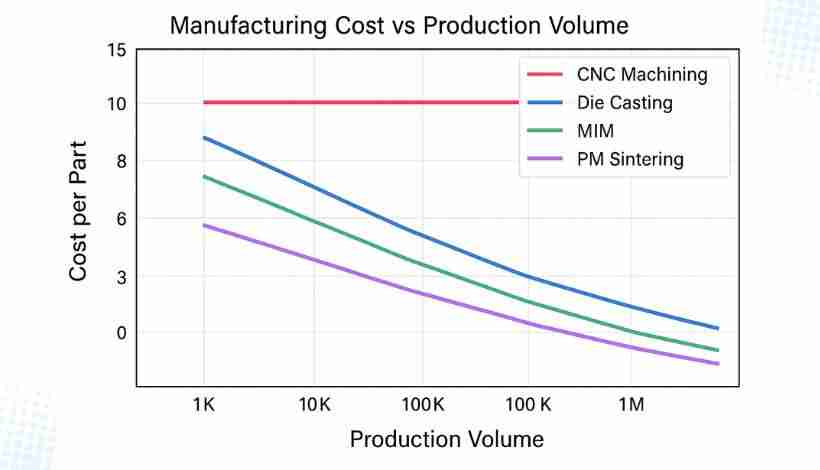
Cost Comparison: The Volume Factor
Sintering has high upfront tooling costs but drastically lower unit costs.
| Process | Tooling Cost | Break-Even Vol. | Cost @ 50K units | Cost @ 200K units |
|---|---|---|---|---|
| Sintering (PM) | Moderate | 25,000+ | Low | Very low |
| CNC Machining | Low | <10,000 | High | High |
| MIM | High | 50,000+ | Moderate | Low |
| Die Casting | High | 30,000+ | Low | Very low |
Video 1: Understanding the Powder Metallurgy Process (7:23).
Part 2: Material Selection Quick Reference
Choose Your Material by Primary Goal
💪 Strength
UseFe-2Cu-0.8C(450-700 MPa)
⚙️ Wear Resistance
UseFe-0.8C + Heat Treat(50-60 HRC Surface)
🛡️ Corrosion
Use316L Stainless(Density > 7.2 g/cm³)
🧲 Magnetic
UseFe-3SiorFe-50Ni
💧 Self-Lubricating
UseBronze 90Cu-10Sn(Porous)
🔥 Thermal Cond.
UseCopper-based Alloys
Material Performance Matrix
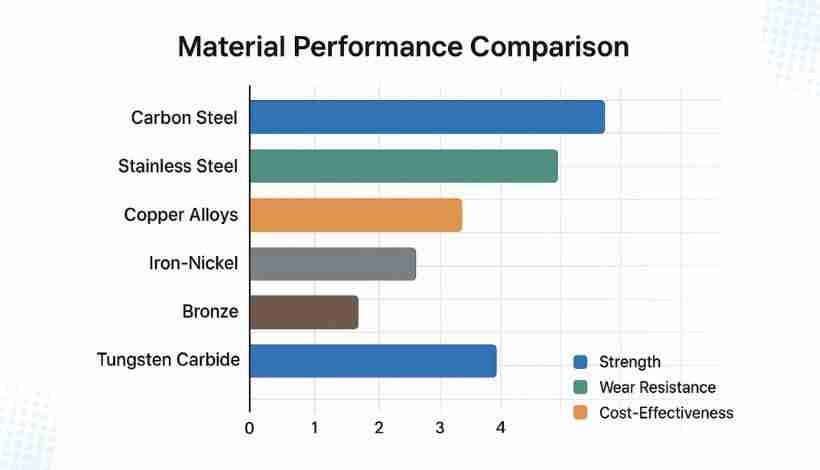
| Material | Density (g/cm³) | Tensile Strength | Cost Factor | Best For |
|---|---|---|---|---|
| Fe-0.8C | 6.8 - 7.2 | 400 - 550 MPa | 1.0× (Base) | General Structural |
| Fe-2Cu-0.8C | 7.0 - 7.4 | 500 - 700 MPa | 1.2× | Gears, Levers |
| Fe-4Ni-1.5Cu | 7.2 - 7.6 | 600 - 850 MPa | 2.5× | Transmission Parts |
| 316L Stainless (PM) | 7.0 - 7.4 | 450 - 550 MPa (PM) 520 - 580 MPa (MIM) | 3.5× | Corrosion Resistance |
| Bronze (Porous) | 5.5 - 6.5 | 150 - 300 MPa | 4.5× | Bearings (Self-Lube) |
Part 3: Core Component Selection Guide (8 Most Common Types)
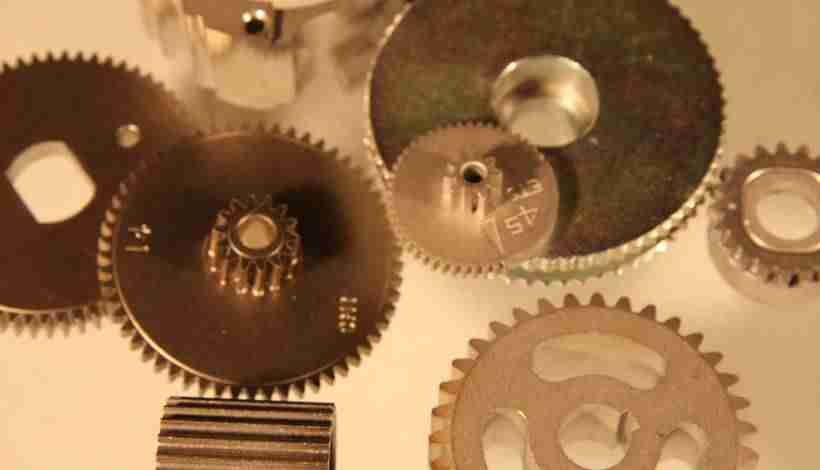
Precision sintered metal components showcase - automotive gears, sprockets, structural parts, custom bearings and brackets manufactured through powder metallurgy process.
Video 2: Sintered Metal Gears in Automotive Transmission.
Part 4: Additional Component Quick Reference
Power Transmission
- Couplings
- Pulleys
- Cams
- Ratchets
Structural
- Housings
- Spacers
- Lockrings
Electrical/Specialty
- Rotors
- Armatures
- Heat Sinks
Part 5: Design Guidelines That Matter
The 5 Critical Rules
1. Uniform Walls
Keep variation within ±20%. Use coring for thick sections (>10mm) to prevent warping.
2. Realistic Tolerances
As-sintered: ±0.05-0.10mm. Coining improves this to ±0.02mm but adds a modest cost premium.
3. Press Direction
Avoid undercuts in the primary axis. Side actions add significant tooling cost.
4. Minimum Features
Holes >1.5mm. Walls >1.5mm. Fillets >0.5mm to reduce stress concentration.
Feature-Specific Limits
- Holes:Max depth 3:1 (Simple).
- Threads:Must be tapped (Secondary).
- Gears:Min module 0.5mm.
- Thin Walls:Max height ratio 5:1.
Part 6: Design Evaluation Framework
Follow this 5-step logic to qualify your part for sintering.
Step 1: Volume Economics
IF 10k-25k →EVALUATE(Only if consolidating parts)
IF >25k →GO(Strong candidate)
Step 2: Geometry Check
IF Wall Var >30% →REDESIGN(Risk of warping)
IF Perpendicular Features → Plan Secondary Machining
Step 3: Material Check
IF Al, Mg, Zn →DIFFICULT(Use Die Casting — stable oxides and low melting points make conventional PM impractical)
Step 4: Performance
IF Corrosion → 316L (3-4x Cost)
IF Pressure Tight → Copper Infiltration Required
Step 5: Tolerance
IF ±0.02-0.05mm → Sizing (+modest cost)
IF <±0.02mm → Machining (+higher cost)
Frequently Asked Questions
Q: What volume makes sintering economical?
As a rule of thumb, if the current part cost is substantial, request a PM quote regardless of volume. For simple parts, sintering beats machining at 50,000+ units/year. For complex parts requiring consolidation, the ROI kicks in at 25,000+ units. For very complex geometries with multiple secondary operations eliminated, 10,000+ units can justify tooling investment.
Q: What are the hidden costs of sintered parts?
Total Landed Cost = Part Price + Secondary Operations + Amortized Tooling. Tooling typically adds only a small per-part amount when amortized over 500,000 shots. Secondary operations are the biggest variable: machining or plating can materially increase per-part cost and should be factored into any cost comparison before switching from machining.
Q: What is the typical development timeline?
Expect 12-20 weeks from PO to first production parts. Weeks 1-2 cover design review and DFM. Weeks 3-10 cover tooling manufacture. Weeks 11-13 are for tryout and first article approval. Production ramp typically begins week 17 or later. Rushing tooling qualification is the most common cause of quality problems in early production.
Q: How does sintered strength compare to machined wrought material?
High-density sintered parts (7.0+ g/cm³) achieve 80-95% of wrought material tensile strength — adequate for the vast majority of industrial applications. Safety-critical parts should be validated through testing rather than relying on handbook values. The strength gap is primarily driven by residual porosity; targeting 7.2+ g/cm³ brings performance close to wrought equivalents.
Q: What materials are difficult or impossible to sinter by conventional PM?
Aluminum, magnesium, and zinc are impractical for conventional powder metallurgy. Aluminum forms a stable Al₂O₃ oxide layer that prevents particle bonding under standard sintering conditions (specialized processes using magnesium additions can overcome this, but add complexity and cost). Magnesium and zinc have melting points too low for practical sintering temperatures. For these materials, die casting is the standard alternative.
Q: What is the effect of porosity on mechanical properties?
Porosity affects tensile and fatigue strength differently. Tensile strength drops 10-20% compared to equivalent wrought material at typical PM densities of 7.0-7.2 g/cm³. Fatigue strength is more sensitive, dropping 30-50% versus wrought — pores act as crack initiation sites under cyclic loading. The exception is intentionally porous bronze bearings (15-25% porosity), where the void network serves as a lubricant reservoir and is a functional feature rather than a defect.
Q: How can sintered parts be made pressure-tight?
Standard sintered parts are porous and will leak fluids or gases under pressure. Four solutions exist depending on application and budget. Steam treatment (lowest cost, basic protection) creates a magnetite surface layer. Resin impregnation (low cost) seals interconnected surface pores with polymer. Copper infiltration (moderate cost) fills pores with molten copper, increasing density to over 95% and significantly improving strength. MIM (highest cost, best result) produces near-fully dense parts inherently suitable for pressure applications.
Your Next Steps
🚀 Evaluating for First Time
- Audit Parts:Use criteria in Part 1.
- Pick Winners:Identify 2-3 high-volume candidates.
- Quote:Request PM quote vs current cost.
- DFM:Optimize design with supplier.
- Prototype:Validate with soft tooling.
🔧 Already Using Sintering?
- Eliminate Ops:Can sizing be removed?
- Material:Are you over-specifying (17-4PH vs 316L)?
- Consolidate:Combine multiple parts?
- Loosen Tolerances:Are they truly functional?
Precision Metal Parts from Emitech
Nanjing Emitech delivers MIM, CNC machining, and custom metal parts. MIM services · Request a quote
Last updated: 2026-06-24
Continue reading
- Titanium MIM: The Precision Manufacturing Revolution Transforming High-Performance Industries
- Comprehensive Analysis of Tool Steel Metal Injection Molding (MIM) Technology
- Why Tungsten MIM Achieves 98% Density: The Science Behind High-Performance Metal Components
- Types of Sintering Processes: From Solid-State to Spark Plasma (SPS)