
Sintered metal can achieve 900-1,300 MPa tensile strength—comparable to forged steel—but only when density exceeds 95%. Below 90% density, it's weaker than casting. Strength is an engineered outcome, not a fixed property.
Wondering if sintered strength fits your part? Emitech produces custom MIM parts with certified material data — request a quote with your load requirements.
Key Takeaways (TL;DR)
Quick Decision Framework:
- ✅Choose sintered metal when: You need complex geometries, high volume production, or cost-effective strength (550-800 MPa as-sintered)
- ⚠️Use advanced processing when: Applications demand >1,000 MPa strength, high ductility, or critical fatigue life
- ❌Avoid when: High tensile loading with <90% density, or when ductility >5% elongation is required
The Strength Spectrum:
| Density Level | UTS Range | Comparable To | Typical Applications |
|---|---|---|---|
| 84-88% (standard) | 350-550 MPa | Standard casting | Light-load gears, brackets, basic structural parts |
| 88-92% (high-density) | 550-800 MPa | High-strength casting/wrought | Medium-load gears, bearings, robust parts |
| 90-94% (sinter-hardened) | 900-1,300 MPa | Mid-grade forging | Connecting rods, high-load gears |
| >99% (HIP) | 1,200-2,000+ MPa | Premium forging | Aerospace, medical implants |
Bottom Line: Sintered metal strength is directly proportional to density. Control density, and you control strength.
Quick Reference: Is Sintered Metal Strong Enough for Your Application?
For most engineers asking this question, here's what you need:
| If You Need (Strength/Property) | Recommended Process | Suitability |
|---|---|---|
| 350-550 MPa tensile strength | Standard Sintering (84-88%) | ✅ Ideal for basic structural parts |
| 550-800 MPa tensile strength | High-Density Sintering (88-92%) | ✅ Excellent for medium-load gears |
| 900-1,300 MPa tensile strength | Sinter-Hardening | ✅ Matches mid-grade forging strength |
| High ductility (>5% elongation) | Forging or Machining | ❌ Avoid sintered metal |
| Pure tensile loading | Sintered (>95% density) | ⚠️ Use with caution only |
Comparison at-a-glance:
- vs. Casting: Sintered is stronger (700 vs 500 MPa typical)
- vs. Forging: Sintered is 60-100% as strong (depends on density)
- vs. Machined wrought: Sintered is 70-95% as strong (but near-net-shape)
The engineering truth: Sintered metal can be engineered to be very strong (up to 2,000 MPa), but you must control density. Higher density = higher strength = higher cost. Choose wisely.
Understanding "Strength" in Sintered Metals: The Four Critical Properties
The question "Is sintered metal strong?" actually asks four different questions. Here's what you're really evaluating:
| Property | What It Measures | Sintered Metal Range | Critical For |
|---|---|---|---|
| Ultimate Tensile Strength (UTS) | Maximum load before fracture | 550-1,300 MPa | Structural load-bearing |
| Yield Strength (YS) | Resistance to permanent deformation | 400-1,200 MPa | Dimensional stability |
| Fatigue Endurance | Cyclic loading survival | 200-540 MPa | Rotating/reciprocating parts |
| Impact Toughness | Energy absorption before failure | Varies with density | Shock loading resistance |
The Fundamental Truth: Unlike wrought steel where strength primarily depends on chemistry and heat treatment,sintered metal strength is a design variable you control through density.
Density = Strength. This simple equation governs everything else in this article.
The Metallurgical Foundation: How Sintering Creates Strength
Your sintered component begins as discrete metal particles and transforms into a solid, load-bearing structure through a carefully controlled thermal process. Understanding this metallurgical journey is fundamental to appreciating why density governs mechanical performance.
From Green Compact to Final Part
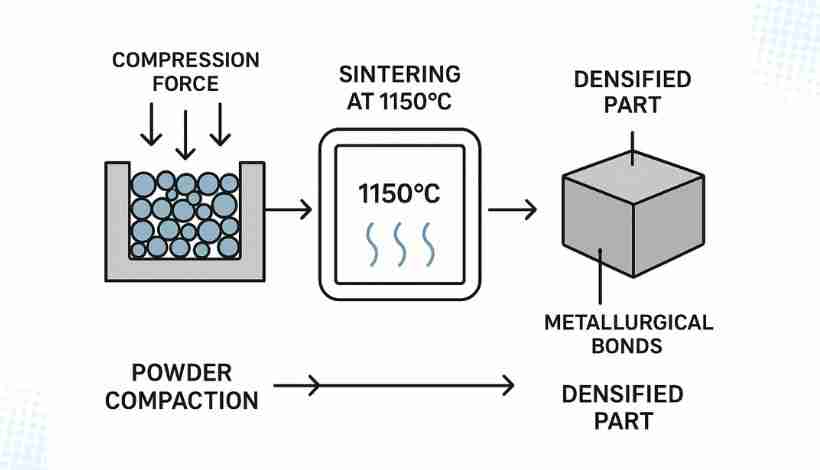
The manufacturing sequence follows three critical stages:
Stage 1: Compaction (400-800 MPa)
Fine metal powders blended with lubricants and binders are compressed under immense pressure into a "green" compact. This fragile form has the precise shape of your final part but possesses only minimal handling strength—comparable to chalk.
Stage 2: Delubrication and Sintering (70-90% of melting point)
As the furnace temperature rises, lubricants are removed through evaporation and chemical degradation. The part then reaches sintering temperature (typically 1,120-1,180°C for steel), where atomic diffusion occurs in the solid state—sintering does not involve melting. Atoms migrate from particle bulk to contact points, forming metallurgical "necks" between adjacent particles.
Stage 3: Densification
Unlike Metal Injection Molding (MIM) which experiences 15-20% shrinkage, traditional press-and-sinter parts undergo minimal dimensional change (typically 0.1-1.0% linearly) because they are already highly compacted in the die. Surface tension pulls particle centers closer together, strengthening the metallurgical bonds. The pore network rounds off and isolates, though parts typically retain 8-16% porosity unless subjected to advanced secondary densification.
The Microscopic Mechanisms of Strengthening
Three concurrent processes determine your final part strength:
Oxide Reduction
Metal powders carry surface oxide layers that prevent metallurgical bonding. The sintering atmosphere (nitrogen-hydrogen blend or vacuum) chemically reduces these oxides, exposing pure metal for particle bonding.
Neck Formation (600-900°C for steels)
Atomic diffusion builds small metallurgical bridges between particles. This presintering stage establishes initial metallic bonds with minimal densification.
Pore Elimination
The driving force is surface energy reduction—a solid block has vastly less surface area than porous powder. Continued heating causes necks to grow, voids to spheroidize and shrink, progressively "healing" the defects inherent in the green compact.
The final strength of your component directly measures how successfully this healing process has been completed.
Video: Understanding the Sintering Process
This comprehensive educational video demonstrates how atomic diffusion creates metallurgical bonds during sintering (7:23, The Engineering Science)
💡 Key Takeaway from Metallurgy: Sintering is a "healing process" that transforms discrete powder particles into a solid by:
- Removing surface oxides (enabling bonding)
- Building atomic bridges between particles (creating necks)
- Shrinking voids through surface energy reduction (densification)
The better this healing completes (higher density), the stronger your part becomes. Think of porosity as unhealed "defects"—each remaining void is a potential failure point.
The Determinants of Strength: Critical Factors You Control
Your final mechanical properties aren't accidental—they result from deliberate engineering choices. By manipulating material composition, compaction process, and sintering cycle, you can tailor strength, hardness, and ductility to meet your specific requirements.
The Primacy of Density and Porosity
Density is the single most important factordetermining your part's mechanical performance. A direct, often linear correlation exists between density and key properties. After sintering, powder metal parts typically exhibit 5-25% porosity.
Porosity degrades mechanical properties through two mechanisms:
- Reduced Load-Bearing Area: A part with 10% porosity has only 90% of solid material to resist stress compared to a fully dense equivalent.
- Stress Concentration: Voids act as internal stress raisers. When loaded, stress flows around these pores, concentrating at their edges. This localized stress can be many times higher than the nominal applied stress, initiating microcracks that lead to premature failure, especially under fatigue or impact loading.
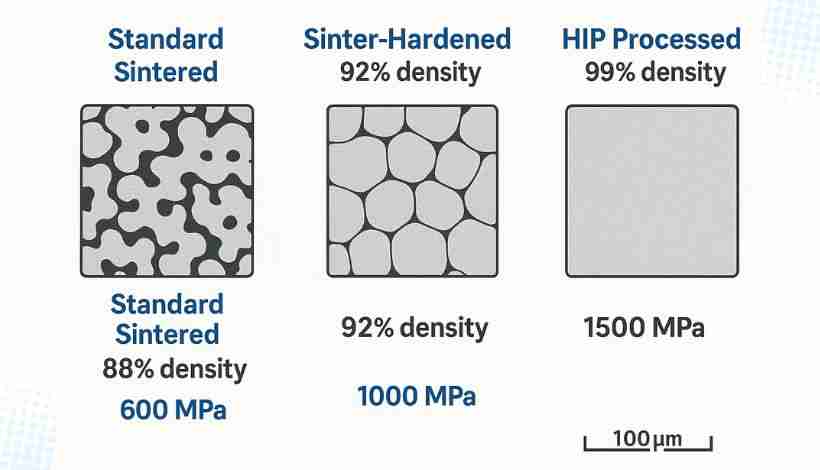
Critical insight: The morphology of pores matters as much as their volume. Irregularly shaped pores with sharp corners from incomplete particle bonding are far more detrimental to ductility and fatigue life than small, rounded, isolated pores characteristic of well-sintered parts.
⚡ Counter-intuitive benefit(Advanced Engineering Insight):Sintered steels can beless sensitive to external geometric stress concentrators(notches, holes, threads) than wrought counterparts. Why? The distributed network of internal pores can blunt and diffuse the high stress field from a sharp external notch, preventing single-point crack initiation.Practical implication: For components with unavoidable geometric stress risers (like threaded connections), a high-density PM part might paradoxically exhibit less sensitivity to the notch compared to wrought material. The pore network acts like a distributed "fuse" that diffuses the stress field.However, caution is required: the overall fatigue life of standard PM parts remains lower than fully dense wrought steel. Never use standard unpeened PM parts for high-cycle fatigue applications with severe external notches without rigorous testing.
Material Composition and Alloying Strategy
Your base powder selection establishes the foundation, but alloying elements dramatically enhance performance:
Carbon (0.3-0.8%)
Primary element for increasing hardness and wear resistance in ferrous PM parts. Similar mechanism to conventional steelmaking.
Copper and Nickel (2-4%)
Solid-solution strengthening increases strength and toughness. Nickel is particularly effective for improving impact energy and gigacycle fatigue strength. Copper also plays a unique role in dimensional control: it melts during sintering and causes slight matrix swelling, which can be precisely balanced against carbon's shrinkage effect to achievezero dimensional changefrom die to final part.
Chromium, Molybdenum, Manganese
Powerful hardenability agents crucial for high-strength, heat-treatable, and sinter-hardening steels. However, these elements present a significant processing challenge—their high oxygen affinity forms stable oxides that inhibit interparticle bonding. Successful processing requires high-purity, low-dew-point atmospheres or vacuum conditions, adding cost and complexity.
Critical trade-off: Pursuing maximum strength through chemistry necessitates more sophisticated and expensive manufacturing processes.
Prealloyed vs. Admixed Powders
Prealloyed powders (where alloying elements are incorporated during atomization) ensure homogeneous microstructure, leading to more consistent and superior mechanical properties compared to simply mixing elemental powders.
Process Parameters: Temperature, Time, and Atmosphere
Sintering Temperature and Time
Higher temperatures and longer hold times promote complete diffusion, leading to higher density, better pore rounding, and greater strength and ductility. However, you must carefully control these parameters to avoid excessive grain growth, which can make the material brittle.
High-temperature sintering (100-250°F hotter than standard) yields significant benefits:
- 30% increase in tensile strength
- 15% increase in bending fatigue strength
- 50% increase in impact energy
Ultra-high-temperature sintering (approaching 2,500°F/1,370°C) further enhances properties, enabling novel alloy use.
Sintering Atmosphere
The atmosphere must prevent oxidation and reduce surface oxides. Your choice—nitrogen-hydrogen blend, inert gas, or vacuum—depends on material sensitivity to oxidation.
Cooling Rate and Sinter-Hardening
For steels with sufficient hardenability (containing Cr, Mo, Mn), you can accelerate cooling after sintering. This rapid cooling within the furnace transforms the microstructure into hard martensite—a highly cost-effective method eliminating separate post-sintering heat treatment.
Process Variables Impact Matrix
| Variable | Tensile Strength | Yield Strength | Hardness | Ductility | Fatigue Life |
|---|---|---|---|---|---|
| Increased Density | ↑↑ Strong | ↑↑ Strong | ↑↑ Strong | ↑↑ Strong | ↑↑ Strong |
| Increased Temp | ↑ Moderate | ↑ Moderate | ↑ Moderate | ↑ Moderate | ↑ Moderate |
| Carbon Content | ↑ Moderate | ↑ Moderate | ↑↑ Strong | ↓ Decreases | Variable |
| Faster Cooling | ↑↑ Strong | ↑↑ Strong | ↑↑ Strong | ↓↓ Strong Decrease | ↑ Moderate |
| Pore Sphericity | Minor | Minor | No Change | ↑ Moderate | ↑ Moderate |
Comparative Benchmark: How Sintered Metal Stacks Against Other Processes
The Strength Hierarchy(for same alloy composition):
| Process | Density | Strength Range (MPa) | Comparison |
|---|---|---|---|
| Forging | 100% | 1,200-2,000 | Benchmark Maximum |
| HIP'd Sintered | 99%+ | 1,200-2,000 | Premium Forging Equivalent |
| Sinter-Hardened | 90-94% | 900-1,300 | Mid-grade Forging |
| High-Density Sintered | 88-92% | 550-800 | Better than Casting |
| Standard Sintered | 84-88% | 350-550 | Standard Casting Equivalent |
To fully appreciate sintered metal strength, you need context against alternative manufacturing methods. The choice between sintering, forging, casting, or machining is a complex engineering decision based on performance, geometric complexity, material efficiency, and cost trade-offs.
Sintered vs. Forged Metals
Forging's Performance Advantage
Forging shapes metal using localized compressive forces, widely regarded as the benchmark for highest strength and reliability. Intense mechanical deformation physically closes internal voids and refines grain structure, forcing grain flow to align with part contours. This creates a continuous, fibrous structure exceptionally resistant to shock, impact, and fatigue.
The Performance Gap
Representative studies show forged steel having:
- 26% higher tensile strength than cast equivalents
- 37% higher fatigue strength
- Up to 6× longer fatigue life
Forging remains the preferred method for safety-critical, high-load applications like aircraft landing gear, engine crankshafts, and high-pressure fittings.
The PM Counterpoint
While standard press-and-sinter components cannot match forged part performance, advanced PM technologies blur this distinction. Processes like powder forging (sintered preform hot-forged in final step) or Hot Isostatic Pressing (HIP) achieve densities exceeding 99% of theoretical. At these near-full densities, PM part mechanical properties become equivalent to wrought and forged materials, effectively eliminating sintering's primary weakness.
Sintered vs. Cast Metals
Casting's Porosity Problem
Casting pours molten metal into molds for solidification. The liquid-to-solid transition introduces defects: gas porosity (dissolved gases coming out of solution), shrinkage porosity (volume reduction during solidification), and inclusions compromise final part integrity. The cooling process creates coarser, more random grain structure compared to forging or PM.
When Sintering is Stronger
A well-processed, high-density sintered part is generally stronger, more ductile, and more reliable than a standard cast equivalent of the same alloy. The finer grain structure and smaller, more controlled porosity provide superior resistance to fracture initiation and propagation.
Casting's Niche
Casting remains optimal where its unique capabilities are required: virtually no upper size limit and unparalleled ability to create components with intricate internal features (like coolant passages in engine blocks) impossible to form by pressing powders.
Sintered vs. Machined Parts
The Real Trade-Off
The fundamental choice isn't between sintering and machining, but between near-net-shape efficiency of sintering versus machining a part from solid wrought (forged or rolled) material.
Material Efficiency Comparison:
- Sintering: ~97% material utilization
- Machining complex parts: "buy-to-fly" ratio of 10:1 or more (>90% becomes waste chips)
Performance Differences
A part machined from high-quality, fully dense forged bar stock will generally exhibit superior mechanical properties to standard sintered parts, primarily due to complete absence of porosity. However, sintered parts offer unique properties unachievable by machining, such as engineered porosity for self-lubrication or filtration.
Crucial warning on machinability: Sintered parts are notoriously difficult to machine due to internal porosity causing "interrupted cutting", which rapidly degrades cutting tools. If secondary machining (like tapping threads or drilling cross-holes) is unavoidable, you must specify machinability-enhancing additives (such as MnS or resin impregnation) during the design phase.
Comparative Performance Data: Medium-Carbon Alloy Steel
| Manufacturing Process | Relative Density | Typical UTS (MPa) | Typical YS (MPa) | Elongation (%) | Fatigue Limit (MPa) |
|---|---|---|---|---|---|
| Casting | 95-98% | 450-600 | 300-450 | 4-10 | 180-240 |
| Standard Sintered | 84-88% | 350-550 | 250-400 | 1-3 | 140-200 |
| High-Density PM | 88-92% | 550-800 | 400-650 | 1-5 | 200-300 |
| Sinter-Hardened | 90-94% | 900-1,300 | 750-1,100 | <1 | 350-450 |
| HIP PM / Forged | >99.5% | 1,200-2,000+ | 1,000-1,600+ | 8-15 | 500-750 |
Engineering for Maximum Performance: Secondary Operations to Enhance Strength
Powder metallurgy offers a unique, modular approach to achieving high performance. While the initial press-and-sinter operation establishes your part's fundamental shape and baseline properties, a wide array of secondary operations can selectively enhance specific characteristics. This allows you to produce a cost-effective base part and invest in additional processing only where necessary to meet demanding performance targets.
Densification Techniques
These processes directly address the primary weakness of sintered parts—residual porosity.
Repressing (Coining and Sizing)
After initial sintering, your part can be placed in a second die and re-pressed. This operation further compacts the material, reducing porosity and increasing density. It's particularly effective for improving dimensional tolerances and enhancing surface finish and density of critical features.
Copper Infiltration
A lower-melting-point copper alloy slug is placed on your iron-based sintered part and reheated in the furnace. The copper melts and is drawn into the interconnected pore network via capillary action. This process fills voids, significantly boosting density and dramatically improving:
- Tensile strength
- Hardness
- Ductility
- Impact resistance
Additional benefit: The process seals the part, making it pressure-tight for hydraulic or pneumatic applications.
Hot Isostatic Pressing (HIP)
The most powerful densification method. Your sintered part is placed in a vessel heated to elevated temperature (still below melting) and pressurized with high-pressure inert gas (typically argon). The combination of heat and isostatic (uniform from all directions) pressure collapses any internal, non-surface-connected pores, driving the part to nearly 100% theoretical density.
HIP is used for the most demanding applications requiring maximum fatigue life, toughness, and reliability, as it effectively eliminates internal defects that can initiate failure.
Thermal Treatments
These operations modify your metal's microstructure to enhance mechanical properties.
Quench and Tempering
Sintered steel parts can be heat-treated like wrought counterparts:
- Heat part to austenitizing temperature
- Rapidly quench in oil or gas to form hard martensitic structure
- Temper at lower temperature to relieve stresses and achieve desired balance of hardness and toughness
Sinter-Hardening
This integrated process uses controlled, accelerated cooling within the sintering furnace to achieve hardened microstructure, providing many benefits of quenching and tempering without the cost and potential distortion of a separate thermal cycle.
Steam Treating
Surface treatment for ferrous components where parts are heated in steam atmosphere. This forms a thin, hard, wear-resistant magnetite (Fe₃O₄) layer on all surfaces, including internal pore surfaces. Benefits include:
- Increased surface hardness
- Improved wear and corrosion resistance
- Surface porosity sealing
Surface Enhancement
These processes modify your part surface to improve performance, particularly against fatigue.
Shot Peening
Your component surface is bombarded with a high-velocity stream of small, spherical media (shot). Each impact creates a small dimple of plastically deformed material. This process induces a layer of high-magnitude compressive residual stress at the surface.
Critical benefit: Since fatigue cracks cannot easily initiate or propagate in a compressive stress field, shot peening significantly enhances component fatigue life. Often applied to high-stress areas like gear teeth roots.
Secondary Operations Impact Summary
| Secondary Operation | Primary Effect | Impact on Density | Impact on Hardness/Strength | Impact on Ductility/Fatigue |
|---|---|---|---|---|
| Repressing/Coining | Densification | ↑ Increases | ↑ Increases | Minor Increase |
| Copper Infiltration | Densification/Pore Filling | ↑↑ Strong Increase | ↑↑ Strong Increase | ↑↑ Strong Increase |
| HIP | Pore Elimination | ↑↑↑ To >99.5% | ↑↑↑ To Wrought Levels | ↑↑↑ To Wrought Levels |
| Quench & Temper | Microstructure Hardening | No Change | ↑↑ Strong Increase | ↓ Decreases |
| Steam Treating | Surface Hardening | Minor (Sealing) | ↑ Surface Hardness | No Change |
| Shot Peening | Surface Compression | No Change | Minor Surface Hardening | ↑↑ Fatigue Life Strong Increase |
Application-Specific Strength Requirements
Understanding how sintered metal performs in real applications provides context for the strength question. Here's where density and processing choices directly impact performance.
Automotive: Mass Production Strength
Strength-Critical Components: Connecting rods, transmission gears, synchronizer hubs, bearing caps
Required Properties:
- Tensile strength: 700-1,000 MPa
- Fatigue endurance: 300-450 MPa (millions of cycles)
- Typical solution: Sinter-hardened PM steel at 90-94% density
Why It Works: The combination of repeatable strength, net-shape efficiency, and cost-effectiveness makes PM dominant in this sector. Connecting rods endure peak cylinder pressures—only high-density PM (>92%) meets this demand.
Aerospace: Maximum Density, Maximum Reliability
Strength-Critical Components: Turbine components, structural airframe parts, landing gear systems
Required Properties:
- Tensile strength: 1,200-2,000+ MPa
- Zero defect tolerance
- Typical solution: HIP processing to >99.5% density
Why It Works: Full density eliminates porosity as a failure mode. HIP'd titanium and nickel-based PM parts achieve wrought-equivalent properties while enabling complex geometries impossible to forge.
Video: Sintered Metal in Automotive Applications
See how high-strength sintered components perform in demanding automotive transmissions and powertrains (1:12, Miba Sinter Group)
Industrial: Functional Strength vs Structural Strength
Strength-Critical Applications: Power transmission gears, cutting tools, self-lubricating bearings
Required Properties:
- Wear resistance often matters more than tensile strength
- Cutting tools: Extreme hardness (70+ HRC) via tungsten carbide sintering
- Self-lubricating bearings: Controlled porosity (15-25%) for oil retention
Why It Works: This demonstrates that "strength" is application-dependent. A filter or bearing requires controlled porosity—intentional "weakness" in density creates functional strength.
Practical Decision Framework: Choosing the Right Processing Route
Based on your strength requirements, here's how to select the appropriate sintered metal processing:
Your Strength Requirement: 400-800 MPa (Good Enough for Most Applications)
Solution: Standard press-and-sinter (88-92% density)
- Cost: $$ (baseline)
- Lead time: Fast
- Best for: Medium-load gears, structural brackets, bearings
- Trade-off: Low ductility (<2% elongation)
Your Strength Requirement: 900-1,300 MPa (High Performance)
Solution: Sinter-hardening or heat treatment (90-94% density)
- Cost: $$$ (+30-50% vs standard)
- Lead time: Moderate
- Best for: Connecting rods, high-load transmission gears
- Trade-off: Very low ductility (<1% elongation), requires hardenable alloys
Your Strength Requirement: >1,200 MPa (Forging-Equivalent)
Solution: HIP processing or powder forging (>99% density)
- Cost: $$$$ (+200-400% vs standard)
- Lead time: Long
- Best for: Aerospace components, critical medical implants
- Trade-off: High cost, limited production volumes
Performance Limitations You Must Consider
Despite its strengths, sintered metal has specific limitations you should understand:
Ductility Trade-offs
Very significant strength levels are accompanied by quite low tensile ductility. Elongation levels below 2% are typical for high-strength sintered parts. This makes them unsuitable for applications experiencing significant tensile loading or requiring plastic deformation.
Density Constraints
PM products at conventional press/sinter density levels (up to 7.1-7.2 g/cm³ maximum) should not be used in applications likely to experience significant tensile loading. For these applications, you need advanced processing like HIP or powder forging.
Process Sensitivity
A laser sintering process that isn't optimized can produce very weak material. This emphasizes the critical importance of proper processing parameters and why working with experienced PM specialists is essential.
Cost-Performance Relationship
Pursuing maximum strength through advanced alloying elements (Cr, Mo, Mn) requires high-purity atmospheres or vacuum conditions, significantly increasing process complexity and cost.
The Engineering Verdict: Your Actionable Answer
Is sintered metal strong? Yes—when engineered correctly.
Sintered metal is not a single material with fixed properties; it's a class of materials whose strength ranges from 550 MPa (weaker than casting) to 2,000+ MPa (matching premium forgings).
The Three Laws of Sintered Metal Strength
Law 1: Strength = Density
Mechanical performance—tensile strength, hardness, ductility, fatigue life—is overwhelmingly determined by final density. Pores are your enemy. Densification is your pathway to strength.
Law 2: Density = Cost
Every 1% increase in density requires exponentially more investment. Choose the minimum density that meets your requirements.
- 90% density: $ baseline cost
- 95% density: $$ (+50-100%)
- 99% density: $$$$ (+300-500%)
Law 3: Application Defines "Strong"
A 700 MPa connecting rod is "strong enough" for most engines. A 1,500 MPa aerospace component is "too weak" for turbine duty. Context matters.
Final Performance Summary
When properly processed, sintered parts achieve:
- Standard (84-88% density): 350-550 MPa UTS—suitable for basic structural applications
- High-Density (88-92% density): 550-800 MPa UTS—handles robust medium-load demands
- Sinter-hardened (90-94%): 900-1,300 MPa UTS—competitive with mid-grade forgings
- HIP (>99%): 1,200-2,000+ MPa UTS—equivalent to premium forgings
Your Next Steps
If you're evaluating sintered metal for your application:
- Define your actual strength requirement(not "as strong as possible")
- Required UTS in MPa?
- Required fatigue endurance?
- Acceptable ductility?
- Calculate minimum required densityusing this article's benchmarks
- <800 MPa needed → 88-92% density (standard)
- 800-1,300 MPa needed → 90-94% density (sinter-hardened)
- >1,300 MPa needed → >99% density (HIP)
- Perform cost-benefit analysis
- Standard PM vs. casting vs. forging
- Include secondary operations if needed
- Factor in design complexity and production volume
The ultimate strength of powder metallurgylies not in matching forged billet properties, but in delivering an optimized balance of performance, geometric complexity, and manufacturing efficiency. For geometrically complex parts requiring 600-1,000 MPa strength in volumes >10,000 units/year, sintered metal is often the superior choice—not just adequate, but optimal.
Frequently Asked Questions
Q: Is sintered metal stronger than cast metal?
Yes, when properly processed. High-density sintered parts (>92% density) are generally stronger and more reliable than cast equivalents. Sintered parts have finer grain structure and controlled porosity, while castings suffer from gas porosity and inclusions.
Typical comparison: Sintered steel at 92% density = 700 MPa UTS vs. cast steel = 500 MPa UTS.
Exception: Casting remains superior for very large parts (>500mm) or those requiring complex internal features.
Q: Can sintered metal be as strong as forged steel?
It depends on processing route:
- Standard press-and-sinter (88-92%): No. Reaches 60-70% of forged strength
- Sinter-hardened (90-94%): Close. Reaches 80-90% of forged strength
- HIP processed (>99%): Yes. Matches forged steel at 1,200-2,000+ MPa UTS
Key insight: At >99% density, sintered metal is metallurgically equivalent to forged material.
Q: What is the weakest aspect of sintered metal?
Ductility, not strength. Standard sintered parts have <2% elongation compared to 10-18% for forged parts. This low ductility means:
- ❌ Cannot be bent or formed after sintering
- ❌ Poor performance under pure tensile loading
- ✅ Good performance under compressive or cyclic loading
Root cause: Residual porosity (8-12%) acts as stress concentrators, limiting plastic deformation before fracture.
Q: Does sintering temperature significantly affect strength?
Yes, dramatically. Temperature is your primary control lever:
- Standard sintering (1,120°C): Baseline strength
- High-temp sintering (+150°C): +30% tensile strength, +50% impact energy
- Ultra-high-temp (1,370°C): Enables novel alloys, near-forging properties
Critical balance: Too hot = grain coarsening (brittleness). Too cool = incomplete bonding (weakness).
Q: What is the typical strength range for sintered steel?
Processing-dependent spectrum:
- Standard Sintered: 350-550 MPa UTS | 250-400 MPa YS
- High-Density PM: 550-800 MPa UTS | 400-650 MPa YS
- Sinter-hardened: 900-1,300 MPa UTS | 750-1,100 MPa YS
- HIP processed: 1,200-2,000+ MPa UTS | 1,000-1,600+ MPa YS
Context: Cast steel = 450-600 MPa | Forged steel = 1,200-2,000+ MPa
Q: Can sintered parts be heat treated like regular steel?
Yes, but with modifications. Porosity affects heat transfer and creates non-uniform hardening.
Best practice: Use sinter-hardening (accelerated cooling within the sintering furnace) for:
- More uniform results
- Lower part-to-part variation
- Eliminates separate heat treatment cost
Conventional quench-and-temperworks but requires careful parameter control.
Q: What secondary operation provides the biggest strength improvement?
Depends on your goal:
| Secondary Operation | Strength Gain | Cost Multiplier | When to Use |
|---|---|---|---|
| HIP | 40-60% increase | 3-4× | Critical aerospace/medical |
| Copper infiltration | 25-35% increase | 1.5-2× | Pressure-tight sealing needed |
| Shot peening | 100-200% fatigue life | 1.2× | High-cycle fatigue critical |
ROI winner: Shot peening provides the best fatigue improvement per dollar spent.
Q: How does porosity percentage affect mechanical properties?
Approximately linear relationship for tensile strength:
- 10% porosity = ~15% strength loss
- 5% porosity = ~8% strength loss
- <1% porosity = Near-wrought properties
Non-linear for fatigue: Reducing porosity from 12% to 5% candoublefatigue life due to elimination of crack initiation sites.
Source Custom MIM Parts from Emitech
Nanjing Emitech delivers MIM from tooling through sintering and finishing, plus precision CNC machining for prototypes and secondary operations. Custom MIM parts · CNC machining services · MIM services · Request a quote
Last updated: 2026-07-23