MIM vs Sintering: Understanding the Difference (One Is Part of the Other)
🚫 The Core Distinction
MIM vs Sintering isn't a valid comparison.
MIM is the completeSystem(4 Stages).
Sintering is the criticalFinal Step(Stage 4).
(You cannot have MIM without sintering, but sintering exists independently.)
Why This Confusion Exists in Manufacturing
If you've worked in metal manufacturing, you've likely encountered professionals using "MIM" and "sintering" interchangeably. This stems from three industry realities:
1. Sintering Dominates Outcome
Sintering determinesmostof final properties (density, strength, dimensions). Engineers often use the part name of the most critical step to refer to the whole process.
2. Industry Shorthand
Casual language blurs distinctions. A purchasing manager might ask for "sintered parts" when they specifically need the geometric complexity of MIM.
3. Historical Precedence
Sintering (PM) predates MIM by decades. MIM borrowed the furnace tech. New engineers often mistake the established thermal process for the entire MIM technology.
What MIM Actually Is: The Complete Four-Stage System
Metal Injection Molding is an end-to-end process. Each stage is interdependent—you cannot skip steps.
Stage 1: Feedstock Preparation
Mixing ultra-fine metal powder (2-20 μm) with polymer binders (60% metal / 40% binder).
Stage 2: Injection Molding
Feedstock is injected into molds to create a "Green Part"—shape-accurate but fragile.
Stage 3: Debinding
Removing 90-95% of the binder to create a porous "Brown Part".
Stage 4: Sintering—The Metallurgical Transformation
This is where powder becomes solid metal. The brown part enters a furnace at 1350-1400°C (near-melting point).
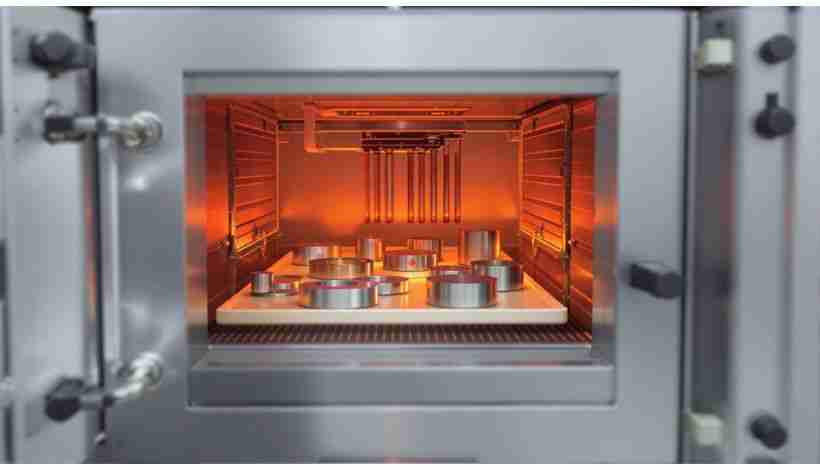
What occurs at the atomic level:
- 🔥Necking:Atoms migrate, bonding adjacent particles.
- 📉Densification:Pores shrink and close; part shrinks 15-20% linearly.
- 💪Solidification:Density reaches 95-99% of theoretical limits.
Conclusion:MIM is the system; Sintering is the engine that powers the final transformation.
What Sintering Is: The Thermal Process Beyond MIM
While sintering is non-negotiable for MIM, it's a fundamental materials science process used across multiple industries. It is the engine that drives the transition from powder to solid.
The Physical Definition
Sintering is a thermal treatment where powder particles bond into a solid mass throughatomic diffusion, without melting the bulk material. The driving force is the reduction of surface energy.
How Sintering Works: The Physics
Temperature provides the activation energy. Atoms migrate through four specific mechanisms:
1. Surface Diffusion
Atoms move along particle surfaces.
2. Volume Diffusion
Atoms migrate through particle interiors.
3. Grain Boundary
Atoms travel along grain boundaries.
4. Viscous Flow
Material transport through molten phase (Liquid Phase).
Video: Understanding the critical sintering stage in MIM.
Critical Process Parameters
🌡️ Temperature (Critical)
High enough for diffusion, low enough to avoid melting. MIM sinters hotter than PM, yielding higher density (96%+).
⏱️ Time
Longer time = higher density, but risks grain growth (reducing toughness). It's a balance.
💨 Atmosphere
Protective (H₂, N₂, Vacuum) to prevent oxidation. Hydrogen actively cleans surface oxides.
Many MIM parts use a low-melting constituent that liquefies during sintering. Capillary forces pull particles together, dramatically accelerating densification. This is the secret sauce for MIM's >95% density.
Where Sintering Exists Outside MIM
"Sintered parts" is an ambiguous term. Here is how MIM compares to other sintering technologies:
| Process | Powder Size | Sintering Temp | Final Density | Geometry |
|---|---|---|---|---|
| MIM | 2-20 μm (Fine) | High (1350°C+) | 95 - 99% | Very High |
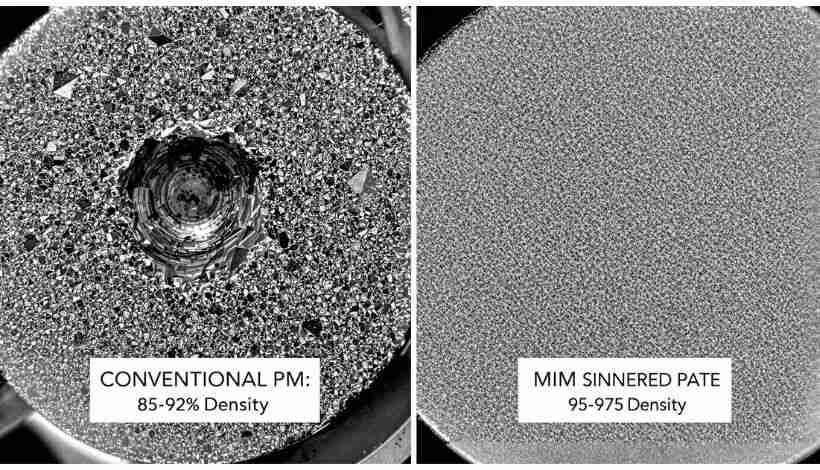
| Traditional PM | 50-100 μm (Coarse) | Medium (1150°C) | 85 - 92% | Limited (2D) |
| Ceramics | 0.5-10 μm | Very High (1600°C+) | 95 - 99% | High |
When to Use Which Term: Communication Guidelines
Precision prevents costly misunderstandings. Use this guide for technical discussions.
🗣️ Say "MIM" when discussing:
- The completemanufacturing process(Powder to Part).
- Technology evaluations ("Should we use MIM?").
- Supplier capabilities.
- Cost analysis vs Machining.
🔥 Say "Sintering" when discussing:
- The specificthermal treatment stage.
- Furnace specs (Atmosphere, Temp).
- Root cause analysis ("Insufficient sintering time").
Be Specific in Documentation
❌ Ambiguous (Bad)
"Parts will be sintered per supplier standard."
"Compare MIM vs sintering economics."
✅ Clear (Good)
"Parts manufactured viaMIM processwith sintering at 1375±25°C."
"Compare MIM vsConventional PMeconomics."
The Three-Tier Relationship Model
To cement your understanding, consider this hierarchical framework:
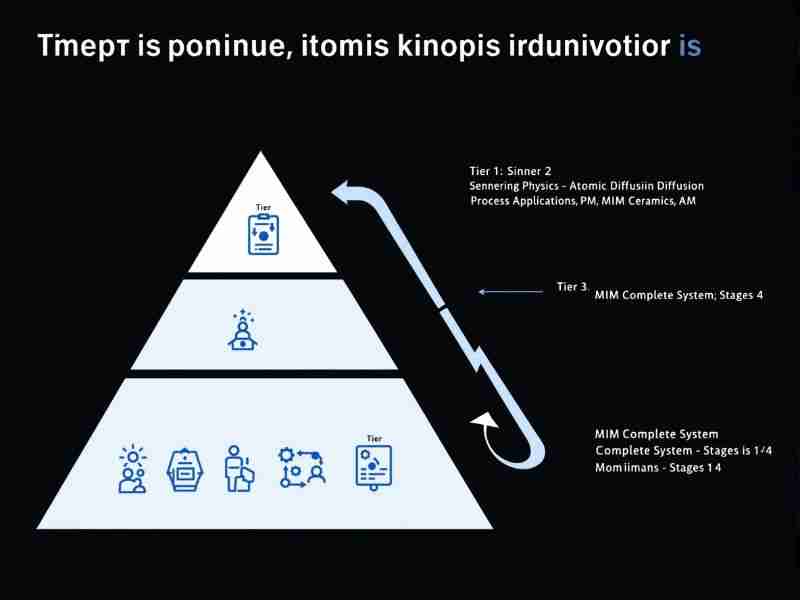
Level 3: MIM as Complete System (The Application)
- Integrates sintering as Stage 4.
- Sintering parameters tuned specifically for injection-molded green parts.
- Complete IP:Feedstock + Molding + Debinding + Sintering.
Level 2: Sintering as Manufacturing Step (The Process)
- Used in: Conventional PM, MIM, Ceramics, AM.
- Same physics, different implementations per industry.
Level 1: Sintering as Fundamental Physics (The Base)
- Atomic diffusion-driven consolidation.
- Independent of how powder was shaped.
Common Questions That Reveal Confusion
Why Understanding This Matters to Your Engineering Practice
Precise terminology improves your effectiveness in four critical areas:
1. Specification Clarity
Don't say:"Sintered density ≥96%." (Ambiguous)
Do say:"Manufactured viaMIM processwith final sintered density ≥96% per ASTM B962."
2. Supplier Evaluation
If a supplier claims "sintering capabilities," probe deeper:
- What powder shaping method? (Press vs Injection)
- What atmosphere controls? (H₂, N₂, Vacuum)
3. Cost Accuracy
Do not separate "sintering costs" from "MIM costs."
MIM cost models must include Tooling + Powder + Molding + Debinding + Sintering as one integrated flow.
4. Failure Analysis
Precise root cause analysis requires knowing if the defect originated in molding (Stage 2) or sintering (Stage 4).
Frequently Asked Questions
Q: What exactly is the difference between MIM and sintering?
MIM is the Whole; Sintering is a Part. MIM is the complete 4-stage process (Mix → Mold → Debind → Sinter). Sintering is specifically Stage 4. You cannot have MIM without sintering, but sintering exists independently in other industries.
Q: Can you do sintering without MIM?
Yes. Sintering is a standalone thermal process used in Conventional PM (Press & Sinter), Ceramics, and Additive Manufacturing (SLS/DMLS).
Q: Why does MIM achieve higher density than Conventional PM?
Although both use sintering, MIM optimizes the physics inputs. For Powder Size, Conventional PM uses 50-100 μm (Low Energy) resulting in 85-92% density, whereas MIM uses fine powders of 2-20 μm (High Surface Energy) resulting in a much higher 95-99% density.
Q: If sintering is so critical, why isn't MIM just called "sintering"?
Because sintering is only one of four essential stages. Naming MIM "sintering" would be like calling swimming "breathing." Without feedstock prep, injection, and debinding, sintering cannot occur.
Q: How should I ask for quotes when procuring these parts?
Don't ask for "Sintered Parts" as suppliers might quote cheap conventional PM (low density) or get confused. Instead, explicitly ask for "MIM Parts" and specify the material, density (>96%), and annual volume. This ensures you get the right high-performance process.
Q: Can I just "switch to sintering" to reduce costs?
This reveals a conceptual error. You switch to a process, not a thermal step. Your choices are to switch to MIM (for complex geometry and high volume >10k), switch to Conventional PM (for simple geometry and very high volume), or stay with Machining (for low volume or extreme tolerances).
Conclusion: The Nested Relationship
The "MIM vs Sintering" framework is fundamentally flawed. Use this nested model to understand the reality:
Sintering is a Phenomenon.Powder particles bonding via atomic diffusion.
Sintering is a Process Step.Used in PM, Ceramics, and MIM.
MIM is the System.It leverages sintering as Stage 4 to deliver final properties.
💬 The Correct Framing
"Sintering isn't versus MIM—it's the thermal stagewithinMIM that transforms powder into solid metal. The real question is whether MIM as a complete process fits our application requirements."
Technical Note:This article focuses on the MIM-sintering relationship. For comparisons of MIM vs CNC or Die Casting, please refer to our specific process comparison guides.
Precision MIM Parts from Emitech
Nanjing Emitech delivers metal injection molding from tooling through sintering and finishing. MIM services · MIM cost guide · Request a quote · Email mim@mikeshoppingroom.com · WhatsApp +86 138 1403 4409
Last updated: 2026-06-27