
5 Stages of Sintering Explained Guide
Definition:Sintering bonds powder particles into solid parts by heating them to50-90% of their melting point. This thermal energy triggers atomic diffusion without liquefaction, transforming loose powder into functional components in 2-12 hours. As detailed in German'sSintering Theory and Practice(Wiley, 1996), the driving force is the reduction of surface energy—a thermodynamic imperative that governs all powder consolidation processes.
💡 Quick Answer: The 5 Stages of Sintering
The Core Mechanism:Powder → Pressed → Heated (Sub-melting) → Atomic Diffusion → Solid Bond.
Sequential Breakdown:
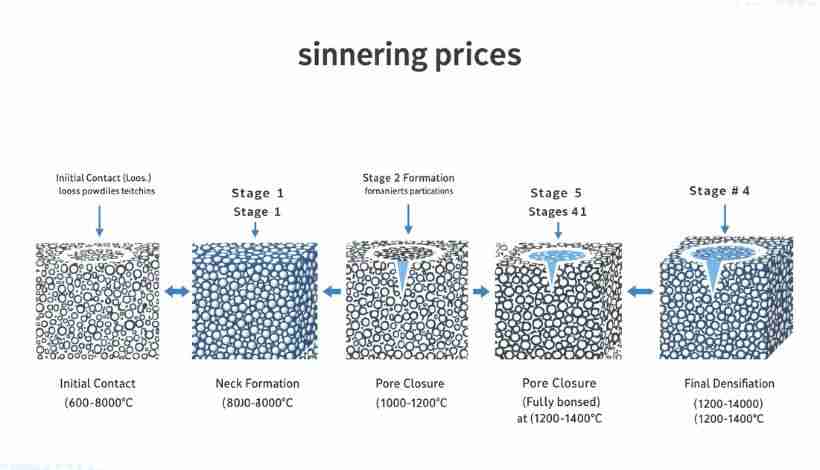
- 1. Compaction:Press at 100-1500 MPa → "Green body" (60-80% density).
- 2. Presintering:Heat to 0.5-0.6 Tm → Necks form, minimal shrinkage (2-3%).
- 3. Intermediate Sintering:Heat to 0.6-0.8 Tm → Rapid densification (up to 90%).
- 4. Final Sintering:Heat to 0.8-0.9 Tm → Max density (>95%), grain growth.
- 5. Cooling:Controlled rate → Prevents thermal shock/cracking.
Key Process Parameters
Google loves structured data. Here are the critical numbers for process control:
| Parameter | Typical Range | Impact |
|---|---|---|
| Temperature | 0.5 - 0.9 × Tm (Melting Point) | Driving force for diffusion |
| Time at Peak | 20-60 mins (Metals) 60-240 mins (Ceramics) | Determines density & grain size |
| Shrinkage | 3 - 15% (Linear) | Requires mold compensation |
| Final Density | 92 - 99% | Determines mechanical strength |
Understanding Sintering: The Physics
Sintering is driven by one thermodynamic law:Surface Energy Minimization.
The Driving Force:
Loose powder has enormous surface area (high energy). The system naturally seeks to reduce this energy by replacing solid-vapor interfaces with solid-solid grain boundaries.
Smaller particles = Higher curvature = Stronger driving force for bonding.
Critical Concept: Sub-Solidus Processing
Sintering occursbelowthe melting point. This allows:
- Processing of Tungsten (Tm 3,422°C)
- Creation of porous filters
- Preservation of material purity
How Atomic Diffusion Works
At high heat, atoms migrate from convex surfaces to concave "necks" between particles. This happens via three pathways:
- Surface Diffusion:Atoms move along the particle skin (low densification).
- Grain Boundary Diffusion:Atoms move between crystals (medium densification).
- Volume Diffusion:Atoms move through the lattice (high densification).
Video: Visualizing particle bonding and neck growth.
The Five Stages of Sintering: Detailed Mechanisms
A deep dive into the atomic and microstructural evolution at each step.
Stage 1: Compaction (The Green Body)
The process begins with mechanical consolidation. Powder is loaded into a die and pressed at100 - 1,500 MPa.
The Result:A "Green Body" with 60-80% density. Particles are held together by friction and interlocking, not atomic bonds. It is fragile but handleable.
⚠️ Critical Rule:
Green density determines final density. You cannot fix poor compaction during sintering.
Stage 2: Presintering (Neck Formation)
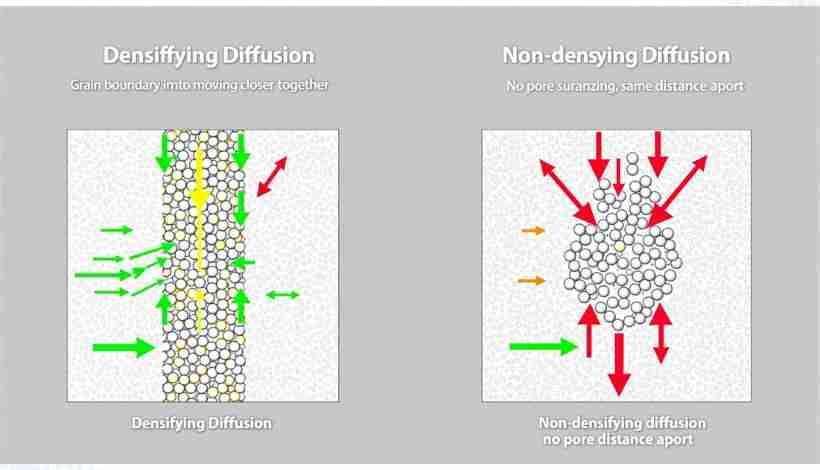
Mechanism: Non-Densifying Diffusion
Atoms migrate to the contact points ("necks") to lower surface energy. Crucially, particle centers donotmove closer together yet.
| Mechanism | Path | Result |
|---|---|---|
| Surface Diffusion | Along particle skin | Neck growth, No shrinkage |
| Vapor Transport | Evaporation / Condensation | Neck growth, No shrinkage |
Stage 3: Intermediate Sintering (Densification)
🚀 Maximum Densification Rate
Temp:0.6 - 0.8 TmShrinkage:5-8% (Linear)Density:Jumps from 75% → 90%
The Shift:Grain Boundary Diffusiondominates. Atoms move from grain boundaries to pores, causing particle centers to approach each other. This is true densification.
- Pore Channels:Narrow into cylinders.
- Grain Boundaries:Become well-defined.
- Competition:Densification vs. Coarsening (Grain growth).
Stage 4: Final Sintering (Pore Closure)
Temp:0.8 - 0.9 Tm |State:Closed Porosity
🛑 The Challenge: Trapped Gas
Pores isolate and close off. Any trapped gas exerts internal pressure, fighting densification.
⚠️ The Risk: Grain Growth
Grain boundaries migrate rapidly. If they move faster than pores, pores get trappedinsidegrains, becoming nearly impossible to remove.
Stage 5: Cooling (Locking It In)
Controlled cooling is an active process step, not just "turning off the oven." It manages thermal stress and phase transformations.
| Material | Cooling Rate | Reason |
|---|---|---|
| Steels | 100-300°C/hr | Control phase transformation (Ferrite vs Martensite). |
| Ceramics | 50-150°C/hr (Slow) | Prevent thermal shock cracking. |
| Copper | 200-500°C/hr (Fast) | High conductivity reduces thermal gradients. |
Atomic-Level Mechanisms: Understanding the Driving Forces
To fully understand sintering, we must look at the atomic-scale processes. Why do atoms move? And why does that movement cause shrinkage?
1. Chemical Potential: The Fundamental Driver
Atoms naturally migrate from high-energy areas to low-energy areas. In sintering, this is driven bySurface Curvature.
🧮 The Physics Formula:
- Convex Surface (High κ):High Chemical Potential (Source of atoms)
- Concave Neck (Low κ):Low Chemical Potential (Sink for atoms)
Result: Atoms flow from the particle surface (Convex) to the neck (Concave).
2. The Six Diffusion Pathways
There are six ways an atom can move. Crucially,only three of them cause densification.
| # | Mechanism | Source → Sink | Result |
|---|---|---|---|
| 1 | Surface Diffusion | Surface → Neck | Neck Growth Only |
| 2 | Volume Diffusion | Surface → Neck | Neck Growth Only |
| 3 | Vapor Transport | Surface → Neck | Neck Growth Only |
| 4 | Grain Boundary Diffusion | Boundary → Neck | Densification (Shrinkage) |
| 5 | Volume Diffusion | Boundary → Pore | Densification (Shrinkage) |
| 6 | Plastic Flow | Dislocation Motion | Densification (Shrinkage) |
Densifying vs. Non-Densifying: The Critical Distinction
🚫 Non-Densifying (Mechanisms 1-3)
Like moving sand from the top of a dune to the valley. The shape changes (smooths out), but thedistance between centersstays the same.
- Neck grows.
- No shrinkage.
- No density increase.
✅ Densifying (Mechanisms 4-6)
Like removing bricks from the wall between two rooms. Material moves from the interior contact point, causing thecenters to pull together.
- Neck grows.
- Macroscopic shrinkage occurs.
- Density increases.
3. Vacancy Diffusion: The Underlying Mechanism
Atoms move in one direction; vacancies (empty spots) must move in the other. This flow explains why grain boundaries are essential.
Atoms migrate from the Grain Boundary → to the Pore Surface.
This creates excessVacanciesat the Grain Boundary.
The Grain Boundary acts as a "Sink," annihilating the vacancies.
The Grain Boundary moves, pulling particles together (Shrinkage).
D ∝ exp(-Q/RT)
Low Temp = Surface Diffusion (Necks). High Temp = Grain Boundary Diffusion (Shrinkage).
Critical Process Parameters: Temperature & Atmosphere
Two levers control the outcome:Temperature(Diffusion Kinetics) andAtmosphere(Surface Chemistry).
1. Temperature: The Master Variable
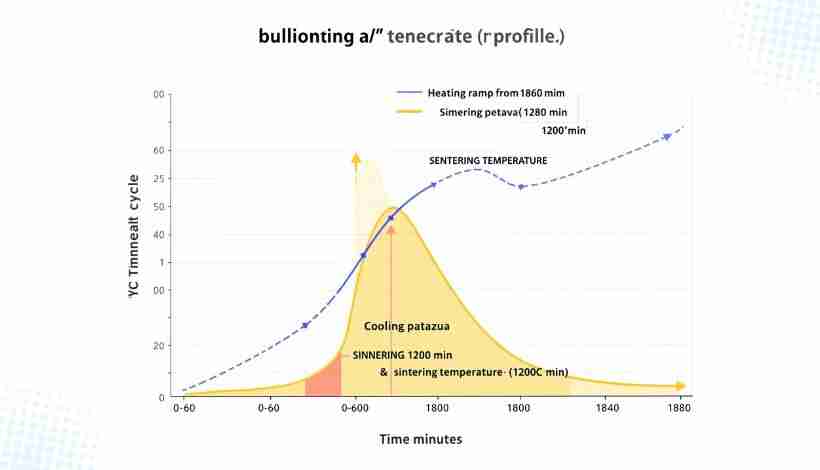
Temperature governs diffusion speed. A small 50°C change candoublediffusion rates.
📈 The Arrhenius Relationship:
Heating Rate
5-10°C/min. Too fast = Thermal shock & cracking.
Dwell Time
20-60 mins. Essential for atomic diffusion across particle boundaries.
Uniformity
Must be ±5-10°C. Variations cause warping.
2. Atmosphere: Surface Chemistry Control
It does more than prevent oxidation; it actively cleans surfaces and controls carbon.
Function A: Oxide Reduction
Removes oxide layers that block diffusion.
Function B: Carbon Control
Maintains steel hardness (prevents decarburization).
| Atmosphere | Characteristics | Best For |
|---|---|---|
| Hydrogen (H₂) | Highly Reducing, Clean | Stainless Steel, Refractory Metals |
| Dissociated Ammonia | Cost-effective (75% H₂, 25% N₂) | Ferrous Materials |
| Nitrogen (N₂) | Neutral / Mild Reducing | General Purpose |
| Vacuum | Removes volatile impurities | Titanium, Reactive Metals |
Understanding Defects: Troubleshooting Guide
Recognize the symptoms to adjust process parameters.
📉 Incomplete Densification
Observation: Low density, excessive porosity.
- Temp too low or time too short.
- Trapped gas in closed pores.
- Particle agglomerates blocking diffusion.
〰️ Warping / Distortion
Observation: Shape deviates from die.
- Non-uniform green density.
- Uneven furnace temperature.
- Gravity sagging (lack of support).
⚡ Cracking
Observation: Surface or internal fissures.
- Heating/Cooling too fast (Thermal shock).
- Rapid binder removal (Gas pressure).
- Phase transformation stress.
🔬 Excessive Grain Growth
Observation: Large grains, reduced toughness.
- Temp too high or time too long.
- High purity (Lack of grain inhibitors).
Frequently Asked Questions
Q: What temperature should I use for sintering?
As a rule of thumb, use 0.7 - 0.8 Tm (Absolute Melting Point in Kelvin). Recommended starting temperatures are 1100 - 1250°C for Iron (Tm 1811 K), 700 - 900°C for Copper (Tm 1358 K), 1400 - 1600°C for Alumina (Tm 2327 K), and 1400 - 1500°C for WC-Co (Liquid Phase). The trade-off is that high temperatures result in faster densification but larger grains, while lower temperatures result in a slower process but finer grains for better strength.
Q: How long does sintering take?
A total cycle takes 2 - 12 hours in a batch furnace. The cycle consists of three distinct phases: 1. Heating takes 2-4 hours at a rate of 5-10°C/min. 2. Peak Dwell takes 20-60 minutes for metals, though ceramics take longer. 3. Cooling takes 2-6 hours at a controlled rate.
Q: Why doesn't the material melt?
Sintering is defined by sub-solidus operation (0.5 - 0.9 Tm). It relies on atomic diffusion, not liquefaction. It works without melting due to thermodynamics (surface energy reduction provides the driving force) and kinetics (small diffusion distances in the micrometers make solid-state transport feasible).
Q: How do I control final porosity?
Adjust these four levers based on your goal (structural vs porous): 1. Powder Size (<20µm for high density, >50µm for porous parts). 2. Compaction Pressure (target >400 MPa green density for structural strength). 3. Temp & Time (limit these parameters to preserve open pores, e.g., for self-lubricating bearings). 4. Atmosphere (Vacuum/H₂ helps close pores, while inert gas tends to trap them).
Q: What's the difference between Stages 2, 3, and 4?
This is the most critical distinction in process control, with maximum densification happening in Stage 3. Stage 2 (Presintering, 0.5-0.6 Tm) is driven by non-densifying surface diffusion, with minimal shrinkage (2-3%) and a density change from 70% to 75%. Stage 3 (Intermediate, 0.6-0.8 Tm) is driven by densifying grain boundary diffusion, exhibiting the maximum shrinkage rate (5-8%) and a density change from 75% to 90%. Stage 4 (Final, 0.8-0.9 Tm) is driven by volume diffusion, with slowing shrinkage (3-5%) and a density change from 90% to 95-99%.
Conclusion: Mastering the Process
Summary: The 5-Step Transformation
- Compaction:Sets the density ceiling.
- Presintering:Builds necks via surface diffusion (No shrinkage).
- Intermediate:Rapid densification via grain boundary diffusion.
- Final:Eliminates residual pores (Risk: Grain growth).
- Cooling:Locks in microstructure.
Key Takeaway:Success lies in balancing competing forces:Densification vs. Grain Growth. UseTemperatureto drive kinetics andAtmosphereto manage surface chemistry.
Precision Metal Parts from Emitech
Nanjing Emitech delivers MIM, CNC machining, and custom metal parts. MIM services · Request a quote
References
- German, R.M., Sintering Theory and Practice, John Wiley & Sons, 1996.
- Kang, S.-J.L., Sintering: Densification, Grain Growth, and Microstructure, Elsevier, 2005.
- Ashby, M.F., "A first report on sintering diagrams," Acta Metallurgica, Vol. 22, No. 3, pp. 275–289, 1974.
Last updated: 2026-08-01
Continue reading
- How P.A.N.A.C.E.A. Stainless Steel Performs in MIM Sintering: An In-Depth Technical Analysis
- Can You Polish MIM Parts? The Complete Technical Guide to Surface Finishing Metal Injection Molded Components
- The Complete Guide to Porous Ceramic Filters: Types, Applications, and Performance Comparison
- The Ultimate Guide to Powder Forging: Everything You Need to Know