
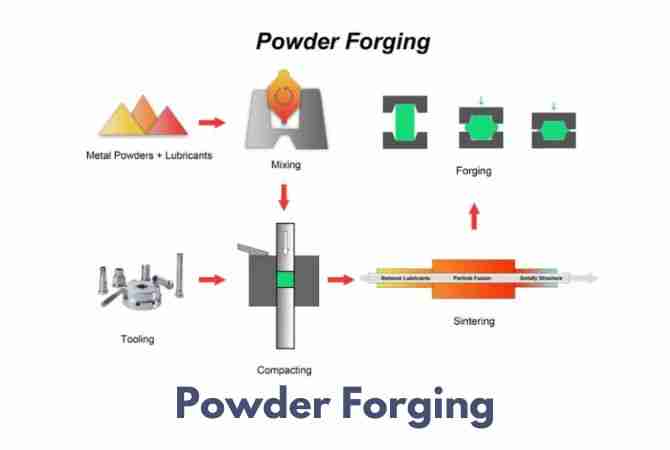
Powder Forging Process
Powder forging combines powder metallurgy accuracy with forging strength. The process compacts metal powders into shapes, sinters them to create metallurgical bonds, then forges thepartsunder high pressure to reach nearly full density. This delivers complex components with minimal waste and exceptional mechanical properties.
Unlike traditional forging that starts with solidmetalbillets, powder forging begins with metal powders. Near-net shape capabilities minimize machining. Material utilization is typically higher than conventional forging, and dimensional accuracy is usually better, though exact results depend on part geometry, material, and process parameters. The process enhances mechanical properties through improved density andreduces production costsfor complex components.
Powder Forging Process Steps
Raw Material Selection
Successful powder forging requires selecting metal powders with high purity and low oxygen content to ensure optimal strength. Pre-alloyed powders typically outperform elemental powder mixes. Particle size, shape, and distribution affect compaction behavior and final part properties.
Powder Mixing
Uniform mixing continues until the blend is homogeneous. Lubricants reduce friction during compaction. Binders enhance green strength of compacted parts. Additives may controlsinteringbehavior and final microstructure.
Compaction
During compaction, metal powders are pressed into cohesive shapes to a controlled green density that balances forgeability and green strength. Lower density risks cracking during forging, while higher density can increase die wear and reduce final densification. Pressures are selected based on material composition and part geometry.
Sintering
Sintering occurs at a controlled temperature below the metal's melting point. Controlled atmosphere prevents oxidation. Diffusion mechanisms establish bonds between particles and initial porosity reduction occurs during this stage.
Forging
The final forging operation increases density toward theoretical density. Remaining porosity is eliminated or significantly reduced. Mechanical properties are substantially improved compared to sintered-only parts. Near-net shape is achieved with minimal flash or waste.
Powder Forging Methods
Cold Powder Forging
Cold forging occurs at room temperature with preforms at a controlled green density. This method provides a fine surface finish, excellent dimensional control, no oxidation issues, and lower energy requirements. Cold forging suits small to medium components, parts requiring precise tolerances, and components where surface finish is critical.
Hot Powder Forging
Hot forging uses elevated temperatures to enhance material flow. Two main approaches exist for hot powder forging.
Direct powder forgingheats compacted powder and directly forges it without intermediate sintering. This approach can reduce energy consumption and is not limited by sintering furnace capacity.Pre-sinter and forge methodheats sintered parts to an elevated temperature in a controlled atmosphere to prevent contamination. This approach provides better metallurgical bonding, superior mechanical properties, and more uniform microstructure compared to direct forging.
Powder Forging vs. Conventional Forging
Powder forging generally offers better dimensional control and material utilization than conventional forging because it starts from a near-net-shape preform. Conventional forging can achieve excellent properties but usually requires more machining and produces more flash. The best choice depends on production volume, part size, mechanical requirements, and cost targets.
Powder Forging Applications
Automotive Components
Connecting rodsare a common powder forged automotive component. The process can reduce weight and reciprocating mass, improve fatigue strength, and lower material waste in high-volume production compared with conventional forged rods.
Cam lobes and camshaftscan benefit from reduced machining requirements, improved wear resistance, and more precise geometry, contributing to better engine efficiency.
Synchronizer gear ringscan be produced cost-effectively compared with traditional copper-based alternatives, while maintaining good performance characteristics and dimensional stability.
Aerospace and Industrial Applications
Aerospace components include critical structural components requiring high strength-to-weight ratios, landing gear components with exceptional fatigue resistance, and turbineengine partswith complex geometries.
Industrial machinery applications use gears with enhanced tooth profiles and wear resistance, cutting tool inserts with superior edge retention, and high-stress bearings with improved wear resistance.
Factors Affecting Powder Forging Quality
Temperature Effects
Forging pressure and temperature for iron-based parts significantly influence densification. Higher forging temperatures generally increase density up to a point, after which gains diminish. Optimal temperature varies by material composition, and uniform heating is essential for consistent properties.
Material Selection
Carbon content strongly influences mechanical properties. Increasing carbon content generally raises tensile strength and hardness but may reduce ductility. Typical carbon content for structural components is selected based on strength and ductility requirements.
Additional alloying elements provide specific benefits.Nickelcan enhance toughness and hardenability.Molybdenumcan improve strength and wear resistance.Coppercan enhance sintering response and corrosion resistance.
Frequently Asked Questions
Q: What size and complexity limitations exist for powder forged parts?
Powder forged components are commonly small to medium in size, with maximum dimensions depending on press capacity and part geometry. Complex geometries with undercuts are challenging but achievable with advanced die design and secondary operations. Part complexity is primarily limited by the ability to eject the green compact from the die without damage.
Q: How does powder forging compare to metal injection molding?
Powder forging typically produces larger components with superior mechanical properties compared to MIM. While MIM excels at small complex parts, powder forging delivers better strength, density, and cost-effectiveness for medium to large components. Powder forging generally achieves higher density than MIM, resulting in mechanical properties closer to wrought materials.
Q: What materials are suitable for powder forging?
Common materials include low and medium carbon steels,low-alloy steels, tool steels, stainless steels, selected aluminum alloys, and copper-based alloys. Exotic materials like titanium and nickel-based superalloys are possible but require specialized equipment and expertise. Iron-based alloys are widely used in powder forging because they combine performance and cost-effectiveness.
Q: What are typical cost savings compared to traditional manufacturing?
Cost savings vary widely by component complexity and production volume. High-volume, near-net-shape parts often see the greatest benefit from reduced material waste, lower energy consumption, and minimal secondary machining. Break-even volume must be evaluated for each part based on tooling investment and annual quantity.
Q: How can I determine if powder forging suits my application?
Consider powder forging when the component requires high strength and precision, production volumes are high enough to amortize tooling investment, material utilization is a significant cost factor, complex geometry would require extensive machining, or weight reduction provides functional benefits. Tooling investment depends on part complexity and must be weighed against annual production volume.
Q: What quality control methods apply to powder forged parts?
Standard quality control includes density measurement through the Archimedes method, dimensional inspection using CMM equipment against drawing tolerances, surface finish measurement, mechanical testing including tensile strength and fatigue properties, and metallographic examination for microstructure uniformity. Non-destructive testing such as ultrasonic inspection detects internal defects in critical applications.
Q: What are environmental benefits of powder forging?
Powder forging can reduce material waste through near-net-shape manufacturing, and lower processing temperatures and reduced machining can decrease energy consumption. Recycled powder utilization in some applications further reduces raw materialrequirements. The overall environmental benefit depends on part design, material, and production volume.
Q: What future developments are expected in powder forging?
Advanced alloy development focuses on hybrid compositions and nanopowder-enhanced materials. Smart manufacturing integration includes real-time monitoring systems, predictive maintenance, and digital twin simulation to optimize process parameters. Automated inspection helps ensure qualityverification, while cleaner production technologies can reduce emissions.
Powder Metallurgy & MIM from Emitech
From compaction and sintering to finishing, Emitech produces complex PM and MIM parts in high volumes. Custom MIM parts · Get a quote
Last updated: 2026-06-24