
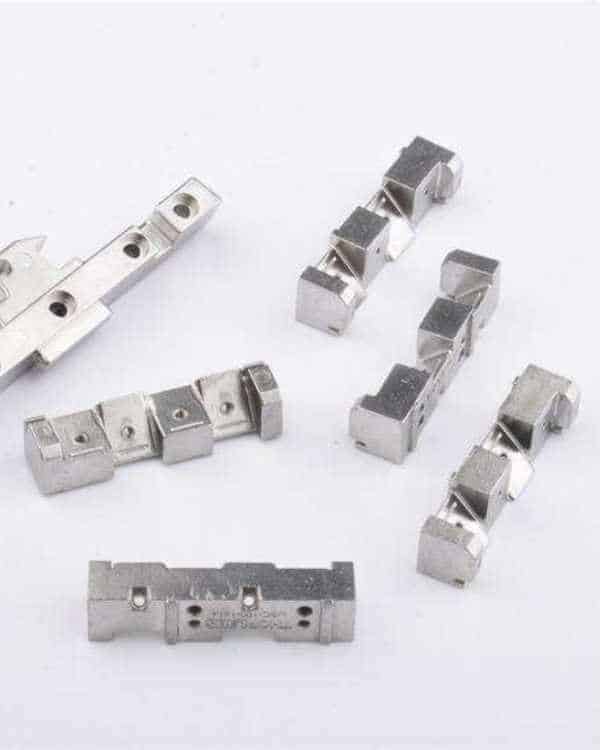
Metal Injection Molding (MIM) and forging are two fundamentally different manufacturing processes, each optimized for distinct applications. MIM produces complex, high-precision small parts in large quantities at low per-unit cost. Forging delivers superior strength and grain structure integrity for high-stress, large-component applications. Understanding when each process excels — and where it falls short — is the critical decision that determines part performance, cost, and production efficiency.
What is MIM?
Metal Injection Molding (MIM) is a manufacturing process that combines plastic injection molding and powder metallurgy to produce complex, high-precision metal parts in large quantities. This process is particularly effective for making intricate shapes that would be difficult or costly to produce with traditional metalworking methods.
How does MIM work?
1. Material Preparation
The process starts with a mixture of fine metal powders and thermoplastic binders. Metal powders are usually produced by gas atomization, creating spherical, low-friction particles ideal for injection molding. The metal powders are mixed with binders such as wax or polypropylene to form a uniform feedstock.
2. Injection Molding
A standard injection molding machine heats the feedstock until molten. High-pressure injection forms the shape in a precision mold. The molded part — the "green part" — is then cooled and ejected. Green parts are 15-20% larger than the final component to account for sintering shrinkage.
3. Debinding
The green parts undergo debinding to remove binder materials through one of three methods:
- Thermal Debinding:Heating the part to evaporate the binder.
- Catalytic Debinding:Gases dissolve the binder through a chemical reaction.
- Solvent Debinding:Dissolving the binder in a solvent.
4. Sintering
After debinding, the "brown parts" are sintered in a high-temperature furnace at temperatures approaching the metal's melting point. This fuses the particles, increasing density and strength while reducing porosity. Parts contract by 15-20% during sintering, which is precisely compensated in the mold design.
5. Post-Sintering Processes
For critical applications, post-sintering processes like Hot Isostatic Pressing (HIP) can increase density to 99.5% of theoretical and eliminate remaining voids or defects.
What are the advantages of MIM?
Pros
- ✔Complex Geometries:MIM produces parts with complex internal structures, thin walls down to 0.2mm, and undercuts that traditional metalworking cannot achieve.
- ✔High Precision and Tight Tolerances:As-sintered tolerance of ±0.3% of nominal dimension, with secondary operations achieving ±0.1%.
- ✔Cost-Effectiveness at Scale:MIM is cost-effective for high-volume production, reducing labor costs, material waste, and secondary assembly.
- ✔High Automation and Repeatability:Fully automatable process with high Cpk values in production, ensuring part-to-part consistency across high volumes.
- ✔Material Selection:Compatible with stainless steel (316L, 17-4PH, 420), titanium alloys, low-alloy steels, cobalt-chrome, and specialty alloys.
- ✔High Density and Strength:MIM achieves 96-99% of theoretical density, delivering mechanical properties comparable to wrought metal per MPIF Standard 35.
- ✔Design Flexibility:Holes, threads, textures, undercuts, and markings are formed in the mold without adding cycle time.
What are the disadvantages of MIM?
Cons
- ✖High Initial Tooling Costs:MIM molds and production equipment represent a significant capital investment. These fixed costs require high volumes to amortize.
- ✖Part Size Limitations:MIM is optimized for parts under 100g. Larger parts exceed the process's practical density and dimensional control limits.
- ✖Long Initial Lead Time:Tooling development, validation, and first article inspection typically require several weeks to months before production parts are available.
- ✖Not Suitable for Prototyping:High mold costs and long lead times make MIM uneconomical for prototype quantities below 1,000 units.
- ✖Design Change Costs:Post-tooling design changes requiring mold modification can cost thousands of dollars and add weeks to the schedule.
What materials does MIM use?
MIM is compatible with a broad range of metal alloys:
1. Stainless Steel
316L Stainless Steel:Excellent corrosion resistance, suitable for food processing, marine, and medical instrument applications.
420 Stainless Steel:Martensitic stainless steel with high strength, hardness up to 50 HRC after heat treatment, and moderate corrosion resistance. Used in surgical instruments and high-end cutlery.
17-4 PH Stainless Steel:Precipitation-hardening steel with yield strength up to 1,200 MPa (H900 condition). Used in aerospace components, medical devices, and ADAS brackets.
2. Low-Alloy Steel
4605 Steel:With gas carburizing achieves surface hardness of 60-62 HRC while maintaining a tough core. Standard specification for MIM gears, parking pawls, and seatbelt mechanisms.
4140 Steel:Heat-treatable high-strength steel used in automotive and industrial structural applications.
3. Titanium Alloys
Ti-6Al-4V (Grade 5):High strength-to-weight ratio, excellent corrosion resistance, and biocompatibility. Used in aerospace structural components, medical implants, and high-performance sports equipment.
4. Nickel Alloys
Nickel-based superalloys for high-temperature applications requiring strength above 900°C. Used in aerospace turbine components and energy industry applications.
5. Tungsten Alloys
Tungsten-copper alloys with densities up to 18 g/cm³ for radiation shielding, counterweights, and high-temperature aerospace components.
6. Copper Alloys
High thermal conductivity (180-350 W/m·K) and electrical conductivity make copper alloys suitable for electrical connectors, heat sinks, and electromagnetic components.
7. Cobalt-Chrome Alloys
Biocompatible and wear-resistant. Used in medical implants, dental prosthetics, and orthopedic components where both corrosion resistance and mechanical performance are required.
8. Hard Metals (WC-Co)
Tungsten carbide-cobalt cermets for cutting tools, wear-resistant components, and precision dies where surface hardness exceeding 70 HRC is required.
Is MIM better than forging?
Whether MIM is better than forging depends entirely on the application:
- For complex, high-precision parts under 100g at high volumes, MIM typically delivers lower per-part cost, better surface finish, and greater geometric freedom.
- For parts requiring maximum strength, toughness, and fatigue resistance — particularly medium-to-large components under high structural loads — forging's grain flow alignment produces properties that MIM cannot match.
Both processes have distinct strengths. The decision should be driven by design complexity, mechanical requirements, production volume, and total program cost.
MIM vs Forging: Key Comparison
| Aspect | MIM | Forging |
|---|---|---|
| Suitable Part Types | Small to medium complex parts (<100g) | Medium to large structural parts |
| Production Cost | High volume (>10k units): Low cost per part Low volume: High cost (tooling amortization) | High volume: Medium cost Low-medium volume: Competitive cost |
| Part Strength | 96-99% theoretical density; properties comparable to wrought | 100% density; superior grain flow alignment; highest fatigue resistance |
| Surface Finish | Ra 0.8-1.6 μm (as-sintered) | Ra 3.2-12.5 μm; typically requires secondary finishing |
| Manufacturing Speed | Fast for high volume (seconds per injection cycle) | Multi-step process; slower per-part throughput |
| Design Complexity | Very high — internal features, undercuts, thin walls to 0.2mm | Limited — axial geometries; severe undercuts require machining |
| Dimensional Tolerance | ±0.3% as-sintered (±0.1% with sizing) | ±0.5-1.0% typical; ±0.1-0.3% with precision die forging |
| Minimum Volume | High volumes | Lower volumes |
| Material Range | Wide — stainless steel, titanium, superalloys, carbides | Most forgeable metals — steels, aluminum, titanium, nickel alloys |
What is forging?
Forging is a manufacturing process that shapes metal using localized compressive forces applied through hammer strikes, press operations, or rolling. The process can be performed at different temperatures — cold, warm, or hot — depending on the material and required properties. Forging's defining advantage over other processes is grain flow: the metal's crystalline structure aligns with the part geometry during deformation, producing directional strength properties that casting, machining, or MIM cannot replicate.
How does forging work?
1. Design and Die Making
The forging process begins with designing and manufacturing dies to shape the metal. Die quality directly determines dimensional accuracy and surface finish of the forged part.
2. Cutting and Heating the Metal Billet
The metal billet is cut to the required weight and heated to the appropriate forging temperature. For steel, this is typically 1,100-1,250°C for hot forging. Heating improves malleability and reduces forging forces required.
3. Forging
The heated billet is placed between dies and subjected to compressive force. Open-die forging shapes simple forms; closed-die (impression die) forging produces near-net-shape complex geometries. Forces range from hundreds of tons for small parts to 50,000+ tons for large aerospace components.
4. Trimming
After forging, excess material (flash) is trimmed to achieve the final geometry. This step ensures dimensional compliance with drawing requirements.
5. Heat Treatment
Heat treatments including quenching, annealing, normalizing, or tempering optimize the mechanical properties of the forged component for its service requirements.
6. Finishing
Final surface operations — shot blasting, CNC machining of critical surfaces, or coating — bring the forged part to final dimensional and surface specifications.
What are the advantages of forging?
Pros
- ✔Superior Strength and Durability:Forging refines and aligns the metal's grain structure, producing parts that are stronger, tougher, and more fatigue-resistant than cast, machined, or MIM equivalents of the same alloy.
- ✔Grain Flow Alignment:Controlled grain flow follows the part contour, maximizing resistance to impact, shear, and fatigue loading in the direction of primary stress.
- ✔Full Density:Forged parts achieve 100% theoretical density with no residual porosity, inclusions, or internal voids that would initiate fatigue cracks.
- ✔Improved Material Properties:Forging breaks down coarse cast grain structure, replacing it with a finer, uniform equiaxed grain that improves mechanical properties in all directions.
- ✔Suitable for Large Parts:No practical upper limit on part size — large aerospace structural forgings exceed 10,000 kg. MIM is limited to parts under approximately 100g.
- ✔Lower Minimum Volume:Economical at modest volumes, making it viable for medium-volume programs where MIM tooling investment is not justified.
What are the disadvantages of forging?
Cons
- ✖High Initial Equipment Costs:Forging requires significant capital investment in presses, hammers, and dies. Production dies for complex parts represent a significant investment.
- ✖Limited Geometric Complexity:Metal flow limitations restrict achievable geometries. Severe undercuts, internal channels, and thin walls below 2mm typically require post-forging machining.
- ✖Energy and Time Consumption:Hot forging requires significant energy to heat billets to forging temperature and maintain die temperatures. Multi-step process adds production time.
- ✖Surface Finish Requires Secondary Operations:As-forged surfaces (Ra 3.2-12.5 μm) typically require machining or grinding to achieve functional surface finishes.
- ✖Safety and Environmental Requirements:High temperatures, heavy machinery, and die lubrication require dedicated safety systems and environmental controls.
- ✖Die Maintenance Costs:Forging dies wear under high cyclic compressive loads and require regular inspection, repair, or replacement.
What materials are used in forging?
1. Carbon Steel
High strength and toughness with hardness and strength determined by carbon content. Used in high-load, high-stress applications including structural components, springs, and blades.
2. Alloy Steel
Contains chromium, manganese, molybdenum, nickel, and other elements that enhance strength, toughness, and wear resistance beyond carbon steel. Used in automotive components, industrial tools, and machinery.
3. Stainless Steel
Iron alloy with minimum 10.5% chromium providing corrosion resistance, durability, and strength. Used in aerospace, automotive, food processing, and medical applications requiring combined corrosion and mechanical performance.
4. Microalloyed (HSLA) Steel
Contains vanadium, titanium, and niobium additions that improve strength-to-weight ratio and toughness without requiring post-forging heat treatment. Widely used in automotive crankshafts, connecting rods, and suspension components.
5. Aluminum
Lightweight with excellent corrosion resistance and high strength-to-weight ratio. Used in aerospace structures, automotive components, and consumer products where weight reduction is a primary driver.
6. Titanium
High strength-to-weight ratio, corrosion resistance, and biocompatibility. Used in aerospace structural parts, medical implants, and performance sports equipment.
7. Copper and Copper Alloys
High electrical and thermal conductivity with corrosion resistance. Used in electrical components, heat exchangers, and plumbing hardware.
8. Nickel Alloys
High-temperature strength and corrosion resistance for aerospace turbine components, chemical processing equipment, and energy industry applications above 900°C.
9. Tool Steel
Exceptional hardness and wear resistance. Used for manufacturing cutting tools, dies, and forming equipment that must maintain precision under high cyclic loads.
Quick Advantages and Disadvantages Comparison
| Process | Key Advantages | Key Disadvantages |
|---|---|---|
| MIM | • Complex geometries (walls to 0.2mm) • Tight tolerances (±0.3% as-sintered) • Cost-effective at high volumes • Smooth surface finish (Ra 0.8-1.6 μm) • High automation and consistency • Wide material selection including titanium | • High tooling cost • Limited to parts under ~100g • Longer initial lead time • Not suitable for prototyping • Design changes costly post-tooling |
| Forging | • Highest strength and fatigue resistance • Grain flow alignment for directional strength • 100% density, no porosity • No upper size limit • Viable from 500+ units/year • Proven for safety-critical applications | • High equipment and die costs • Limited geometric complexity • High energy consumption • Rough as-forged surface (requires finishing) • Multi-step production process • Die wear and maintenance costs |
Frequently Asked Questions
Q: Is forging cheaper than MIM?
For low-to-medium volume production of larger, simpler parts, forging is typically more economical because die costs are lower and minimum volumes are modest. MIM becomes more cost-effective at high volumes for small, complex parts — at that scale, MIM's lower per-part variable cost and elimination of secondary machining operations can outweigh the higher tooling investment.
Q: Is forging stronger than MIM?
Yes, forged parts are generally stronger than MIM parts of the same alloy. Forging achieves 100% theoretical density with aligned grain flow that maximizes fatigue strength and impact resistance. MIM achieves 96-99% density with isotropic properties — excellent for most applications, but below the fatigue life of equivalent forged parts. For safety-critical high-cycle fatigue applications such as aircraft structural components, forging is the required process.
Q: Which is faster — MIM or forging?
MIM is faster for mass-producing small complex parts. Injection molding cycles take 15-60 seconds, and the process is fully automated with minimal secondary operations. Forging involves multiple steps — heating, forming, trimming, heat treatment, and surface finishing — making it slower per part. For 10,000 identical small parts, MIM completes production in 3-8 weeks versus 8-16 weeks for forging.
Q: Which has the smoothest surface — MIM or forging?
MIM produces significantly smoother surfaces. As-sintered MIM achieves Ra 0.8-1.6 μm, often requiring no additional surface finishing for functional applications. As-forged surfaces are Ra 3.2-12.5 μm and typically require machining or grinding to achieve acceptable surface quality for mating or bearing surfaces.
Q: Which is more cost-effective — MIM or forging?
It depends on volume and part complexity. MIM is more cost-effective for high-volume production of small, complex parts where its automation and near-net-shape capability eliminate expensive secondary operations. Forging is more cost-effective for medium-volume programs, large parts, and applications where maximum mechanical properties reduce the need for structural safety factors.
Q: Which produces the strongest parts — MIM or forging?
Forging produces structurally stronger parts due to grain flow alignment and 100% density. MIM produces parts with properties comparable to wrought metal (96-99% density per MPIF Standard 35), which is sufficient for the vast majority of industrial, automotive, and medical applications. The distinction matters most in high-cycle fatigue, impact, and safety-critical load cases where forging's directional grain structure provides a measurable advantage.
Q: Are forged parts always stronger than MIM parts?
A: No — 'always' fails here. Forging wins on fiber flow and full density for highly stressed parts, but strength depends on alloy, heat-treatment condition and geometry. A well-sintered MIM part in a hardened 17-4 PH condition can outperform a poorly specified forging; each case needs the actual load path, not a process label.
Q: When is MIM better than forging?
A: When the part is small, geometrically complex, and needed at volume: forging dies for intricate 3D features cost heavily and still leave machining stock, while MIM molds the complexity directly and holds it repeatably. Below roughly the 100 g class and above volume thresholds, MIM economics usually win.
Q: Can MIM parts handle shear loads?
A: Shear-critical features deserve caution. Load-bearing sections under direct shear are where MIM's residual porosity matters most, so the honest engineering answer is to redesign the feature, add local densification, or finish-machine the shear path rather than trust an as-sintered section. General suitability limits are covered in advantages and disadvantages.
Conclusion
Choosing between MIM and forging is a decision driven by part size, production volume, mechanical requirements, and design complexity. MIM is the optimal choice for high-volume production of complex small parts under 100g where dimensional precision, surface finish, and material efficiency are priorities. Forging is the optimal choice when structural integrity, maximum fatigue life, and grain-flow strength are non-negotiable — particularly for large structural components and safety-critical applications.
For programs at the boundary — moderate volumes, medium complexity, moderate strength requirements — evaluate total program cost including tooling amortization, secondary operations, and qualification costs, not just per-part material cost. If you are evaluating MIM for your application, contact us to discuss material options, tooling investment, and production economics for your specific part geometry and volume requirements.
Precision Metal Parts from Emitech
Nanjing Emitech delivers MIM, CNC machining, and custom metal parts. MIM services · Request a quote
Last updated: 2026-06-24
Continue reading
- Types of Sintering Processes: From Solid-State to Spark Plasma (SPS)
- Understanding Internal Gears: A Comprehensive Guide to Their Design and Function
- Small Gear Materials Selection: Complete Guide to Steel, Aluminum & Advanced Composites
- What Are MIM Parts? A Complete Technical Guide to Metal Injection Molding