
Mixing and kneading in Metal Injection Molding combines metal powder (60% by volume) with multi-component binders (40%) to create homogeneous feedstock. Poor mixing causes many MIM defects including shrinkage variation, porosity, and weak mechanical properties. This guide shows you how to optimize your mixing process for consistent, high-quality feedstock.
Understanding What You're Mixing
Deficiencies in feedstock homogeneity cannot be corrected after mixing. Your mixing process must uniformly distribute metal particles throughout the binder matrix and ensure complete wetting of every particle surface.
Raw Material Specifications That Affect Mixing
Metal Powder Requirements:
Your powder characteristics directly impact mixing difficulty and final feedstock quality.
| Property | Specification | Impact on Mixing |
|---|---|---|
| Particle Size (D₅₀) | 5-25 µm | Finer = higher viscosity, harder to mix |
| Morphology | Spherical preferred | Spherical reduces viscosity 30-40%, easier mixing |
| Purity (O₂ content) | < 0.3 wt% | High oxygen may require inert atmosphere mixing |
| Particle Size Distribution | Broad (slope n < 3) | Broader distribution improves packing, easier mixing |
Spherical vs. Irregular Particles:
- Spherical: 30-40% lower viscosity at same loading, better flow in mixer
- Irregular: Interlock and increase friction, require higher shear for dispersion
For reactive metals (Ti, Al):Use inert atmosphere or vacuum mixing to prevent oxidation during heated mixing.
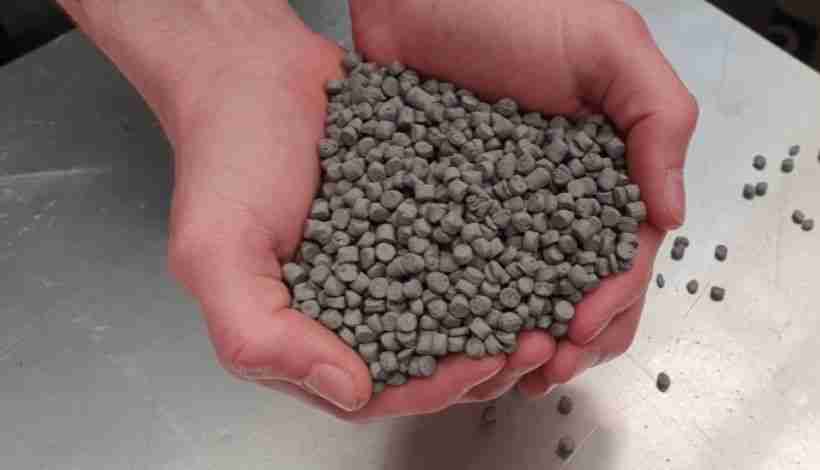
Binder System Composition:
Modern MIM binders are three-component systems optimized for mixing and processing:
| Component | Typical Materials | Proportion | Function in Mixing |
|---|---|---|---|
| Primary Binder | Paraffin wax, PEG, Carnauba wax | 40-60% of binder | Reduces viscosity, enables flow |
| Backbone Polymer | PP, PE, PMMA, POM | 30-50% of binder | Provides mechanical strength |
| Surfactant | Stearic acid, Oleic acid | 1-3% of binder | Critical: improves wetting, reduces viscosity 40-60% |
Surfactants are non-optional.They act as wetting agents between hydrophilic powder and hydrophobic polymer, reducing interfacial tension and enabling uniform coating. Without surfactants, you'll experience poor wetting, agglomeration, and high viscosity.
For multi-polymer binders:Add compatibilizers (EVA: 5-10%) to prevent phase separation during mixing and storage.
Determining Optimal Powder Loading
Powder loading (volume % of metal) is your most critical mixing parameter. Typical range: 60-65 vol%.
The Trade-off:
- Higher loading (63-65%): Lower shrinkage, faster debinding, but exponentially higher viscosity
- Lower loading (58-60%): Easy mixing, but excessive shrinkage and longer processing
Finding Your Critical Powder Volume Concentration (CPVC):
Method: Experimental torque testing
- Mix batches at 58, 60, 62, 64, 66 vol% loading
- Monitor steady-state mixing torque for each
- Plot torque vs. loading
- Sharp torque increase = CPVC (material becomes unmixable)
- Optimal loading = CPVC minus 2-3 vol%
Example:If CPVC = 67 vol%, operate at 64-65 vol% for optimal balance.
Practical tip:For spherical powder, CPVC typically 66-68 vol%. For irregular powder, CPVC typically 62-65 vol%.
Selecting Mixing Equipment
Your equipment determines mixing quality, throughput, and batch-to-batch consistency. You need bothdistributive mixing(macroscopic homogenization) anddispersive mixing(breaking agglomerates).
Equipment Selection Decision Guide
Use this volume-based matrix to identify the right technology for your scale.
| Monthly Production | Scenario | Recommended Equipment | Est. Cost |
|---|---|---|---|
| < 100 kg/month | Frequent formulation changes | Planetary Mixer | Quoted per project |
| Single formulation | Z-Blade Mixer | Quoted per project | |
| 100 - 500 kg/month | R&D + Production mix | Z-Blade Mixer | Quoted per project |
| Production only | Small Twin-Screw (TSE) | Quoted per project | |
| > 500 kg/month | High volume consistency | Twin-Screw Extruder (TSE) | Quoted per project |
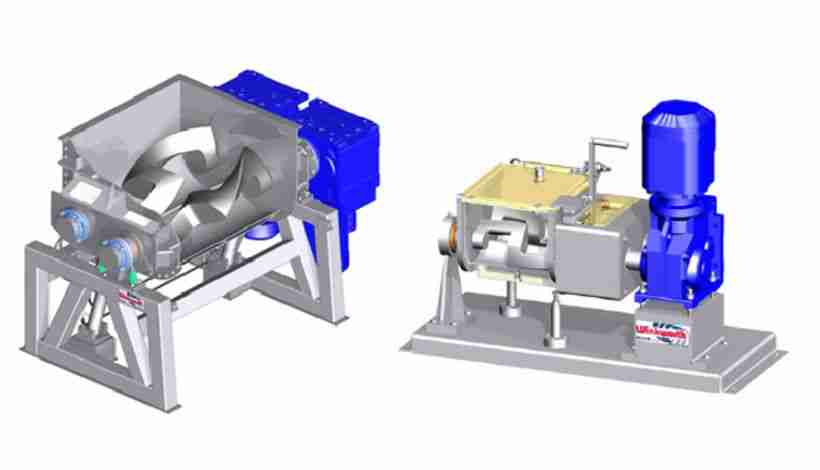
Batch Mixing Equipment
1. Z-Blade (Sigma) Mixers
Two counter-rotating Z-shaped blades create intensive shearing and kneading action. This is the industry standard for small-to-mid scale production.
- Best For:Production < 500 kg/month, high shear needs, and very high viscosity materials.
- Key Spec:45-90 minutes to homogeneity.
- Limitation:Potential "dead corners" and labor-intensive cleaning (2-3 hours).
2. Double Planetary Mixers
Blades rotate on their own axes while orbiting the vessel, ensuring complete coverage without dead spots.
- Best For:Lab scale, frequent formulation changes (3+ per week).
- Advantage:Interchangeable vessels allow 5-minute changeovers.
- Operating Tip:Keep speeds lower (25-35 rpm) to prevent air entrapment.
Continuous Mixing Equipment
3. Twin-Screw Extruders (TSE)
Two intermeshing co-rotating screws provide continuous compounding with superior consistency.
Video: Professional demonstration of MIM feedstock preparation process by GKN Powder Metallurgy.
Why TSE is the Production Standard:
- Consistency:Batch-to-batch variation is ±0.5-1% (vs. ±3-5% for batch mixers).
- Throughput:10-20× higher than batch systems.
- ROI:Typically pays back in 18-24 months for volumes >500 kg/month.
Screw Configuration Basics:
- Conveying (60%):Transport material forward.
- Kneading (30%):Intensive distributive mixing.
- Reverse/Mixing (10%):Dispersive action and residence time control.
Summary: Equipment Comparison Table
| Equipment | Throughput | Consistency | Capital Cost | Best Application |
|---|---|---|---|---|
| Planetary | 5-20 kg/hr | ±5% | $ (Low) | Lab, frequent changes |
| Z-Blade | 10-50 kg/hr | ±3-5% | $$ (Med) | R&D, Pilot Production |
| Single-Screw | 20-80 kg/hr | ±2-3% | $$ (Med) | Simple formulations |
| Twin-Screw (TSE) | 50-500 kg/hr | ±0.5-1% | $$$$ (High) | Mass Production |
Controlling Mixing Parameters
Mixing success depends on precise control of temperature, time, and shear intensity. These parameters determine feedstock rheology—how it flows during processing.
Temperature Control
Why heating is necessary:Melt binder components to create low-viscosity liquid that wets powder particles.
Temperature Ranges by Binder Type:
| Binder System | Mixing Temperature | Control Tolerance |
|---|---|---|
| PE/PP-based | 160-175°C | ±2°C |
| Wax-heavy | 130-150°C | ±3°C |
| POM catalytic | 140-160°C | ±2°C |
| PMMA-based | 150-165°C | ±2°C |
Effects of incorrect temperature:
Too low (< optimal -10°C):
- Incomplete melting
- Viscosity 2-3× higher than target
- Poor particle wetting
- Extended mixing time (+50-100%)
Too high (> optimal +15°C):
- Polymer degradation
- Discoloration (brown/black)
- Altered powder-binder ratio
- Unpredictable processing
Temperature control implementation:
- Multiple thermocouples (minimum 3 zones)
- PID controllers maintaining ±2°C
- Verify no zones vary > ±5°C from target
- Monitor continuously during mixing
- Controlled cooling to 60-90°C before pelletization
Flow Activation Energy (Eₐ):Measure of temperature sensitivity. Target Eₐ < 50 kJ/mol. Lower values mean small temperature variations won't cause large viscosity changes—more stable processing.
Mixing Time and Achieving Homogeneity
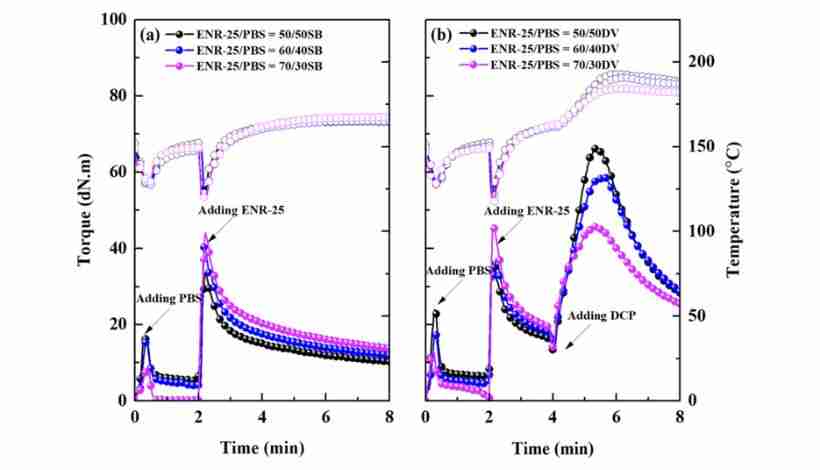
Torque monitoring is your key indicator.As powder and binder mix, torque fluctuates then stabilizes.
Typical mixing progression:
- 0-5 minutes: Initial incorporation, sharp torque rise
- 5-20 minutes: Distribution phase, torque fluctuates
- 20-45 minutes: Refinement, torque begins stabilizing
- 45+ minutes: Steady state achieved
Homogeneity criterion:Torque variation < ±2% for 15+ consecutive minutes
Don't rush this stage.Discharging before steady state produces inhomogeneous feedstock with:
- Powder agglomerates (become porosity)
- Binder-rich regions (cause warping)
- Density variations (unpredictable shrinkage)
For different equipment:
| Equipment | Time to Steady State | Speed Range | If Steady State Not Reached |
|---|---|---|---|
| Z-Blade | 45-90 min | 40-55 rpm | Extend time or increase temperature 5°C |
| Planetary | 30-60 min | 25-35 rpm | Check for dead spots, verify mixing action |
| TSE | Continuous (residence time 2-5 min) | 200-350 rpm | Adjust screw speed or configuration |
Mixing Speed Optimization
Speed affects both mixing time and shear intensity.
Too slow:
- Extended mixing time (+50%)
- Incomplete agglomerate breaking
- Lower throughput
Too fast:
- Frictional heating (can degrade binder)
- Air entrapment (voids in feedstock)
- Excessive equipment wear
Optimization approach:
- Start at mid-range speed (Z-blade: 45 rpm, Planetary: 30 rpm)
- Monitor time to steady-state torque
- Test feedstock rheology
- Adjust speed ±10-15%
- Select speed giving shortest time without degradation
Achieving Pseudoplastic (Shear-Thinning) Behavior
Your feedstock must exhibit pseudoplastic behavior—viscosity decreases as shear rate increases.
Why this is critical:
- At rest (low shear): High viscosity prevents powder settling
- During injection (high shear 10³-10⁴ s⁻¹): Low viscosity enables mold filling
Quantified by Flow Behavior Index (n):
- n = 0.4-0.6: Ideal range
- n = 0.6-0.8: Acceptable
- n > 0.8: Poor processability (insufficient shear-thinning)
- n < 0.4: Excessive shear-thinning (risk of jetting defects)
If n is too high (> 0.7):
- Increase surfactant content (+0.5-1 wt%)
- Increase primary binder proportion
- Reduce powder loading (-1-2 vol%)
- Verify mixing temperature is optimal
Component Addition Sequence
Addition order affects mixing efficiency and homogeneity.
Recommended sequence for batch systems:
- Preheat empty mixer to 80-100°C
- Add metal powder (allows powder preheating)
- Heat to process temperature while mixing at low speed
- Add primary binder (waxes)
- Mix 10-15 minutes at full speed
- Add backbone polymer
- Mix 10-15 minutes
- Add surfactants and additives
- Continue mixing until steady-state torque
For TSE continuous systems:
- Pre-blend powder with surfactants (dry mixing 5-10 minutes)
- Feed premix and liquid binders simultaneously
- TSE's intensive shearing handles simultaneous addition effectively
Critical: Add surfactants.Even 1-2 wt% stearic acid reduces viscosity by 40-60% and dramatically improves wetting.
Atmosphere Control for Reactive Metals
When you need inert atmosphere mixing:
- Titanium alloys (oxidation threshold: O₂ > 0.15%)
- Aluminum alloys
- Reactive tool steels
- Any material where surface oxides inhibit sintering
Implementation:
- Vacuum-capable mixer (< 50 mbar during mixing)
- Inert gas purging (argon or nitrogen)
- Sealed charging and discharge systems
Cost:Adds a substantial premium to mixer capital cost
For standard stainless steels:Atmospheric mixing usually adequate if final oxygen content meets specs.
Quality Control of Mixed Feedstock
Rigorous testing is non-negotiable. Deficiencies in feedstock cannot be corrected downstream.
Rheological Testing (Primary Quality Metric)
Capillary Rheometry at High Shear Rates
This is your gold standard—measures viscosity at shear rates (10³-10⁴ s⁻¹) representative of injection molding.
Required measurements:
- Viscosity vs. shear rate curves
- Test range: 100-10,000 s⁻¹
- Confirm η < 1000 Pa·s at 1000 s⁻¹
- Verify pseudoplastic behavior
- Flow behavior index (n)
- Calculate from power-law model fitting
- Acceptance: 0.4 < n < 0.7
- Activation energy (Eₐ)
- Test at 3+ temperatures (molding temp ±10°C)
- Calculate using Arrhenius equation
- Target: Eₐ < 50 kJ/mol
Testing protocol:
- Frequency: Every batch for production
- Samples: Minimum 3 pellets per batch
- Temperatures: Molding temp, +10°C, -10°C
- Compare to established baseline
Acceptance criteria:
| Parameter | Target | Acceptable Range | Reject If |
|---|---|---|---|
| Viscosity @ 1000 s⁻¹ | 200-600 Pa·s | 100-800 Pa·s | > 1000 Pa·s |
| Flow index (n) | 0.45-0.60 | 0.40-0.70 | < 0.35 or > 0.75 |
| Activation energy | 30-45 kJ/mol | < 50 kJ/mol | > 70 kJ/mol |
| Batch-to-batch variation | ±5% | ±10% | ±15% |
Don't use MFI as primary test.Melt Flow Index tests operate at low shear rates (< 10 s⁻¹) that don't represent injection conditions. Two feedstocks with identical MFI can behave completely differently during molding.
Homogeneity Verification
Multiple methods required—no single test is sufficient.
1. Torque Monitoring (In-Process)
Monitor mixing torque in real-time:
- Steady-state plateau (±2% for 15+ min) indicates homogeneity
- Record torque curve for every batch
- Compare to baseline torque profile
2. Density Measurement
Test multiple pellets from different batch locations:
- Method: Helium pycnometry (±0.001 g/cm³ precision)
- Sample size: 5-10 pellets per batch
- Acceptance: Standard deviation < ±0.020 g/cm³
- Rejection: Any sample > ±0.035 g/cm³ from mean
3. Thermogravimetric Analysis (TGA)
Verify binder content consistency:
- Test 3-5 samples per batch
- Heat through binder decomposition range
- Acceptance: Binder content within ±1 wt% of target
- Detects segregation and degradation
4. Visual and Microscopic Inspection
Visual (every batch):
- Uniform color throughout pellets
- No visible powder clusters
- No binder pooling or separation
- Consistent pellet appearance
SEM (periodic spot checks):
- Polish feedstock cross-section
- Examine at 500-2000× magnification
- Verify: uniform particle spacing, complete coating, no agglomerates > 50 µm
Batch Release Criteria
All criteria must pass before releasing to production:
- ☐ Mixing torque reached steady state for 15+ minutes
- ☐ Density test: std dev < 0.020 g/cm³ across 5+ samples
- ☐ Rheology: viscosity, n, and Eₐ within specifications
- ☐ TGA: binder content within ±1 wt% of target
- ☐ Visual inspection: no visible defects
If any test fails:Hold batch, investigate root cause, retest or reject.
Troubleshooting Common Mixing Defects
Understanding root causes in the mixing stage enables effective solutions.
Powder-Binder Separation
Symptoms in feedstock:
- Non-uniform appearance (binder-rich and powder-rich regions)
- Viscosity instability (changes over time at constant temperature)
- Phase separation visible in pellet cross-section
Root causes in mixing:
- Insufficient surfactant content
- Poor powder-binder compatibility
- Inadequate mixing time (not reaching steady state)
- Wrong binder formulation for powder type
Solutions:
- Add surfactant:Stearic acid 1-2 wt% of binder
- Verify mixing completion:Extend time until torque stable 15+ min
- Increase backbone polymer:+5-10% of binder system
- Add compatibilizer:EVA 5-10% for multi-polymer binders
- Test compatibility:Hold mixed feedstock at molding temp 4 hrs, remeasure viscosity (should vary < 10%)
Verification test:Rheological stability. If viscosity changes > 15% after 4-hour hold at molding temperature, separation is occurring.
Particle Agglomeration
Symptoms in feedstock:
- Visible powder clumps in pellets
- Gritty texture when pellets rubbed between fingers
- SEM shows particle clusters > 50 µm
Root causes in mixing:
- Insufficient shear energy (wrong equipment or speed)
- Poor powder wetting (missing surfactant)
- Mixing time too short
- Temperature too low (incomplete binder melting)
Solutions:
- Increase mixing time:+30-50% beyond first steady-state indication
- Increase temperature:+5-10°C (verify below degradation temp)
- Increase mixing speed:+10-15% (monitor for overheating)
- Add surfactant:1-2 wt% stearic acid if not present
- Pre-disperse powder:Dry mix powder + surfactant 10 min before adding binders
- Upgrade equipment:If using low-shear system, consider Z-blade or TSE
For TSE users:Adjust screw configuration—add more kneading blocks (90° angle) in early zones for increased dispersive mixing.
Verification:SEM examination should show no particle clusters > 50 µm.
Binder Degradation During Mixing
Symptoms:
- Viscosity 30-50% lower than baseline
- Brown or black discoloration
- Burning smell during mixing
- Inconsistent batch-to-batch properties
Root causes:
- Mixing temperature too high (> optimal +15°C)
- Extended residence time in heated equipment
- Hot spots in mixer (temperature non-uniformity)
Solutions:
- Lower mixing temperature:-10-15°C (verify still above binder melting point)
- Reduce mixing time:If steady state reached early, discharge immediately
- For TSE:Reduce screw speed to decrease residence time
- Check temperature uniformity:Verify all zones within ±5°C
- Add antioxidant:0.1-0.3 wt% stabilizer
- Verify thermocouples:Calibrate or replace if readings suspect
For recycled material:Degradation accelerates with each reheating cycle. Limit regrind to 10-15% maximum.
Verification:TGA comparison—degraded binder shows shifted decomposition peaks.
Air Entrapment and Voids
Symptoms:
- Visible bubbles in pellet cross-sections
- Lower measured density than theoretical (by > 0.5%)
- Pellets float in water (should sink)
Root causes in mixing:
- Vortex formation (high-speed mixing)
- Air drawn in during powder addition
- Moisture in raw materials (vaporizes during heating)
Solutions:
- Mix under vacuum:Most effective—maintain < 50 mbar during mixing
- Reduce mixing speed:Lower to prevent vortex formation
- Pre-dry materials:4 hours at 80-100°C before mixing
- Slow powder addition:Add over 5-10 minutes, not all at once
- Add degassing step:For batch mixers, pull vacuum after mixing complete
- For TSE:Use vacuum venting ports in downstream barrel zones
Verification:Density test should match theoretical within 0.5%. SEM should show no voids.
High Viscosity Problems
Symptoms:
- Viscosity > 1000 Pa·s at standard test conditions
- Mixing torque extremely high (> 80% motor capacity)
- Difficult to mold (high injection pressures required)
Root causes:
- Powder loading too high (above CPVC)
- Insufficient surfactant
- Irregular particle morphology (vs. spherical)
- Powder agglomeration
- Temperature too low
Solutions:
- Reduce powder loading:-1-2 vol%, retest
- Add surfactant:If < 1.5 wt%, increase to 2-3 wt%
- Increase temperature:+5-10°C
- Verify powder morphology:Request spherical if using irregular
- Extend mixing time:May have agglomerates increasing apparent viscosity
- Increase primary binder:+5% wax content
Decision tree:
- If viscosity > 1200 Pa·s → reduce loading 2 vol%
- If viscosity 900-1200 Pa·s → add surfactant or increase temperature
- If viscosity improves but n > 0.7 → further surfactant addition needed
Batch-to-Batch Inconsistency
Symptoms:
- Viscosity variation > ±10% between batches
- Density variation > ±0.030 g/cm³
- Unpredictable molding behavior
Root causes:
- Raw material variability (powder or binder specs not tight enough)
- Inconsistent process execution (temperature, time, loading)
- Equipment wear (blade clearances increased)
- Operator variations (manual processes)
Solutions:
- Tighten supplier specifications:
- Powder: D₅₀ ±1 µm, morphology verified
- Binder: Molecular weight ±5%, purity verified
- Implement process controls:
- Automated weighing (±0.1% accuracy)
- Temperature monitoring (all zones, ±2°C)
- Torque recording (track to steady state)
- Mixing time SOP (don't discharge early)
- Check equipment condition:
- Measure blade-to-wall clearances
- Replace worn components
- Verify heating zones functional
- Statistical process control:
- Plot viscosity trend over 20+ batches
- Calculate Cpk (target > 1.33)
- Identify systematic shifts
Implementation:Document every process parameter for every batch. When variation occurs, compare parameters to identify the variable causing the change.
Troubleshooting Quick Reference
| Problem | Quick Check | Immediate Action | Root Fix |
|---|---|---|---|
| Separation | Visual: binder pools | Add 1% surfactant | Reformulate binder |
| Agglomerates | SEM: clusters > 50µm | +30% mixing time | Increase shear |
| Degradation | Color: brown/black | -15°C temperature | Check all zones |
| Voids | Density < theoretical | Pre-dry materials | Vacuum mixing |
| High viscosity | η > 1000 Pa·s @ 1000s⁻¹ | -2% powder loading | Add surfactant |
| Inconsistency | Batch variation > ±10% | Review process log | Tighten raw material specs |
Critical Mixing Parameters Quick Reference
Copy this to your mixing station:
| Parameter | Target | Tolerance | Action If Outside |
|---|---|---|---|
| Powder Loading | 62-64 vol% | ±0.5 vol% | Adjust and retest rheology |
| Mixing Temperature | Material-specific | ±2°C | Recalibrate thermocouples |
| Time to Steady Torque | 30-60 min (batch) | - | Verify temperature and speed |
| Torque Stability | ±2% for 15+ min | ±5% max | Continue mixing |
| Viscosity @ 1000 s⁻¹ | 200-600 Pa·s | 100-800 Pa·s | Adjust temp or loading |
| Flow Index (n) | 0.45-0.60 | 0.40-0.70 | Modify surfactant |
| Activation Energy (Eₐ) | < 45 kJ/mol | < 50 kJ/mol | Optimize binder |
| Density Std Dev | < ±0.015 g/cm³ | < ±0.020 g/cm³ | Extend mixing time |
Best Practices for Mixing Operations
Standard Operating Procedure Elements
Document these essential parameters:
Pre-mixing preparation:
- ☐ Component weights verified (±0.1% accuracy)
- ☐ Materials pre-dried if hygroscopic (4 hrs @ 80-100°C)
- ☐ Equipment cleaned and verified operational
- ☐ Temperature controllers calibrated
Mixing execution:
- ☐ Preheat temperature reached and stable
- ☐ Addition sequence followed precisely
- ☐ Target temperature maintained (±2°C)
- ☐ Mixing time: Continue until torque stable 15+ min
- ☐ No early discharge (premature discharge = inhomogeneous feedstock)
Post-mixing:
- ☐ Controlled cooling to 60-90°C before pelletization
- ☐ Pellet size within specification (2-4 mm typical)
- ☐ Batch documentation complete
Quality verification:
- ☐ Visual inspection passed
- ☐ Density test passed (5+ samples)
- ☐ Rheology sample pulled for testing
- ☐ Batch labeled with date, number, formulation code
Managing Recycled Material
Regrind from runners and defective parts can be reincorporated with strict controls:
Maximum limits:
- 10-20% regrind maximum (never exceed 20%)
- Only 1-2 reprocessing cycles total
Required testing before use:
- Rheology: Compare to virgin baseline (viscosity should be within ±15%)
- Visual: No contamination, discoloration should be minimal
- TGA: Verify binder hasn't degraded
Warning signs of over-degradation:
- Viscosity > 30% below virgin material → reject
- Brown/black discoloration → reject
- Visible contamination → reject
Best practice:Create tested batches (e.g., 15% regrind + 85% virgin), verify quality, approve for production use. Don't add regrind continuously without verification.
Frequently Asked Questions
Q: How do I determine the optimal powder loading (CPVC)?
Do not guess. Use experimental torque testing to find the Critical Powder Volume Concentration (CPVC).
- The Method:Mix batches incrementally from 58% to 66% (2% steps).
- The Signal:Plot torque vs. loading. The point where torque spikes vertically is the CPVC.
- The Target:Your optimal loading is2-3 vol% below the CPVC.
- Typical Result:For spherical powders, this usually lands at 62-64 vol%.
Q: What's the fastest way to verify my feedstock is homogeneous?
Rely on the "Triangle of Verification":
- Torque Stability:Must be flat (±2% variation) for at least 15 minutes before discharge.
- Density Check:Measure 5 pellets from start, middle, and end. Standard deviation must be< ±0.020 g/cm³.
- Visual Inspection:Break a pellet. Look for uniform color and zero white specks (binder rich) or dry spots (powder rich).
Q: Should I buy batch or continuous mixing equipment?
This is purely a volume and budget decision. Use this comparison to decide:
| Factor | Batch Mixer | Twin-Screw (TSE) |
|---|---|---|
| Monthly Volume | < 500 kg | > 500 kg |
| Formulation | Frequent changes (R&D) | Locked/Fixed |
| Consistency | Good (±3-5%) | Excellent (±0.5%) |
| Capital Cost | Low (moderate outlay) | High (substantial outlay) |
Q: My feedstock has high viscosity even at 60% loading—what's wrong?
If you aren't exceeding the CPVC, check these 5 hidden variables:
| Potential Cause | Corrective Action |
|---|---|
| 1. Powder Shape | Irregular powder increases viscosity 30-40%. Switch to spherical or reduce loading. |
| 2. Surfactant | Ensure Stearic Acid (SA) is 2-3 wt% of binder. If <1.5%, viscosity spikes. |
| 3. Temperature | Binder may be too cold. Increase mixing temp by +5-10°C. |
| 4. Agglomerates | Powder clusters act like large particles. Extend mixing time by 30%. |
| 5. Binder Ratio | Backbone polymer may be too dominant. Increase wax component. |
Q: How do I fix powder-binder separation?
Separation indicates poor wetting. The binder is slidingpastthe powder rather than gripping it.
- Immediate Fix:Add surfactant (Stearic Acid) at 1-2 wt% of binder. This acts as the "bridge" between metal and plastic.
- Process Fix:Ensure steady-state torque was reached. Premature discharge often looks like separation.
- Validation Test:Hold feedstock at molding temp for 4 hours. Viscosity change should be < 10%.
Q: Can I use MFI testing instead of capillary rheometry?
MFI tests at very low shear rates (< 10 s⁻¹). Injection molding happens at high shear rates (10,000 s⁻¹). Two feedstocks can have identical MFI scores but behave completely differently in the mold. Use MFI only for basic incoming inspection, not process validation.
Q: What causes batch-to-batch viscosity variation?
Viscosity fluctuations are symptoms of upstream process inconsistencies. The 5 most common root causes are:
- 1. Raw Material Variability:Require tight supplier specs (e.g., Powder D₅₀ ±1 µm, Binder Mw ±5%).
- 2. Temperature Control:Viscosity is highly sensitive to heat. Verify all barrel zones are calibrated to within±2°C.
- 3. Mixing Endpoint:Do not rely on time alone. Always mix tosteady-state torqueto ensure true homogeneity.
- 4. Weighing Errors:Small deviations in the powder-to-binder ratio drastically alter rheology. Verify scale accuracy to ±0.1%.
- 5. Equipment Wear:Worn blades increase the gap to the wall, reducing shear efficiency. Inspect blade clearances annually.
Q: Do I need vacuum mixing for stainless steel powders?
Usuallynot necessaryfor 316L or 17-4PH with standard binders. Atmospheric mixing is adequate if final oxygen content meets specifications.
Vacuum IS required for:Titanium alloys, Aluminum alloys, reactive tool steels, or any material where surface oxides significantly inhibit sintering. It adds a substantial premium to mixer cost.
Q: How long does it take to reach homogeneous mixing?
Never discharge before achieving steady-state torque (flatline ±2% for 15+ minutes). Typical times:
- Z-blade batch mixer:45-90 minutes.
- Planetary mixer:30-60 minutes.
- Twin-screw extruder:Continuous (Residence time 2-5 min, but requires 20-30 min to stabilize).
Q: What mixing speed should I use?
Speed is a trade-off between shear heat and dispersion efficiency.
| Equipment | Target RPM Range | Note |
|---|---|---|
| Z-Blade | 40 - 55 rpm | Go higher for finer powders to break clusters. |
| Planetary | 25 - 35 rpm | Keep low to prevent vortexing (air entrapment). |
| TSE | 200 - 350 rpm | Dependent on screw design; monitor melt temp. |
Conclusion
Successful MIM production begins with proper mixing and kneading. The homogeneity you achieve at this stage directly determines your ability to produce consistent, high-quality parts.
Critical implementation points:
- Match equipment to your requirements.Batch systems for development and volumes < 500 kg/month. Twin-screw extruders for production scale where consistency is critical.
- Control the process rigorously.Temperature (±2°C), powder loading (±0.5 vol%), and mixing time (to steady-state torque) must be monitored and documented for every batch.
- Test at high shear rates.Capillary rheometry at 10³-10⁴ s⁻¹ is required. MFI testing alone is inadequate.
- Never discharge before steady state.Torque must stabilize (±2%) for 15+ minutes. Premature discharge produces inhomogeneous feedstock that causes defects throughout all subsequent processing.
- Use surfactants.Even 1-2 wt% stearic acid reduces viscosity by 40-60% and dramatically improves powder wetting. Non-negotiable for quality feedstock.
Your mixing process is not just preparation—it establishes the quality ceiling for everything that follows.Invest in proper equipment, implement rigorous controls, test comprehensively, and document your process. The payoff is consistent feedstock that enables reliable, repeatable MIM production.
Start with excellent mixing, and your entire process benefits.
Precision Metal Parts from Emitech
Nanjing Emitech delivers MIM, CNC machining, and custom metal parts. MIM services · Request a quote
Last updated: 2026-06-24
Continue reading
- Small Gear Materials Selection: Complete Guide to Steel, Aluminum & Advanced Composites
- What Are MIM Parts? A Complete Technical Guide to Metal Injection Molding
- What is Metal Injection Molding (MIM) for Aluminum? Benefits and Applications Explained
- Comprehensive Guide to the Yield Strength of 316 Stainless Steel