
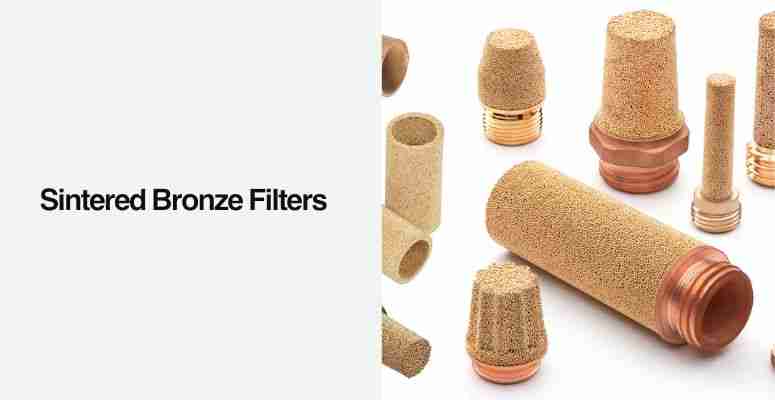
Sintered bronze filters displaying the porous structure that provides precise filtration with high flow capacity and temperature resistance
Emitech manufactures custom MIM parts including porous and filter components — upload your drawing for a quote.
What Are Sintered Bronze Filters?
Sintered bronze filters are porous metal filtration components manufactured through powder metallurgy. Bronze powder—typically88-89% copperand9-11% tin—is compressed and heated below its melting point (750-850°C) to form a solid structure with controlled interconnected porosity. This process creates filters with exceptional mechanical strength, temperature resistance, and consistent filtration performance.
Key Advantages of Sintered Bronze Filtration
Sintered bronze filters deliver measurable performance advantages over alternative filtration media:
| Feature | Benefit | Comparison to Alternatives |
|---|---|---|
| Temperature Resistance | Operates effectively from -250°C to 450°C | Outperforms polymer filters (max 80-150°C) and paper filters (max 120°C) |
| Pressure Handling | Withstands up to 5MPa (725 psi) | Superior to cellulose filters (0.6MPa) and many mesh filters (1-2MPa) |
| Corrosion Resistance | Resists many chemicals, fuels, and oils | More resistant than iron-based filters, though less than stainless steel |
| Cleanability | Can be backwashed, ultrasonically cleaned, or heat-treated | Significantly more cleanable than disposable media filters |
| Service Life | Typically much longer than disposable filters with proper maintenance | Longer than disposable filters in many applications |
| Porosity | Consistent 35-45% with controlled pore sizes | More uniform than sintered aluminum (25-35%) or most fiber-based filters |
Manufacturing Process: Creating Precision Filtration Media
High-quality sintered bronze filters are produced through these critical steps:
- Raw MaterialPreparation:Bronze powder with controlled particle sizes (typically10-200μm) is blended with temporary binders
- Compaction:The powder mixture is pressed in specialized molds at100-400 MPato achieve the desired shape
- Sintering:The compactedpartsare heated to750-850°Cin controlled atmosphere (nitrogen or hydrogen) for20-40 minutes
- Quality Control:Each batch undergoes bubble point testing, flow rate verification, and dimensional inspection
Thisprocess allows manufacturersto produce filters with precisely controlled pore sizes ranging from sub-micron (0.2μm) to coarse filtration (200μm).
Common Shapes and Configurations
| Configuration | Typical Dimensions | Best For | Relative Cost |
|---|---|---|---|
| Filter Discs | 5-300mm diameter, 0.5-10mm thickness | Small flow applications, analytical instruments | Lower |
| Filter Sheets | Up to 1200×300mm, 1-25mm thickness | Large surface area filtration, custom cutting | Lower |
| Filter Tubes | 40-900mm length, 4-300mm diameter | High flow rates, increased dirt capacity | Moderate |
| Mufflers/Silencers | 1/8" to 1" thread sizes | Pneumatic exhaust, noise reduction | Lower |
| Custom Shapes | According to specification | Specialized applications, OEM integration | Moderate to high |
Performance Comparison: Sintered Bronze vs. Alternative Filter Media
| Performance Factor | Sintered Bronze | Sintered Stainless | Wire Mesh | Pleated Media | Ceramic Filters |
|---|---|---|---|---|---|
| Max Operating Temp | 450°C | 550°C | 400°C | 120-150°C | 800°C+ |
| Pressure Resistance | 5MPa | 6MPa | 2-3MPa | 0.5-1MPa | 3-4MPa |
| Cleanability | Excellent | Excellent | Good | Poor | Very Good |
| Initial Cost | Moderate | High | Low | Low | Very High |
| Lifetime Cost | Low | Low | Moderate | High | Low |
| Filtration Consistency | Excellent | Excellent | Good | Fair | Excellent |
| Weight | Moderate | High | Low | Very Low | High |
| Machinability | Good | Poor | N/A | N/A | Poor |
Real Performance Data
Flow Rate vs. Pressure Drop
| Filter Grade | Pore Size (μm) | Air Flow at 0.1 MPa (L/min/cm²) | Water Flow at 0.1 MPa (L/min/cm²) |
|---|---|---|---|
| Extra Fine | 0.5-2 | 1-4 | 0.05-0.2 |
| Fine | 2-10 | 5-15 | 0.2-0.6 |
| Medium | 10-30 | 15-40 | 0.6-1.5 |
| Coarse | 30-100 | 40-100 | 1.5-4.0 |
| Extra Coarse | 100-200 | 100-200 | 4.0-8.0 |
Filtration Efficiency Testing Results
| Grade | Particle Size (μm) | Single-Pass Efficiency (%) | Multi-Pass Efficiency (%) |
|---|---|---|---|
| Extra Fine | 2 | 99.5 | 99.9+ |
| Fine | 5 | 98.0 | 99.8 |
| Medium | 15 | 95.0 | 99.5 |
| Coarse | 50 | 90.0 | 98.0 |
Practical Applications by Industry
| Industry | Specific Application | Why Bronze is Ideal | Typical Pore Size |
|---|---|---|---|
| Automotive | Transmission oil filtration | Withstands high temperatures and vibration | 5-25μm |
| Pneumatics | Air line mufflers/silencers | Reduces noise while filtering particulates | 20-60μm |
| Chemical | Catalyst bed support | Corrosion resistant with uniform flow | 10-50μm |
| Medical | Oxygen delivery systems | Cleanable and sterilizable | 1-5μm |
| Food & Beverage | Steam filtration | Temperature resistant and food-safe | 5-20μm |
| Electronics | Vacuum pick-up tooling | Precise porosity for controlled suction | 5-15μm |
| Hydraulics | System breather vents | Prevents contaminant ingress | 3-10μm |
| Scientific | Gas sparging/bubbling | Creates uniform bubble distribution | 10-30μm |
| Marine | Fuel water separators | Corrosion resistant in harsh environments | 2-10μm |
| Energy | Natural gas filtration | Withstands pressure cycling | 0.5-5μm |
Selection Guide: Finding the Perfect Filter for Your Application
When selecting a sintered bronze filter, evaluate these critical parameters:
1. Filtration Requirements
- Target particle size for removal
- Contamination level of the fluid (parts per million or mg/L)
- Absolute vs. nominal filtration requirement
- Expected dirt holding capacity needed
2. Operating Conditions
- Temperature range: minimum and maximum (-250°C to +450°Cavailable)
- Operating pressure: normal and peak (up to 5 MPa)
- Flow rate requirements (L/min or m³/hr)
- Chemical compatibility concerns with fluid media
3. Physical Constraints
- Available installation space and envelope dimensions
- Preferred connection method (threaded, flanged, press-fit)
- Orientation limitations (horizontal vs. vertical mounting)
- Access requirements for maintenance and cleaning
4. Economic Considerations
- Initial investment budget
- Expected service life requirements (1-3 yearstypical)
- Cleaning and maintenanceresourcesavailable
- System downtime costs and criticality
Installation Best Practices
Proper installation ensures optimal filter performance and service life:
- Install with flow direction indicators properly aligned
- Use appropriate sealing methods: O-rings for dynamic applications, gaskets for static, or direct metal-to-metal for high-temperature
- Provide sufficient clearance (minimum 150mm) for maintenance access
- Consider bypass systems for critical applications requiring continuous operation
- Install pressure gauges before and after the filter when possible (differential pressure monitoring)
- Secure firmly but avoid over-tightening threaded connections (follow manufacturer torque specifications)
Maintenance and Cleaning
Cleaning Methods Comparison
| Method | Best For | Equipment Needed | Effectiveness | Potential Risks |
|---|---|---|---|---|
| Backwashing | Light contamination | Reverse flow setup | Good | May not remove all particles |
| Ultrasonic Cleaning | Embedded particles | Ultrasonic bath + solvent | Excellent | May damage very fine pore filters |
| Chemical Cleaning | Specific contaminants | Compatible solvents | Very Good | Chemical handling hazards |
| Heat Treatment | Organic contaminants | Controlled oven | Excellent | Potential oxidation at high temps |
| Compressed Air | Dry particles | Air compressor | Fair | May embed particles deeper |
Recommended Cleaning Procedure
- Step 1:Preliminary rinse with compatible solvent to remove bulk contamination
- Step 2:Ultrasonic bath treatment (15-30 minutesat40-60°C)
- Step 3:Thorough rinse with clean solvent until discharge runs clear
- Step 4:Low-temperature drying (80-120°Cfor2-4 hours)
- Step 5:Flow testing to verify restoration to≥90%of original performance
Innovative Applications
Beyond traditional filtration, sintered bronze filters excel in specialized applications:
- Flame Arrestors:Preventing flame propagation in hazardous environments through thermal quenching
- Controlled Gas Diffusion:Creating precise bubble patterns for aquaculture and aeration systems
- Laminar Flow Creation:Generating consistent flow patterns for analytical instruments and flow meters
- Liquid Atomization:Breaking liquids into consistent droplet sizes for spray applications
- Vacuum System Protection:Preventing particulate contamination in vacuum pumps and systems
Environmental and Sustainability Considerations
Sintered bronze filters deliver measurable environmental advantages:
- Longevity:Service life5-10×longer than disposable alternatives reduces waste generation
- Recyclability:End-of-life filters are100% recyclableas metallic scrap with recovery value
- Resource Efficiency:Reduced waste compared to disposable filters—one sintered filter replaces20-50disposable cartridges
- Energy Savings:Lower pressure drops can reduce pumping energy compared to high-efficiency disposable media
Frequently Asked Questions
Q: What is the difference between nominal and absolute filtration ratings?
Nominal ratings capture90-95%of particles at the stated size; absolute ratings capture99.9%+of particles at that size.
- Nominal filtration:Indicates typical performance under normal conditions—90-95%efficiency at stated micron rating
- Absolute filtration:Guarantees removal of virtually all particles (99.9%+) larger than stated size
- Application selection:Nominal ratings suit general protection applications; absolute ratings required for critical contamination control
- Sintered bronze capability:Can be manufacturedto meet either specification through pore size control during sintering
Q: How do I know when it's time to clean or replace my sintered bronze filter?
Clean when pressure differential increases noticeably from the initial value; replace when cleaning no longer restores adequate flow.
Primary Indicators:
- Pressure differential:Noticeable increase from the initial value indicates cleaning needed
- Flow rate reduction:Noticeable decrease at standard operating pressure
- Visual inspection:Surface discoloration, visible particle embedding, or structural damage
- Downstream contamination:Particle count increase indicating filter bypass or breakthrough
Replacement Criteria:
- Cleaning fails to restore flow to an adequate share of original capacity
- Visible cracks, erosion, or mechanical damage to filter structure
- Repeated cleaning cycles have degraded pore structure
Q: Can sintered bronze filters be used with caustic or acidic fluids?
Bronze has moderate chemical resistance—effective with hydrocarbons and neutral solutions but unsuitable for strong acids or alkaline solutions.
Compatible Fluids:
- Hydrocarbons (oils, fuels, solvents)
- Neutral aqueous solutions (pH6-8)
- Many alcohols and ketones
- Mostindustrialgases (air, nitrogen, CO₂)
Incompatible Fluids:
- Strong acids (pH<4): Causes copper dissolution
- Strong alkaline solutions (pH>10): Dezincification risk
- Ammonia solutions: Causes stress corrosion cracking
For corrosive environments, considersintered stainless steelalternatives.
Q: What are the limitations of sintered bronze filters?
Despite numerous advantages, sintered bronze filters have specific application limitations to consider.
Technical Limitations:
- Chemical compatibility:Not suitable for strong acids (pH<4) or bases (pH>10)
- Temperature ceiling:Maximum450°C(ceramic alternatives reach800°C+)
- Galvanic corrosion:Risk when coupled with dissimilar metals in electrolytic environments
- Ultrapure applications:Requires special processing to remove metallic ions
Economic Considerations:
- Higher initial cost than disposable filters
- Heavier than polymer alternatives (density8.8 g/cm³vs.1-2 g/cm³for polymers)
- Requires cleaning equipment and procedures for maintenance
Q: How does porosity affect filter performance?
Porosity (35-45%typical) directly impacts flow rate, dirt capacity, strength, and filtration efficiency in inverse relationships.
Porosity Impact on Performance:
- Flow rates:Higher porosity increases flow by15-30%at equivalent pressure drop
- Dirt holding capacity:Higher porosity increases contaminant capacity by20-40%
- Mechanical strength:Lower porosity provides50-80%greater compressive strength
- Filtration efficiency:Lower porosity with smaller pores increases removal efficiency
Manufacturers optimize this balance based on application priorities—high flow vs. fine filtration vs. structural requirements.
Q: What is the expected lifespan of a sintered bronze filter?
With proper maintenance, sintered bronze filters deliver1-3 yearsservice life in typical industrial applications—significantly longer than disposable alternatives.
Service Life by Application:
- Industrial hydraulic/pneumatic systems:2-5 yearswith regular cleaning
- General process filtration:1-3 yearsdepending on contamination load
- Severe service conditions:6 months to 1 year(high contamination, extreme temperatures)
- Clean applications:5+ yearspossible with minimal maintenance
Lifespan Factors:
- Contamination levels: Higher particle loads reduce life by30-50%
- Cleaning frequency: Regular cleaning extends life
- Operating conditions: Temperatures well above ambient or pressures near maximum reduce life
Q: Can sintered bronze filters be custom-manufactured for specific applications?
Sintered bronze filters are highly customizable through powder metallurgy process control—manufacturers adjust composition, porosity, dimensions, and treatments.
Customization Options:
- Pore size distribution:Tailored from0.2μm to 200μmthrough particle size selection
- Overall porosity:Adjustable from25% to 50%through compaction pressure variation
- Physical dimensions:Custom shapes, sizes, and geometries via tooling design
- Connection types:Threaded, flanged, press-fit, or welded mounting provisions
- Density control:Range of4.5-7.0 g/cm³for strength vs. permeability balance
- Surface treatments:Nickel plating, passivation, or specialized coatings
Custom Order Requirements:
- Minimum order quantities: Typically100-500 piecesdepending on complexity
- Lead times:6-12 weeksfor tooling and first article;2-4 weeksfor repeat orders
- Engineering support: Most manufacturers provide application analysis and design assistance
Q: How do temperature fluctuations affect sintered bronze filter performance?
Sintered bronze maintains consistent performance across-250°C to +450°Cwithout softening, embrittlement, or pore size changes—superior to polymer alternatives.
Temperature Stability Advantages:
- No softening:Maintains structural integrity at elevated temperatures (polymers soften at80-150°C)
- Dimensional stability:Thermal expansion coefficient of17.5 × 10⁻⁶/°Cmaintains pore sizes during cycling
- No embrittlement:Remains ductile at cryogenic temperatures (polymers become brittle below-20°C)
- Thermal conductivity:60-120 W/m·Kreduces thermal gradients and stress
Performance Across Temperature Range:
- Cryogenic (-250°C to -100°C):Maintains filtration efficiency with no embrittlement
- Ambient (-20°C to +80°C):Optimal performance range for all applications
- Elevated (100°C to 300°C):<5%flow rate change from ambient
- High temperature (300°C to 450°C):Slight oxidation possible but performance maintained
Q: How do you calculate the proper filter size for your application?
Proper sizing requires calculating minimum filter area based on flow rate, acceptable pressure drop, and fluid viscosity—then applying a safety factor.
Sizing Calculation Steps:
- Step 1:Determine required flow rate (Q) in liters per minute
- Step 2:Identify acceptable pressure drop (ΔP) in kPa (typically35-70 kPafor clean filter)
- Step 3:Determine fluid viscosity (μ) in centipoise at operating temperature
- Step 4:Calculate minimum filter area (A) in cm²:
Formula: A = (Q × K × μ) ÷ ΔP
where K = filter coefficient provided by manufacturer (typically0.05-0.15for bronze)
- Step 5:Apply safety factor of1.5-2×for contamination accumulation over service life
Example Calculation:
- Flow rate:20 L/min
- Pressure drop:50 kPa
- Viscosity:10 cP(hydraulic oil)
- Filter coefficient:0.10
- Minimum area: (20 × 0.10 × 10) ÷ 50 =0.4 cm²
- With safety factor (2×):0.8 cm²required
Q: What tools are needed for proper installation and maintenance?
Basic toolkit requirements ensure proper installation, maintenance, and performance verification of sintered bronze filters.
Essential Tools:
- Torque wrench:For proper tightening to manufacturer specifications (typically20-50 N·mfor threaded connections)
- Clean containers:Stainless steel or glass vessels for solvent cleaning
- Protective equipment:Chemical-resistant gloves and safety eyewear
- Compressed air source:With regulator for drying and testing (0.5-0.8 MPa)
- Pressure gauges:Differential pressure monitoring (0-1 MParange typical)
Recommended Equipment:
- Ultrasonic cleaner:For thorough particle removal (40-60 kHzfrequency)
- Drying oven:Temperature-controlled (80-150°Crange)
- Flow meter:For performance verification after cleaning
- Bubble point tester:For pore size verification and integrity testing
Contact usfor application-specific filter selection, custom design consultation, and technical support for demanding filtration requirements.
Precision Metal Parts from Emitech
Nanjing Emitech delivers MIM, CNC machining, and custom metal parts. MIM services · Request a quote
Last updated: 2026-07-23
Continue reading
- Metal Injection Molding with Hot Isostatic Pressing: Complete Engineering Guide to Achieving 99.9% Density
- Metal Powder Sintering Temperature Guide: Optimal Settings for Different Alloys
- MIM 304 Stainless Steel: High-Temperature, Oxidation, and Corrosion Resistance
- MIM 420 Stainless Steel: High-Hardness Complex Components