
Setting the wrong sintering temperature can ruin an entire production batch. Parts crack, warp, or fail to achieve required density—costing time, materials, and credibility. Understanding the precise temperature requirements for each alloy eliminates these failures and ensures consistent, high-quality results.
Emitech sinters custom MIM parts across stainless, low-alloy, and specialty alloys — send your drawing for a free DFM review.
Quick Reference: Sintering Temperatures by Material
| Material | Temperature Range | Typical Setting | Atmosphere | Hold Time |
|---|---|---|---|---|
| Iron / Low-Alloy Steel | 1,100 – 1,300°C | 1,120°C | 90% N₂ / 10% H₂ | 20–40 min |
| 316L / 304L Stainless Steel | 1,200 – 1,400°C | 1,300°C | 100% H₂ or Vacuum | 30–60 min |
| 17-4PH Stainless Steel | 1,250 – 1,310°C | 1,280°C | 100% H₂ or Vacuum | 30–60 min |
| Pure Copper | 750 – 900°C | 820°C | H₂ or N₂ (<5ppm O₂) | 20–45 min |
| Bronze (Cu-10% Sn) | 740 – 800°C | 770°C | Reducing / N₂ | 20–30 min |
| Aluminum Alloys | 550 – 650°C | 610°C | N₂ (99.999%) | 30–120 min |
| Tungsten | 2,400 – 3,000°C | 2,500°C | H₂ | 2–12 hrs |
| Molybdenum | 2,000 – 2,400°C | 2,200°C | H₂ | 1–3 hrs |
Understanding Metal Powder Sintering Fundamentals
Sintering transforms loose metal powder into a coherent solid through controlled heating below the material's melting point. You rely on atomic diffusion—not melting—to bond particles together. This distinction defines the entire process and determines why temperature control matters so critically.
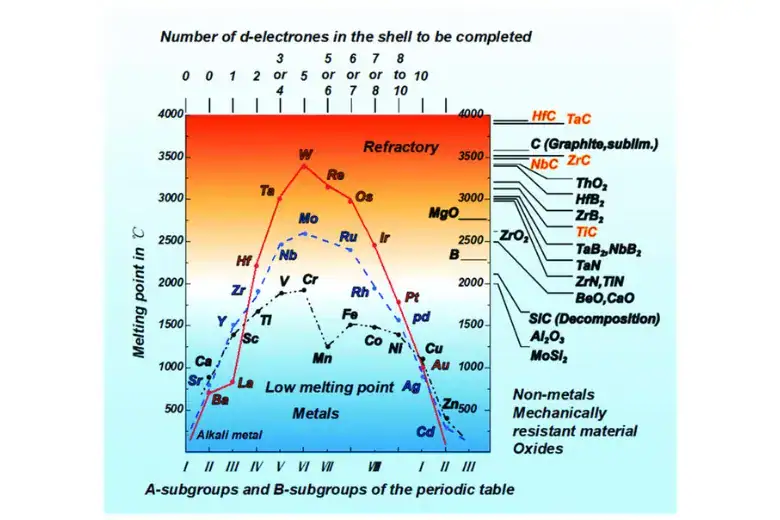
The 70-90% Melting Point Rule
Effective sintering occurs between 70-90% of a material's absolute melting point (measured in Kelvin). This range provides sufficient thermal energy for atomic diffusion while maintaining solid-state conditions. For iron with a melting point of 1538°C (1811 K), you need sintering temperatures between 1077-1358°C.
The thermodynamic driving force behind sintering is interfacial energy reduction. Powder particles have high surface area and correspondingly high surface energy. At elevated temperatures, the system reduces this energy by decreasing surface area through particle bonding and pore elimination.
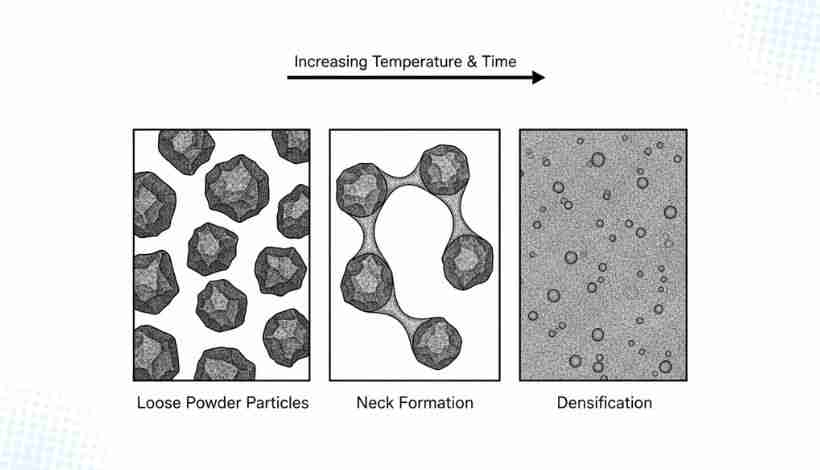
Three-Stage Microstructural Evolution
Sintering progresses through distinct stages, each with characteristic temperature-dependent mechanisms:
- Initial Stage (0-3% shrinkage):Neck formation begins at particle contact points. Grain boundary diffusion dominates, creating bonds between adjacent particles. Surface diffusion contributes to neck growth but does not promote densification. You observe neck radius reaching approximately 0.3 times the particle radius.
- Intermediate Stage (3-10% shrinkage):Continuous pore channels form along three-grain junctions. Volume diffusion becomes increasingly important. Grain boundary diffusion remains active, transporting material from grain boundaries to pore surfaces. The pore structure transitions from interconnected channels to isolated spherical pores.
- Final Stage (>10% shrinkage):Isolated spherical pores shrink through volume diffusion and vacancy annihilation. Grain growth accelerates, potentially trapping pores within grains. Pores at grain boundaries can be eliminated, while intragranular pores become difficult to remove. Your choice of temperature and hold time determines whether you achieve theoretical density or retain residual porosity.
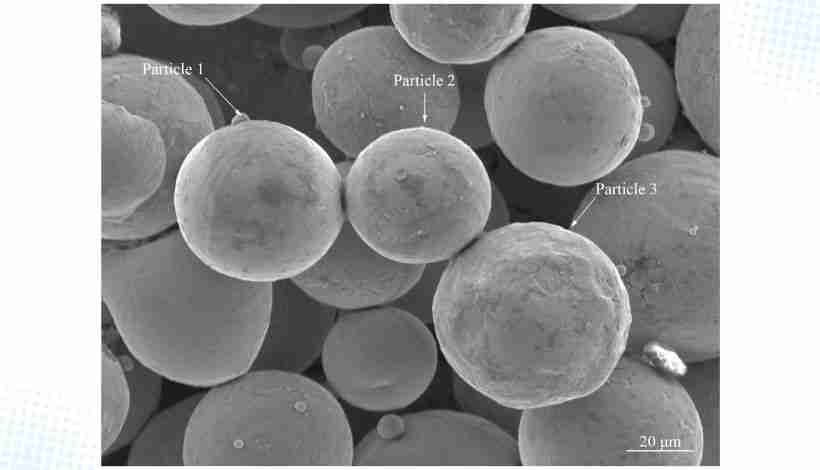
Solid-State vs. Liquid Phase Sintering: Temperature Strategy Selection
Your temperature strategy depends fundamentally on whether you employ solid-state sintering (SSS) or liquid phase sintering (LPS). Each mechanism requires different temperature considerations and produces distinct microstructures.
Solid-State Sintering (SSS)
In SSS, all constituents remain solid throughout the process. Densification occurs entirely through solid-state diffusion mechanisms. You maintain temperatures below the lowest melting point in your system. Pure metals and single-phase alloys typically use SSS.
Temperature requirements:
- 0.7-0.9 Tm for most systems.
- Iron-based materials sinter at 1100-1300°C.
- Copper requires 750-900°C.
- Stainless steels need 1200-1400°C due to chromium oxide formation that impedes diffusion.
Liquid Phase Sintering (LPS)
LPS involves forming a transient liquid phase during heating. The liquid wets solid particles, fills pores through capillary action, and facilitates rapid densification through solution-reprecipitation mechanisms. You achieve higher densities in shorter times compared to SSS.
Temperature requirements:
- Above the lowest eutectic temperature in your system, but below the melting point of major constituents.
- The liquid phase typically constitutes 5-20 volume percent.
- Iron-copper systems form liquid at 1095°C.
- Tungsten heavy alloys (W-Ni-Fe) form liquid at approximately 1460°C.
LPS mechanisms produce different microstructures than SSS. You observe liquid film persistence at grain boundaries, rounding of solid particles, and potential secondary porosity if liquid volume is excessive or wetting is poor.
Key Variables Affecting Temperature Requirements
Atmosphere-Temperature Coupling
Sintering atmosphere directly impacts your required temperature through its effect on surface chemistry. Hydrogen atmospheres reduce surface oxides, lowering the activation energy for diffusion. You can often reduce sintering temperature by 50-100°C when using hydrogen compared to nitrogen.
For 17-4PH stainless steel, hydrogen atmosphere at 1250-1308°C effectively reduces silicon and chromium oxides that would otherwise impede sintering. The reduction reactions become thermodynamically favorable above 1200°C in hydrogen, but require temperatures exceeding 1350°C in vacuum or inert atmosphere.
Vacuum sintering eliminates oxide reduction concerns but requires higher temperatures to compensate for slower diffusion kinetics in the absence of surface-active species. Reactive metals like titanium and aluminum require vacuum or inert atmosphere regardless of temperature to prevent catastrophic oxidation.
Powder Particle Size Effects
Smaller particles require lower sintering temperatures due to increased surface area and shorter diffusion distances. The Herring scaling law predicts sintering time varies with particle size to the third or fourth power, depending on the controlling diffusion mechanism.
Nanoscale powders (particle size <100 nm) can sinter at temperatures 200-300°C below conventional micron-scale powders. However, you must manage increased susceptibility to oxidation and contamination. Agglomeration during heating can negate the benefits of small particle size if you use inadequate heating rates.
Hold Time and Temperature Trade-offs
Densification kinetics follow Arrhenius behavior—rate increases exponentially with temperature. You can achieve equivalent densification by increasing temperature and reducing time, or vice versa. However, grain growth also accelerates with temperature, establishing practical limits.
For water-atomized 316L stainless steel powder, sintering at 1350°C for 30 minutes produces similar density to 1250°C for 120 minutes. But the higher temperature causes significantly larger grain size (ASTM 4 vs. ASTM 6), potentially reducing mechanical properties. Your application requirements determine the optimal temperature-time combination.
Temperature Guidelines by Alloy System
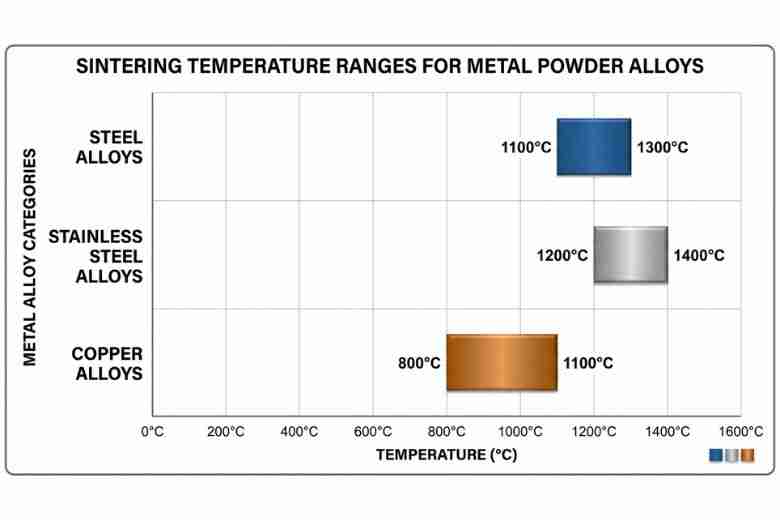
Iron and Low-Alloy Steels
- Temperature range:1100-1300°C
- Typical industrial setting:1120°C
- Hold time:20-40 minutes
- Atmosphere:90% N₂ / 10% H₂ (dissociated ammonia) or endothermic gas
Plain carbon steels sinter effectively at 1120°C in reducing atmosphere. You achieve 90-93% of theoretical density with water-atomized powder, 95-97% with reduced powders. Increasing temperature to 1150-1180°C improves density by 1-2% but risks decarburization if atmosphere control is inadequate.
Low-alloy steels containing copper (1-3%) use transient liquid phase sintering. Copper melts at 1084°C, forming liquid that enhances densification. You sinter at 1120-1150°C—above copper's melting point but well below iron's 1538°C melting point. The copper distributes during cooling, strengthening the matrix.
Stainless Steels
- Temperature range:1200-1400°C
- Typical industrial setting:1250-1300°C
- Hold time:30-60 minutes
- Atmosphere:Hydrogen (dewpoint <-40°C) or high vacuum (10⁻⁴ torr)
Austenitic stainless steels (304L, 316L) require higher temperatures than carbon steels due to stable surface oxides. Chromium oxide forms a passive layer that impedes diffusion. Hydrogen atmosphere at temperatures above 1250°C provides sufficient thermodynamic driving force for oxide reduction.
Sintering 316L at 1300°C for 45 minutes in hydrogen typically produces 95-97% density. The same material sintered at 1200°C achieves only 88-90% density—insufficient for most applications requiring corrosion resistance.
Precipitation-hardening grades like 17-4PH sinter at 1250-1310°C. The precipitation hardening occurs during cooling or subsequent heat treatment, not during sintering itself. You must avoid exceeding 1320°C to prevent excessive chromium carbide precipitation that depletes the matrix of chromium and reduces corrosion resistance.
Copper and Copper Alloys
- Pure copper:750-900°C (typical: 820°C) for 20-45 minutes
- Bronze (Cu-10% Sn):740-800°C for 20-30 minutes
- Brass (Cu-20% Zn):800-900°C for 10-20 minutes
- Atmosphere:Reducing (H₂ or dissociated ammonia) or nitrogen with <5 ppm O₂
Copper's lower melting point (1084°C) permits sintering at moderate temperatures. Pure copper powder achieves 85-90% density at 820°C. You reach higher densities (92-95%) by increasing temperature to 870-900°C, approaching the onset of liquid phase formation through surface melting of fine particles.
Bronze alloys are sintered by transient liquid phase sintering. Although tin melts at only 232°C, the Cu-Sn system forms a low-melting eutectic around 798°C. During heating, a small amount of liquid forms, dissolves copper, and redistributes tin through solution-reprecipitation, producing rapid densification. The final microstructure is a homogeneous α-copper solid solution with dispersed tin-rich phases.
Aluminum Alloys
- Temperature range:550-650°C
- Typical industrial setting:580-620°C
- Hold time:30-120 minutes
- Atmosphere:Nitrogen (99.999% purity) or high vacuum
Aluminum's reactivity and stable aluminum oxide (Al₂O₃) layer create unique sintering challenges. The oxide melts at 2072°C while aluminum melts at 660°C, preventing solid-state oxide reduction. You must either disrupt the oxide mechanically (through deformation during compaction) or add elements that react with alumina.
Magnesium additions (0.5-1.5%) react with Al₂O₃ to form magnesium aluminate spinel (MgAl₂O₄), which has lower surface energy and does not impede sintering as severely. With this technique, you achieve 92-95% density at 610°C for 60 minutes in nitrogen.
Refractory Metals
- Tungsten:2400-3000°C for 2-12 hours in hydrogen
- Molybdenum:2000-2400°C for 1-3 hours in hydrogen
- Tantalum:2200-2800°C for 0.5-2 hours in vacuum
Ultra-high melting points necessitate extreme sintering temperatures. Tungsten (melting point 3422°C) typically sinters at 2400-2600°C in hydrogen atmosphere. Even at these temperatures, you remain below 0.85 Tm, following the standard 70-90% rule.
Hydrogen atmosphere prevents oxide formation and, for tungsten, participates in oxide reduction. Water vapor from WO₃ reduction must be continuously removed to maintain low dewpoint (<-40°C) and prevent reoxidation.
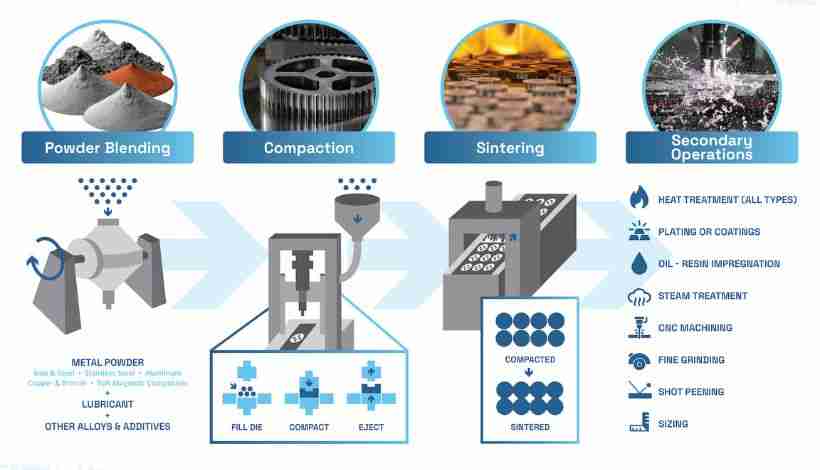
Common Temperature-Related Defects and Solutions
Temperature deviations produce characteristic defects. Recognizing these patterns allows you to diagnose process issues and implement corrective actions.
Insufficient Densification (Temperature Too Low)
- Manifestation:Porosity exceeds specification, mechanical properties below target, poor surface finish
- Root cause:Inadequate thermal energy for atomic diffusion
- Diagnostic:Microstructure shows minimal neck development, isolated particles, large interconnected pores
- Solution:Increase temperature by 25-50°C increments or extend hold time. Verify furnace calibration—actual temperature may be 20-40°C below setpoint
Excessive Grain Growth (Temperature Too High)
- Manifestation:Reduced strength and hardness despite adequate density, coarse microstructure
- Root cause:Grain growth kinetics overwhelm densification benefits
- Diagnostic:Metallography reveals grain size exceeding ASTM 4, often with abnormal grain growth
- Solution:Reduce temperature by 25-50°C. Consider shorter hold time at elevated temperature. For materials requiring high temperature for densification, add grain growth inhibitors (e.g., TiC for steels)
Case example: Water-atomized 316L sintered at 1200°C achieves 92% density with ASTM grain size 7. The same material at 1300°C reaches 96% density but grain size coarsens to ASTM 3-4. At 1400°C, density improves marginally to 97% but grain size exceeds ASTM 2, with corresponding 20% reduction in yield strength.
Dimensional Distortion
- Manifestation:Warping, slumping, or dimensional variations exceeding tolerance
- Root cause:Differential densification, excessive sintering (approaching melting), or inadequate green strength
- Diagnostic:Distortion correlates with thin sections, protruding features, or unsupported spans. Surface may show evidence of localized melting
- Solution:Reduce peak temperature if approaching melting range. Increase heating rate through critical temperature range (0.6-0.7 Tm) where grain boundary sliding occurs. Use setters or supports for complex geometries
Decarburization or Oxidation
- Manifestation:Surface layer with altered composition, reduced hardness case, or oxide scale
- Root cause:Atmosphere composition unsuitable for temperature employed
- Diagnostic:Microstructure shows ferrite layer at surface of steel parts (decarburization) or oxide scale. Measure carbon gradient using EPMA
- Solution:Adjust atmosphere carbon potential to match steel composition. For 0.5% C steel at 1120°C, maintain carbon potential at 0.5% ±0.1%. Increase atmosphere flow rate to prevent ingress of air. Verify dewpoint control—excessive moisture causes oxidation even in nominally reducing atmospheres
Blistering or Surface Porosity
- Manifestation:Surface bubbles, near-surface porosity layer, or cratering
- Root cause:Gas evolution during sintering from lubricant decomposition or trapped air
- Diagnostic:Porosity concentrated at surface or just below surface. May correlate with rapid heating rate or insufficient debinding temperature hold
- Solution:Implement proper thermal debinding cycle. Hold at 450-600°C for 30-60 minutes before ramping to sintering temperature. This allows complete lubricant removal before pores close at higher temperature. Reduce heating rate through debinding range (5-10°C/min instead of 15-20°C/min)
6-Step Temperature Optimization Process
Establishing optimal sintering temperature requires systematic experimentation. This methodology ensures you identify the best temperature-time-atmosphere combination for your specific powder and part geometry.
- Step 1: Establish baseline from material data— Begin with powder supplier recommendations or literature values for similar compositions. Calculate 0.75-0.85 Tm as starting temperature range. For new alloy development, start at lower end (0.75 Tm) to avoid exceeding critical temperatures unknowingly.
- Step 2: Design factorial experiment— Test minimum three temperatures spanning 50-100°C range, with three hold times at each temperature. For 316L stainless steel example: temperatures of 1250°C, 1300°C, 1350°C; hold times of 30, 60, 90 minutes. This 3×3 matrix identifies temperature-time interactions.
- Step 3: Measure key properties— Evaluate each condition for: density (Archimedes method), hardness (Rockwell or Vickers), tensile properties (if critical), dimensional accuracy, and microstructure (grain size, pore morphology). Prioritize properties relevant to your application.
- Step 4: Identify optimal window— Plot properties versus temperature and time. Identify temperature where density plateaus—further increases provide minimal benefit. Select temperature providing required density with minimum grain growth. Balance density against dimensional stability if shrinkage varies significantly.
- Step 5: Validate atmosphere effects— Test optimal temperature identified in Step 4 with varied atmosphere compositions (if applicable). For steels, vary H₂ concentration (5%, 10%, 25%) or carbon potential. Measure effect on density, carbon content, and oxide level. Select atmosphere providing adequate reducing conditions without excessive cost.
- Step 6: Confirm with production trials— Run statistically significant quantity (minimum 30 parts) at selected conditions. Measure capability (Cpk) for critical dimensions and properties. If Cpk <1.33, narrow temperature tolerance or adjust setpoint. Document final parameters as standard operating procedure.
Example optimization result for 316L:Initial trials at 1250°C/60 min achieved 92% density, adequate for non-structural applications. Increasing to 1300°C/60 min improved density to 96%, meeting structural requirements with acceptable grain size (ASTM 5-6). Further increase to 1350°C provided only marginal density improvement (97%) with excessive grain growth (ASTM 3-4) and 50% higher furnace operating cost. Selected condition: 1300°C, 60 minutes, 100% H₂ atmosphere, dewpoint <-40°C.
Frequently Asked Questions
Q: What is the ideal sintering temperature for stainless steel powder?
For austenitic stainless steels like 304L and 316L, you need 1250-1300°C in hydrogen atmosphere or vacuum. The exact temperature depends on your target density. For 95% density, 1250°C for 45 minutes suffices. Achieving 97% density requires 1300°C for 60 minutes. Never exceed 1320°C for precipitation-hardening grades like 17-4PH to avoid chromium carbide precipitation.
Q: Why is sintering done below the melting point?
Sintering relies on solid-state diffusion to bond particles while maintaining dimensional control. Melting causes loss of shape, uncontrolled shrinkage, and grain coarsening. The solid-state process allows you to achieve near-theoretical density while controlling microstructure and properties. Maintaining 70-90% of absolute melting temperature (in Kelvin) provides sufficient atomic mobility for bonding without losing the dimensional stability that makes powder metallurgy economically viable.
Q: How long should metal powder be held at sintering temperature?
Hold time depends on material, part size, and target density. Typical ranges include: Steel (20-40 minutes), Stainless steel (30-60 minutes), Copper (20-45 minutes), and Refractory metals (1-12 hours). Thin sections (<5 mm) densify faster than thick sections. You determine optimal hold time by measuring density versus time at your selected temperature—density plateaus when sufficient sintering occurs.
Q: Can you sinter different alloys at the same temperature?
No. Each alloy requires specific temperature based on its melting point, oxide stability, and diffusion kinetics. Copper sintering at 820°C will not densify steel (requires 1120°C minimum). Even within alloy families, composition changes demand temperature adjustments. 316L stainless steel sintering at 1300°C may cause melting in brass (melting point 900-940°C). Always calculate appropriate temperature as fraction of absolute melting temperature for the specific alloy you process.
Q: What happens if sintering temperature is too high?
Excessive temperature causes grain growth, dimensional distortion, and potential localized melting. Grain growth reduces mechanical strength—increasing temperature from 1300°C to 1400°C for 316L stainless steel increases grain size from ASTM 5 to ASTM 2, reducing yield strength by 20%. Near-melting temperatures cause warping, loss of dimensional control, and surface defects. For materials with multiple constituents, excessive temperature may cause one phase to melt while others remain solid, creating uncontrolled liquid phase sintering.
Q: How do you control sintering temperature in a furnace?
Industrial furnaces use multiple thermocouples positioned in the hot zone. Type K (Chromel-Alumel) thermocouples work for temperatures up to 1260°C. Type S (Platinum-Rhodium) handles 1300-1550°C. Control systems maintain ±5°C tolerance in the hot zone. You verify actual temperature using test thermocouples placed with parts, not just furnace control thermocouples. Calibrate at least quarterly using NIST-traceable standards. For temperatures above 1400°C, use optical pyrometry to verify actual part temperature.
Q: What's the difference between sintering temperature for copper vs. steel?
Copper sintering occurs at 750-900°C (70-80% of its 1084°C melting point), while steel requires 1100-1300°C (65-80% of iron's 1538°C melting point). The lower copper temperature reduces energy cost and allows use of less expensive furnace materials. However, copper's high thermal conductivity requires careful atmosphere control to prevent oxidation—even traces of oxygen cause surface oxide formation that impedes subsequent operations. Steel tolerates slightly less stringent atmosphere control due to effectiveness of hydrogen reduction at elevated temperatures.
Q: Do nanoparticles require lower sintering temperatures?
Yes. Nanopowders (particles <100 nm) sinter at temperatures 200-300°C below conventional micron-scale powders. The increased surface area and reduced diffusion distances accelerate sintering kinetics. Copper nanopowder achieves full density at 600-700°C versus 850-900°C for micron-scale powder. However, nanopowders present handling challenges—extreme reactivity, agglomeration tendency, and health hazards. You must use protective atmosphere even during storage and handling, not just during sintering.
Q: How does atmosphere affect the required sintering temperature?
Reducing atmospheres (hydrogen or dissociated ammonia) lower required temperature by removing surface oxides that impede diffusion. For 316L stainless steel, sintering in hydrogen at 1250°C produces equivalent density to vacuum sintering at 1300-1320°C. The 50-70°C temperature reduction translates to significant energy savings and reduced grain growth. However, atmosphere cost and safety considerations may favor higher temperature with inert atmosphere over lower temperature with reactive atmosphere.
Q: What temperature range works for activated sintering?
Activated sintering uses additives to lower sintering temperature below normal values. For tungsten heavy alloys (W-Ni-Fe), nickel additions (1-5%) enable sintering at 1450-1550°C instead of the 2400-2600°C required for pure tungsten—a dramatic reduction. The mechanism involves a small liquid phase that dissolves tungsten and redistributes it through solution-reprecipitation. The temperature must exceed the W-Ni-Fe eutectic (around 1460-1500°C) but remain low enough to avoid excessive liquid and shape loss. Pure tungsten activated sintering with trace Ni/Pd still requires much higher temperatures than W-Ni-Fe heavy alloys.
Q: How do you prevent decarburization during steel sintering?
Control atmosphere carbon potential to match steel composition. For 0.5% carbon steel sintered at 1120°C, maintain atmosphere carbon potential at 0.5% ±0.1%. Use endothermic atmosphere with controlled natural gas addition, or adjust dissociated ammonia with hydrocarbon enrichment. Monitor continuously with oxygen probe or dewpoint sensor. Insufficient carbon potential causes decarburization (surface carbon loss), while excessive carbon potential causes carburization (carbon pickup). Either condition alters properties and dimensional accuracy.
Q: What causes temperature variation across large parts?
Thermal mass differences create temperature gradients. Thick sections heat slower than thin sections. You observe center-to-surface temperature differences in parts exceeding 25 mm thickness. Radiation heat transfer dominates in high-temperature sintering—outer surfaces receive more radiation from heating elements than internal regions. Reduce gradients by decreasing heating rate (allowing time for conduction), using circulating atmosphere (convective heat transfer), and pre-heating in a lower temperature zone before entering the high temperature zone. Complex geometries may require computer simulation to predict temperature distribution and adjust the heating profile.
MIM and Powder Metallurgy Sintering at Emitech
Emitech delivers controlled-atmosphere sintering for MIM and powder metallurgy parts in stainless steel, copper alloys, and specialty materials. MIM services · Request a DfM review
Conclusion
Selecting the correct sintering temperature requires understanding the fundamental relationship between temperature, diffusion kinetics, and material properties. You cannot simply apply generic temperature values—each alloy system, powder characteristic, and part geometry demands specific consideration.
The 70-90% melting point rule provides a reliable starting point, but optimization requires systematic experimentation considering atmosphere effects, particle size, and hold time interactions. Temperature deviations of 50°C significantly impact properties—insufficient temperature yields inadequate density, while excessive temperature causes grain growth and dimensional distortion.
Modern powder metallurgy achieves precise property control through understanding these temperature-microstructure relationships. Your success depends on recognizing that sintering temperature is not a single number, but rather a carefully selected condition within a process window defined by material science fundamentals and production economics.
Last updated: 2026-07-23