MIM 420 Stainless Steel
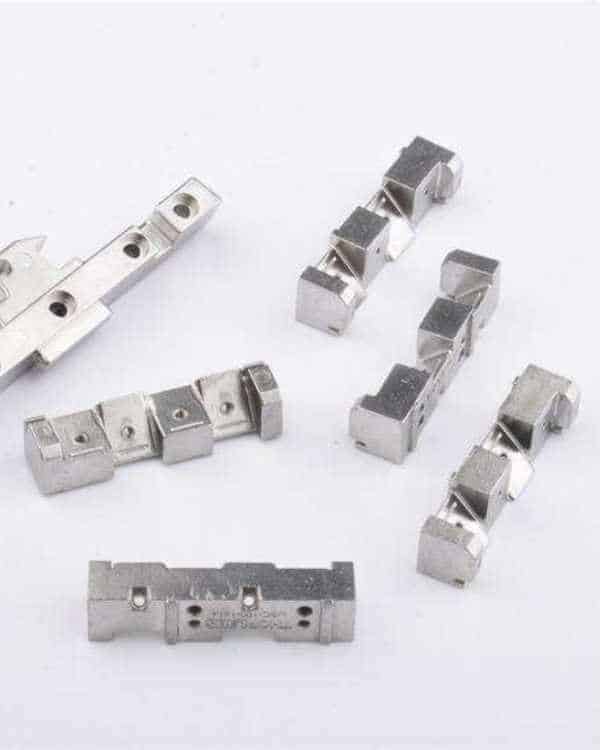
MIM 420 Stainless Steelis a martensitic grade that achieves 50-54 HRC hardness (up to 57 HRC with cryogenic treatment) while enabling complex geometries through Metal Injection Molding. This combination makes it the preferred choice for surgical instruments, aerospace components, and industrial tooling requiring both wear resistance and intricate shapes.
Quick Reference
- Hardness:50-54 HRC standard heat treatment; 55-57 HRC with cryogenic processing
- Strength:Ultimate tensile strength up to 1,370 MPa
- Corrosion Resistance:Moderate—suitable for surgical instruments, not implants
- Primary Advantage:Combines high hardness with complex MIM geometries
- Key Limitation:Single-alloy composition; cannot mix materials in one part
Core Performance Characteristics
MIM 420 delivers wrought-equivalent properties in geometries impossible to machine economically. The material achieves exceptional hardness through heat treatment while MIM enables features like internal channels, undercuts, and wall thickness as thin as 0.5mm.
Chemical Composition
The alloy contains 12-14% chromium for corrosion resistance and 0.15-0.45% carbon for hardenability. This composition represents a trade-off: you sacrifice the superior corrosion resistance of 316L in exchange for exceptional hardness and wear resistance.
| Element | Content (%) | Purpose |
|---|---|---|
| Carbon | 0.15-0.45 | Enables hardening |
| Chromium | 12.00-14.00 | Corrosion protection |
| Manganese | 1.00 max | Processing aid |
| Silicon | 1.00 max | Strength addition |
Mechanical Properties After Heat Treatment
Heat treatment transforms MIM 420 from soft as-sintered condition into a high-performance material. Properties depend on tempering temperature—you control the hardness-toughness balance based on application requirements.
| Tempering Temp | Hardness (HRC) | Tensile Strength (MPa) | Typical Application |
|---|---|---|---|
| 227°C | 48-50 | ~1,450 | Surgical blades, cutting tools |
| 288°C | 44-46 | 1,310 | Mold inserts, wear parts |
| 370°C | 40-42 | 1,170 | Valve components, gears |
Note: Avoid tempering between 425-600°C due to chromium carbide precipitation causing temper embrittlement.
Corrosion Resistance: Understanding the Limits
MIM 420 provides moderate corrosion resistance adequate for surgical instruments with intermittent sterilization, industrial environments, and fresh water systems. Properly hardened, polished, and passivated parts withstand 72-96 hours in salt spray testing before red rust appears.
The material fails in marine environments, continuous chloride exposure, and strong acids. For implantable medical devices requiring years of body fluid contact, use 316L instead. Maximum corrosion resistance requires fully hardened condition with polished surface finish (Ra < 0.8 μm) and passivation treatment.
Primary Applications
Medical and Dental Instruments
The medical device industry relies on MIM 420 for instruments requiring edge retention, wear resistance, and sterilization compatibility. At 50-54 HRC, surgical scalpels and scissors maintain sharp cutting edges through hundreds of sterilization cycles and extended procedures.
Typical applications: surgical scalpels and scissors, orthopedic curettes and bone cutters, biopsy punches, dental explorers and scalers, endoscopic instrument actuators, and articulation joints. The material's hardness substantially exceeds what austenitic 316L can achieve (~15 HRC), making it essential for cutting applications.
Critical distinction: MIM 420 is biocompatible for non-implantable devices with short-term tissue contact during surgical procedures. For long-term implants like orthopedic screws or cardiovascular stents, use 316L or titanium alloys due to superior long-term corrosion resistance.
Aerospace Components
Aerospace adoption demonstrates MIM 420's capability in applications where failure consequences are catastrophic. The material appears in fuel system components (injector nozzles, valve elements), structural hardware (latching mechanisms, hinges, specialty fasteners), and interior systems (seat belt mechanisms, galley latches).
With heat-treated tensile strength up to 1,370 MPa and 50-54 HRC hardness, engineers design load-bearing components with minimal mass in geometries requiring extensive machining if produced conventionally. MIM technology entered commercial aerospace in the early 1980s, establishing over 40 years of service history in flight-critical environments.
Industrial Tooling and Components
Glass-filled and mineral-filled engineering plastics are highly abrasive. At 50-54 HRC, MIM 420 mold inserts resist erosive wear from molten plastic flowing at high pressure over millions of cycles, maintaining dimensional accuracy and surface finish.
Applications span injection mold core and gate inserts, power tool gears and ratchet mechanisms, valve seats and check valve components, pump impellers handling abrasive slurries, and high-end cutlery requiring edge retention. Properly heat-treated knife blades maintain cutting ability through 500+ cutting board contacts before requiring sharpening.
Material Comparison and Selection
MIM 420 vs. Common Alternatives
| Property | MIM 420 | MIM 17-4 PH | MIM 316L |
|---|---|---|---|
| Hardness (HRC) | 50-54 | 38-42 | ~15 |
| Tensile Strength (MPa) | 1,370 | 1,200 | 520 |
| Impact Toughness (J) | ~30 | ~100 | ~140 |
| Corrosion Resistance | Moderate | Good | Excellent |
| Magnetic | Yes | Yes | No |
| Best Application | Cutting tools, wear parts | Aerospace, balanced needs | Implants, marine, chemical |
Selection Decision Framework
Choose MIM 420 when:Surface hardness above 48 HRC is required, wear resistance drives component life, cutting edge retention is critical, and moderate corrosion resistance is acceptable. The material typically has a lower feedstock cost than 17-4 PH.
Choose MIM 17-4 PH when:Impact toughness is critical (~100 J versus ~30 J for 420), better corrosion resistance is necessary for coastal atmospheres, fatigue loading is a primary concern, or aerospace qualification is required with established databases.
Choose MIM 316L when:Superior corrosion resistance is critical for marine environments or chemical processing, maximum ductility is required (~40% elongation), non-magnetic properties are necessary for MRI compatibility, or biocompatibility for long-term implantation is required.
Heat Treatment Fundamentals
Heat treatment transforms as-sintered MIM 420 at ~96 HRB into high-performance material at 50-54 HRC. The process requires austenitizing at 1,010-1,066°C with oil or high-pressure gas quenching, followed immediately by tempering at 150-370°C for 1-2 hours per inch of section thickness.
For thin-walled MIM components, vacuum heat treatment with gas quenching dramatically reduces distortion versus oil quenching—critical since you have no stock for corrective machining. Strictly avoid tempering between 425-600°C due to chromium carbide grain boundary precipitation causing severe embrittlement.
Advanced Processing Options
Cryogenic Treatment:Sub-zero processing at −80°C for 2+ hours immediately after quenching converts retained austenite to martensite, increasing hardness by 2-3 HRC points and enabling 55-57 HRC in optimized conditions. This improves dimensional stability with less than 0.0002 in/in long-term dimensional change.
Hot Isostatic Pressing (HIP):For fatigue-critical aerospace and medical applications, HIP at 1,150°C under 100-200 MPa argon pressure eliminates residual microporosity. Density increases from 97-98% to over 99.5% theoretical, improving fatigue life by 30-50%.
Surface Treatments:Passivation (ASTM A967) optimizes the chromium oxide layer and is mandatory for medical devices. Electropolishing achieves Ra less than 0.4 μm for surgical instruments. Black oxide or nitride coatings enhance aesthetics and mild corrosion resistance for consumer products.
Frequently Asked Questions
Q: What hardness can I reliably achieve with MIM 420?
Standard heat treatment consistently achieves 50-54 HRC. With cryogenic treatment at −80°C for 2+ hours between quenching and final tempering, hardness reaches 55-57 HRC by converting retained austenite to martensite. This substantially exceeds 316L (~15 HRC) and 17-4 PH (38-42 HRC). Always specify both target hardness range and tempering temperature since "MIM 420" alone does not define a property set.
Q: How does corrosion resistance compare to 316L?
MIM 420 offers moderate corrosion resistance adequate for mild atmospheres, fresh water, sterilization cycles, and non-marine industrial environments. Properly hardened, polished, and passivated MIM 420 withstands approximately 72-96 hours in salt spray testing before red rust appears. 316L exceeds 1,000 hours under the same test. For implantable devices requiring continuous body fluid contact, 316L is required. The trade-off: 420 achieves 50-54 HRC hardness impossible with 316L.
Q: Can MIM 420 be used for implantable medical devices?
No. MIM 420 is biocompatible for non-implantable devices with short-term tissue contact during surgical procedures, not long-term implants. For implantable devices like orthopedic screws, bone plates, or cardiovascular stents requiring years of body fluid exposure, specify 316L stainless steel or titanium alloys. Use MIM 420 for surgical instruments where hardness and edge retention drive performance.
Q: What is the maximum operating temperature?
Continuous service temperature limit is approximately 300°C. The critical rule: never exceed your final tempering temperature in service. If you tempered at 260°C to achieve ~50 HRC, sustained exposure above 260°C causes progressive softening. For sustained high-temperature service above 300°C, specify 17-4 PH (maintains properties to ~400°C) or tool steels.
Q: How do I prevent distortion during heat treatment?
Vacuum heat treatment with high-pressure gas quenching (10-20 bar) dramatically reduces distortion compared to oil quenching—critical for thin-walled MIM parts. Additional strategies include designing uniform wall thickness, using proper fixturing during heat treatment, specifying multiple tempering cycles (2-3 cycles) for stress relief, and working with heat treaters experienced specifically in MIM components.
Making the Decision
MIM 420 stainless steel delivers exceptional hardness (50-54 HRC standard, up to 57 HRC with cryogenic processing) and ultimate tensile strength up to 1,370 MPa in complex geometries impossible to machine economically. This combination makes it the preferred choice for surgical cutting instruments, aerospace structural components, and high-strength industrial tooling.
The material's versatility stems from heat treatment tunability—temper at 227°C for maximum hardness in cutting applications, or at 370°C for enhanced toughness in structural parts. Same material, different performance profiles based on application requirements.
Choose MIM 420 when hardness and wear resistance dominate requirements and moderate corrosion resistance is acceptable. For superior corrosion resistance in marine environments or implantable devices, specify 316L. For balanced toughness with high strength in aerospace applications, select 17-4 PH. Always specify complete heat treatment requirements including target hardness range and tempering temperature—"MIM 420" alone does not define a property set.
Precision Metal Parts from Emitech
Nanjing Emitech delivers MIM, CNC machining, and custom metal parts. MIM services · Request a quote
Last updated: 2026-08-01
Continue reading
- Metal Injection Molding vs. Stamping: Choosing the Best Process for Your Parts
- Metal Injection Molding with Hot Isostatic Pressing: Complete Engineering Guide to Achieving 99.9% Density
- Metal Powder Sintering Temperature Guide: Optimal Settings for Different Alloys
- MIM 304 Stainless Steel: High-Temperature, Oxidation, and Corrosion Resistance