
Your heat exchanger component just failed after six months in a 600°C steam environment—even though 304 stainless steel is rated for high-temperature service.The issue isn't the alloy itself; it's sensitization during processing that depleted chromium at grain boundaries, destroying corrosion resistance. Understanding how temperature exposure and corrosive environments interact with MIM 304's microstructure is critical for preventing costly failures.
By Mike, MIM Metallurgist specializing in high-temperature corrosion failures. Last updated: October 2025.
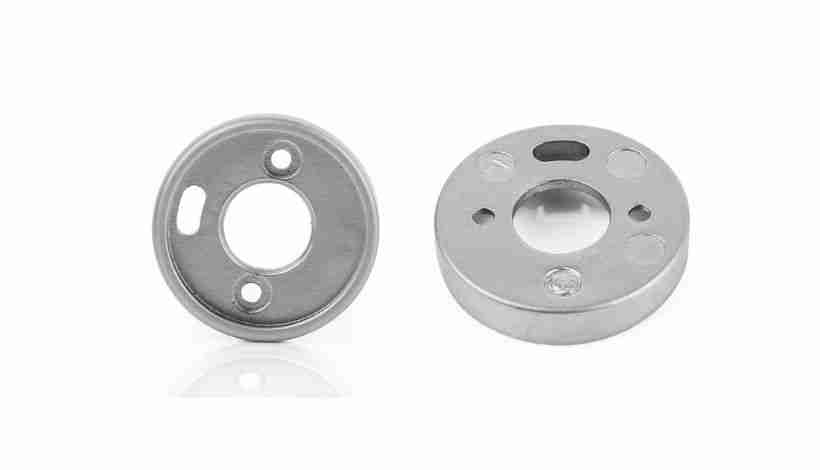
High-precision MIM 304 stainless steel components showcasing the dimensional accuracy and surface finish achievable through metal injection molding process
Key Takeaways
- Sensitization Danger Zone:Exposure between 425-860°C causes chromium carbide precipitation; use304Lto prevent intergranular corrosion in wet environments.
- Chloride Thresholds:MIM 304 resists pitting below 100ppm chlorides at low temps but fails rapidly in seawater or >200ppm environments where316Lis required.
- Porosity Impact:Residual 1-3% porosity lowers effective corrosion resistance by 10-20°C; specifyelectropolishingto seal surface-connected pores.
- High-Temp Limits:Maximum continuous service is920°C(oxidation limit), but304His mandatory for structural loads above 500°C due to creep strength.
- Critical Design Factor:Apply a1.5-2.0x safety factorfor high-temperature creep calculations and ensure rapid cooling through the sensitization range.
Why High-Temperature and Corrosion Resistance Matter for MIM 304
When you specify MIM 304 stainless steel, you're selecting it for one primary reason: its ability to resist environmental degradation. The 18% chromium and 8% nickel composition creates a material that excels in three critical areas:
- High-temperature stabilityup to 920°C continuous service
- Oxidation resistancethrough protective chromium oxide scale formation
- Corrosion resistancevia a self-healing passive film
However, MIM processing introduces microstructural features—primarily 1-3% residual porosity—that affect these properties in ways that wrought 304 doesn't experience. More critically, the thermal cycles during sintering and any subsequent heat exposure can triggersensitization, a metallurgical phenomenon that catastrophically degrades corrosion resistance.
This guide focuses exclusively on how MIM 304 performs in elevated temperature and corrosive environments, when it succeeds, when it fails, and how to select the right variant (304, 304L, or 304H) for your specific operating conditions.
Understanding Metal Injection Molding Process
Professional overview of the metal injection molding process, covering material selection, molding, debinding, and sintering stages (5:08)
High-Temperature Performance: Service Limits and Thermal Stability
Understanding Your Temperature Operating Windows
MIM 304's high-temperature capability isn't a single number—it's a series of distinct temperature regimes, each with different metallurgical behaviors and design implications.
| Temperature Range | Material Behavior | Primary Concerns | Recommended Grade |
|---|---|---|---|
| Room temp to 425°C | Stable austenitic structure | None—full performance | Any 304 variant |
| 425-860°C | DANGER ZONE:Sensitization risk | Chromium carbide precipitation | 304L only |
| 500-800°C continuous | Creep becomes significant | Long-term deformation under load | 304H preferred |
| 860-920°C | Stable high-temp operation | Oxidation, scaling | 304H for structural loads |
| >920°C | Excessive oxidation | Rapid material degradation | Consider higher alloys |
Critical insight:The 425-860°C sensitization window is more dangerous to your component's corrosion resistance than the high temperature itself. A part that operates at 700°C is safe, but if it cools slowly through 600°C during shutdown, you've just created a component that will fail catastrophically in subsequent aqueous corrosion.
Continuous vs. Intermittent Service
Continuous Service (24/7 operation):
- Maximum temperature: 920°C (1690°F)
- Optimal grade: 304Hfor applications above 500°C requiring structural integrity
- Design consideration:Creep strength becomes limiting factor above 500°C
Intermittent Service (cyclic heating/cooling):
- Maximum temperature: 870°C (1600°F)
- Critical risk:Each thermal cycle through 425-860°C increases sensitization unless cooling is rapid
- Optimal grade: 304Lif cycling through sensitization range frequently
Creep Strength: When Temperature Meets Long-Term Loading
Above approximately 500°C, MIM 304 components under sustained load experience creep—time-dependent plastic deformation. Your part will slowly elongate, even under stresses well below the yield strength.
Creep rate comparison at 600°C, 100 MPa stress:
| Material | Creep Rate | 100,000-Hour Rupture Strength |
|---|---|---|
| MIM 304 | Moderate | ~70 MPa |
| MIM 304H | Lower (better) | ~85 MPa |
| Wrought 304H | Lowest (best) | ~90 MPa |
Engineering implication:For boilers, pressure vessels, and heat exchangers operating above 500°C, always specify 304H. The higher carbon content (0.04-0.10% vs. 0.08% max in standard 304) provides carbide strengthening that resists creep deformation.
Design safety factor:Apply a 1.5-2.0x safety factor on stress calculations for MIM 304H in creep regimes due to residual porosity effects.
Oxidation Resistance: The Protective Chromium Oxide Barrier
How MIM 304 Protects Itself at High Temperatures
When you expose MIM 304 to high-temperature oxidizing environments, a remarkable protective mechanism activates. The 18-20% chromium content reacts with atmospheric oxygen to form a dense, adherent chromium oxide (Cr₂O₃) scale on the surface.
Scale formation kinetics:
- Below 600°C:Very slow oxidation; scale thickness ~1-2 μm after 1000 hours
- 600-800°C:Moderate oxidation; scale thickness ~5-10 μm after 1000 hours
- 800-920°C:Active oxidation; scale thickness ~20-40 μm after 1000 hours
- Above 920°C:Excessive oxidation; scale becomes non-protective and begins spalling
Oxide Scale Composition and Stability
The protective scale isn't pure Cr₂O₃—it's a complex, multi-layered structure:
Outer layer:Mixed iron-chromium oxides (Fe₂O₃, FeCr₂O₄ spinel)
Middle layer:Chromium-rich oxide (Cr₂O₃)—the primary protective barrier
Inner layer:Chromium-depleted substrate with potential manganese/silicon enrichment
Why this matters:The integrity of this scale determines your component's lifespan. Thermal cycling causes differential expansion between the oxide and metal, potentially causing scale cracking and spalling. Once the protective Cr₂O₃ layer is compromised, rapid catastrophic oxidation can occur.
Atmosphere Effects on Oxidation Performance
| Atmosphere | Oxidation Rate | Scale Characteristics | Max Recommended Temp |
|---|---|---|---|
| Air | Baseline | Protective Cr₂O₃ scale | 920°C continuous |
| Oxygen-enriched | 2-3x faster | Thicker, more Fe-rich scale | 850°C continuous |
| Steam/wet air | 1.5-2x faster | More prone to spalling | 870°C continuous |
| Reducing (H₂, CO) | Variable | Non-protective; internal oxidation risk | Not recommended |
| Sulfur-containing | Catastrophic | Scale breakdown; rapid failure | Avoid—use Ni-based alloys |
Critical warning:If your application involves sulfur-containing gases (H₂S, SO₂) at elevated temperatures, MIM 304 isunsuitable. Sulfur disrupts the protective chromium oxide, causing rapid accelerated corrosion. Consider nickel-based superalloys instead.
MIM Porosity Effects on High-Temperature Oxidation
The 1-3% residual porosity in MIM components creates additional oxidation concerns not present in wrought 304:
Surface-connected pores:Act as pathways for oxygen ingress, creating internal oxidation ahead of the main surface scale. This can result in:
- Subsurface void formation
- Reduced effective load-bearing cross-section
- Preferential crack initiation sites under thermal cycling
Mitigation strategies:
- Specify minimum density:Require ≥97.5% theoretical density (7.80 g/cm³)
- Surface sealing:Electropolishing removes 10-30 μm of surface material, sealing shallow porosity
- Hot Isostatic Pressing (HIP):Post-sinter densification to >99.5% eliminates internal porosity concerns
Corrosion Resistance: The Passive Film and Its Vulnerabilities
The Chromium Oxide Passive Film: Your Primary Defense
At ambient and moderate temperatures, MIM 304's corrosion resistance depends entirely on a 2-4 nanometer passive film of chromium oxide that forms spontaneously on the surface. This invisible barrier:
- Forms within seconds of exposure to oxygen
- Self-heals when scratched (if oxygen is present)
- Remains stable in pH range of approximately 4-12
- Provides protection in most atmospheric and aqueous environments
The critical threshold:This passive film requires minimum 12% chromium in the immediate surface region. Standard 304 with 18% chromium has substantial margin—which is why sensitization (chromium depletion) is so dangerous.
Corrosion Performance by Environment
Understanding where MIM 304 excels and where it fails is essential for reliable design:
| Environment | Performance | Expected Life | Mechanism | Upgrade Recommendation |
|---|---|---|---|---|
| Fresh water | Excellent | >20 years | Stable passive film | None needed |
| Atmospheric (rural) | Excellent | >30 years | Minimal attack | None needed |
| Atmospheric (urban/industrial) | Very good | 15-25 years | Surface staining only | None needed |
| Atmospheric (marine, >1km from ocean) | Good | 10-15 years | Mild pitting possible | Consider 316L for critical apps |
| Dilute acids (organic, <5%) | Good | Variable | Depends on oxidizing/reducing nature | Test specific conditions |
| Alkaline solutions (pH 8-12) | Very good | >10 years | Passive film stable | None needed |
| Chloride <100 ppm, <60°C | Good | 5-15 years | Marginal pitting risk | Monitor periodically |
| Chloride >200 ppm, any temp | Poor | <2 years | Pitting and crevice corrosion | Upgrade to 316L minimum |
| Seawater | Unacceptable | Weeks to months | Rapid pitting failure | Upgrade to duplex or super-austenitic |
| Swimming pools (chlorinated) | Poor | <3 years | Pitting under deposits | Upgrade to 316L |
| Food processing | Excellent | >15 years | FDA-approved, easy cleaning | 304L preferred for welded equipment |
Chloride-Induced Corrosion: Your Primary Failure Mode
If your MIM 304 component fails unexpectedly in corrosion, chloride ions are the most likely culprit. Chlorides are uniquely aggressive because they:
- Penetrate the passive filmat defect sites
- Prevent film repairby concentrating in incipient pits
- Create autocatalytic conditionswhere corrosion accelerates exponentially
Pitting corrosion mechanism:
Once a pit initiates (typically at surface inclusions or pores), the environment inside becomes:
- Highly acidic (pH drops to 2-3)
- Oxygen-depleted (passive film cannot reform)
- Chloride-concentrated (100-1000x bulk concentration)
- Anodic relative to surrounding surface (electrochemical driving force)
Critical pitting temperature (CPT):For MIM 304, pitting becomes increasingly probable above:
- 25°C:500+ ppm Cl⁻ (marginal)
- 40°C:200-300 ppm Cl⁻ (high risk)
- 60°C:100 ppm Cl⁻ (very high risk)
- 80°C+:Any chloride presence (failure expected)
MIM-specific consideration:Surface-connected pores lower your effective CPT by approximately 10-20°C compared to wrought 304 because pores act as pre-existing micro-crevices where chloride-rich, oxygen-depleted conditions develop rapidly.
Crevice Corrosion in Stagnant Conditions
Even without chlorides, MIM 304 can fail via crevice corrosion in tight gaps or shielded areas where:
- Fluid circulation is restricted
- Oxygen cannot replenish
- pH drops locally
Common crevice corrosion scenarios:
- Under gaskets or O-rings
- In threaded connections
- Between overlapping surfaces
- Inside surface-connected pores in MIM parts
Critical crevice temperature (CCT):Temperature above which crevice corrosion initiates in stagnant seawater:
- Wrought 304:~15-20°C
- MIM 304:~5-10°C (lower due to porosity providing crevice sites)
Design mitigation:
- Eliminate crevices through design (full-penetration welds, sealed joints)
- Ensure fluid circulation and aeration
- Specify electropolished surface finish to seal surface porosity
- Upgrade to 316L if crevice conditions are unavoidable
Stress Corrosion Cracking (SCC): The Overlooked Risk
When three factors combine—susceptible material, tensile stress, and chloride environment—sudden brittle fracture can occur without warning:
- Susceptible material:Austenitic stainless steels like 304
- Tensile stress:>30% of yield strength (applied load or residual stress)
- Specific environment:Chlorides + temperature >60°C
SCC failure characteristics:
- Transgranular cracking (through grain bodies)
- Catastrophic sudden fracture
- Minimal visible surface corrosion before failure
- Requires only trace chloride levels (>10 ppm at 100°C)
Surprising advantage:Research indicates MIM 304 may beless susceptible to SCCthan cold-worked wrought 304 because:
- Fine, equiaxed grain structure (vs. elongated grains in rolled plate)
- Lower residual stress state after sintering
- Stress relief at grain boundaries during sintering
However, don't rely on this advantage—if SCC conditions exist, upgrade to duplex stainless steel, which has inherent SCC immunity.
The Sensitization Problem: When Temperature Destroys Corrosion Resistance
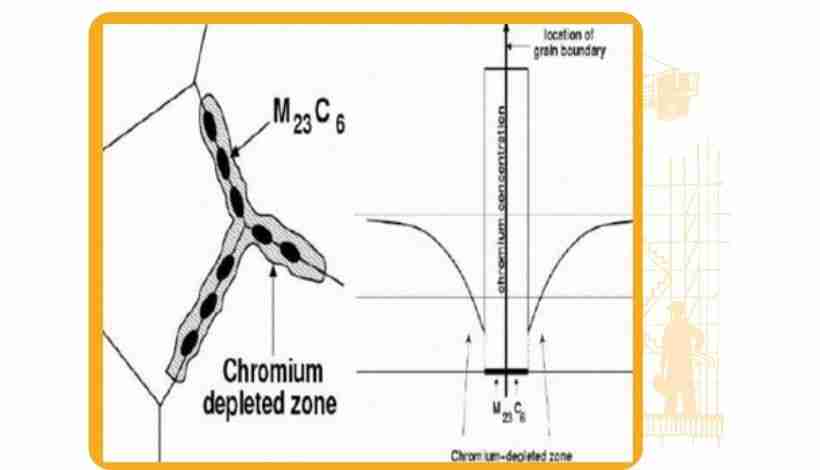 Above: Normal austenitic stainless steel microstructure. Right: Sensitized microstructure showing chromium carbide precipitation at grain boundaries
Understanding Sensitization: Chromium Carbide Precipitation
Sensitization is the most insidious failure mode for MIM 304 because it occurs during processing or service, often before the part ever sees its intended corrosive environment. The part emerges from your furnace looking perfect, passes dimensional inspection, but is metallurgically compromised and destined to fail.
What happens during sensitization:
When MIM 304 is held at or slowly cooled through 425-860°C (800-1580°F):
- Carbon atoms diffuseto grain boundaries (high-energy defect sites)
- Chromium carbides (Cr₂₃C₆) precipitatealong grain boundaries
- Adjacent regions become chromium-depleted(falling below 12% Cr threshold)
- Grain boundaries lose passivityand become anodic relative to grain interiors
- Intergranular corrosionproceeds rapidly along these depleted zones in subsequent aqueous exposure
Time-temperature relationship:
| Temperature | Time to Sensitization |
|---|---|
| 500°C | >100 hours |
| 600°C | 5-20 hours |
| 650-700°C | 1-5 hours (peak sensitivity) |
| 750°C | 5-10 hours |
| 850°C | >50 hours |
Critical implication:The peak sensitization occurs at 650-700°C—right in the middle of many heat treatment, stress relief, and welding thermal cycles.
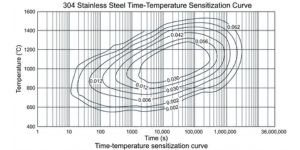 TTS diagram illustrating how carbon content affects sensitization onset time, with low-carbon grades (304L) providing extended resistance to grain boundary sensitization
How MIM Processing Can Cause Sensitization
Standard MIM 304 faces three sensitization risks:
Risk #1: Slow cooling after sintering
- Sintering at 1350-1380°C fully dissolves all carbides
- Cooling rate through 860-425°C determines whether carbides re-precipitate
- Controlled furnace cooling (common for dimensional stability) = sensitization
- Solution:Rapid cooling or quenching mandatory
Risk #2: Incomplete debinding
- Residual binder carbon remains in pore structure
- During sintering, this carbon diffuses into stainless steel matrix
- Locally elevated carbon content exceeds 0.08% specification
- Enhanced carbide precipitation during cooling
- Solution:Validate complete debinding; measure residual carbon <0.02%
Risk #3: Post-sinter heat treatment
- Stress relief, solution annealing, or secondary processing in 425-860°C range
- Even brief exposures (30-60 minutes) can sensitize if grade selection is wrong
- Solution:Use 304L for any post-sinter thermal processing
Detecting Sensitization: Laboratory Testing
You cannot visually detect sensitization—it's a microstructural phenomenon requiring metallurgical testing:
ASTM A262 Practice E (Strauss Test):
- Immerse specimen in boiling copper sulfate-sulfuric acid solution for 24 hours
- Non-sensitized: No cracks visible at 10X magnification
- Sensitized: Intergranular cracks visible
- Limitation:Pass/fail only; doesn't quantify degree of sensitization
Electrochemical Potentiokinetic Reactivation (EPR):
- Measures chromium depletion quantitatively
- Provides degree of sensitization (DOS) value
- DOS <5% = acceptable; DOS >10% = likely field failure
- Advantage:Quantitative, suitable for process control
Metallographic examination:
- Polish and etch sample with oxalic acid
- Ditch structure at grain boundaries indicates sensitization
- Step structure = non-sensitized
- Advantage:Direct visual confirmation of microstructure
Preventing Sensitization: Grade Selection Strategy
| Application Scenario | Recommended Grade | Rationale |
|---|---|---|
| High-temp service >500°C, no corrosion | 304H | Maximum creep strength; sensitization acceptable if no aqueous exposure |
| High-temp cycling through 425-860°C + corrosion | 304L | Low carbon prevents sensitization during thermal cycling |
| Welded components | 304L | Heat-affected zone will be sensitized unless low carbon |
| As-sintered, no post-processing | 304 | Standard grade acceptable if cooling is controlled |
| Post-sinter heat treatment required | 304L | Prevents sensitization during secondary thermal exposure |
| Maximum corrosion resistance required | 304L + solution anneal | Guarantees chromium in solution at grain boundaries |
Solution annealing to reverse sensitization:
If your MIM 304 or 304H components become sensitized, you can restore corrosion resistance:
- Heat to 1010-1120°C (1850-2050°F)
- Hold for sufficient time to dissolve carbides (typically 30-60 minutes)
- Rapidly coolthrough 860-425°C (water quench or forced-air cooling)
- Result: Chromium returns to solid solution; corrosion resistance restored
Material Selection: 304 vs. 304L vs. 304H Decision Framework
Your Environmental Conditions Dictate Material Choice
Use this decision tree to select the optimal grade:
START: What is your maximum operating temperature?
→Below 425°C:
- No sensitization risk
- Any corrosion concerns?
- NO → Standard304
- YES (chlorides, acids) →304Lfor maximum corrosion resistance
→425-860°C (cycling or sustained):
- High sensitization risk zone
- Will component see aqueous corrosion after thermal exposure?
- NO (dry service only) →304Hif creep is concern, otherwise304
- YES (wet environments, chemicals) →304L mandatory
→Above 860°C continuous:
- Primary concerns: creep and oxidation
- Structural loads >50 MPa?
- YES →304H(superior creep strength)
- NO → Standard304acceptable
THEN: Evaluate corrosion environment
→Freshwater, atmosphere, mild chemicals:
- Any grade adequate
- Use304Lif welding required
→Chlorides 100-200 ppm OR temp 40-60°C:
- Marginal for any 304 grade
- Consider316Lfor long-term reliability
→Chlorides >200 ppm OR seawater OR temp >60°C with any chlorides:
- 304 unsuitable—upgrade to 316L or higher
Real-World Application Examples
Grade selection should be based on operating temperature, corrosion exposure, and loading conditions. For thermal cycling through the sensitization range followed by aqueous exposure, 304L is normally preferred. For sustained loads above 500°C, 304H or higher alloys provide better creep resistance. For chloride-rich environments, 316L or super-austenitic grades are typically required.
When to Upgrade from 304 to Higher Alloys
304 vs. 316L: The Molybdenum Advantage
The single most common upgrade decision. Grade 316L adds 2-3% molybdenum, which:
Improves:
- Pitting resistance in chlorides (CPT increase of ~20-30°C)
- Crevice corrosion resistance (CCT increase of ~15-25°C)
- Performance in acidic environments
- Resistance to reducing acids (sulfuric, phosphoric)
Doesn't improve:
- High-temperature oxidation resistance (similar to 304)
- Maximum service temperature (same 920°C limit)
- General atmospheric corrosion (both excellent)
Cost penalty:Higher material cost than 304
Upgrade to 316L when:
- Chloride concentration exceeds 100 ppm continuously
- Temperature + chloride combination exceeds 304 CPT envelope
- Seawater, brackish water, or deicing salt exposure
- Medical implants or marine hardware
- Regulatory requirements specify 316L (some FDA applications)
[caption id="attachment_15327" align="aligncenter" width="780"]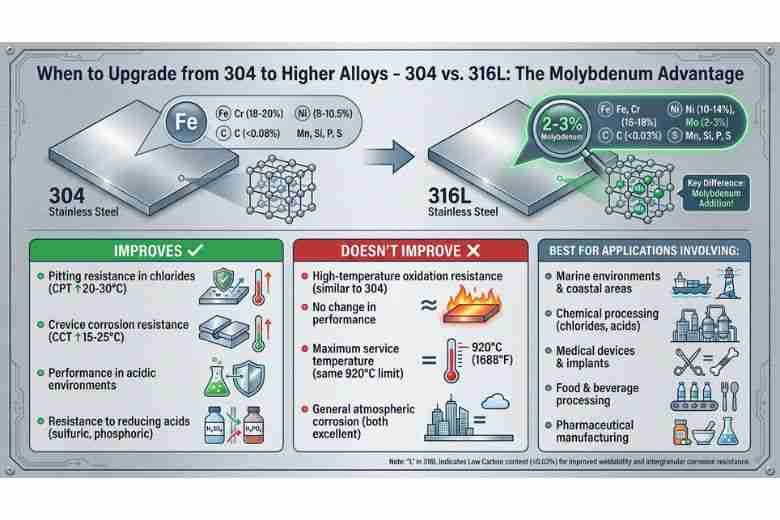 Comprehensive comparison of 304 and 316L stainless steel grades highlighting the 2-3% molybdenum addition in 316L, performance improvements in chloride and acidic environments, cost implications, and specific conditions requiring material upgrade[/caption]
Beyond 316L: Duplex and Super-Austenitic Grades
When 316L isn't enough:
→Duplex stainless steels (2205, 2507):
- Use when:Chloride SCC is risk; high-strength + corrosion needed
- Advantages:2x yield strength of 304; immune to chloride SCC; excellent pitting resistance
- Limitations:Not available in standard MIM (special processing required); maximum temp ~300°C
→Super-austenitic (6% Mo grades like 254 SMO, AL-6XN):
- Use when:Extreme chloride resistance required (seawater, hot brines)
- Advantages:PRE (Pitting Resistance Equivalent) >40 vs. ~18 for 304
- Limitations:Expensive; limited MIM availability; maximum temp ~400°C
→Nickel-based superalloys (Inconel, Hastelloy):
- Use when:Extreme high-temperature (>920°C) + corrosion; sulfur-containing atmospheres
- Advantages:Service to 1100°C+; superior oxidation and sulfidation resistance
- Limitations:Very expensive; specialized MIM processing; difficult to machine
MIM-Specific Corrosion Considerations
How Residual Porosity Affects Corrosion Performance
The 1-3% porosity in MIM components creates corrosion concerns not present in wrought material:
Surface-connected pores (0.1-1% of pore volume):
- Act as micro-crevices where corrodent becomes trapped
- Create oxygen-depleted, acidified local environments
- Serve as initiation sites for pitting in chloride exposure
- Harbor bacteria in medical/food applications if not sealed
Quantitative impact:
- Critical pitting temperature:10-20°C lower than wrought 304
- Critical crevice temperature:10-15°C lower than wrought 304
- General corrosion rate:Typically <10% increase vs. wrought in most environments
Mitigation strategies:
1. Density specification:
- Require minimum 97.5% theoretical density (7.80 g/cm³)
- Higher density = less porosity = better corrosion resistance
2. Surface sealing treatments:
| Treatment | Effect | Relative Cost | Best Application |
|---|---|---|---|
| Passivation (citric/nitric acid) | Removes free iron; enhances passive film | Low | Standard practice for all parts |
| Electropolishing | Removes 10-30 μm surface; seals shallow pores | Moderate | Medical, food, high-corrosion |
| Impregnation (resin) | Fills open porosity; creates barrier | Moderate | Pressure containment, leak-tight requirements |
| HIP (Hot Isostatic Pressing) | Collapses internal pores to <0.2% | High | Maximum corrosion resistance required |
3. Design modifications:
- Avoid stagnant pockets where corrodent can concentrate
- Design for drainage and aeration
- Specify electropolished finish for fluid-contact surfaces
Test Data: MIM 304 vs. Wrought 304 in Corrosive Environments
Salt spray testing (ASTM B117) - 5% NaCl, 35°C:
| Material | Time to First Corrosion | Corrosion Rate |
|---|---|---|
| Wrought 304 (mill finish) | 240+ hours | Minimal surface staining |
| MIM 304 (as-sintered, 96% dense) | 180-220 hours | Light surface pitting |
| MIM 304 (as-sintered, 98% dense) | 220-260 hours | Minimal surface staining |
| MIM 304 (electropolished, 96% dense) | 240+ hours | Equivalent to wrought |
Conclusion:High-density MIM 304 with proper surface treatment performs equivalently to wrought material in standard accelerated corrosion testing.
Frequently Asked Questions
Q: Q1: Can MIM 304 handle thermal cycling between room temperature and 700°C?
Yes, but grade selection is critical.If your component cycles repeatedly through the 425-860°C sensitization zone:
- Use 304Lif the component will see any aqueous corrosion (condensation, cleaning chemicals, atmospheric moisture)
- Standard 304 or 304H acceptableonly if service is completely dry (inert atmosphere, vacuum)
The cycling itself doesn't damage the material, but each slow cool-down through 600°C allows chromium carbide precipitation. After 50-100 cycles, standard 304 will be heavily sensitized and will fail rapidly in corrosive environments.
Q: Q2: How do I know if my MIM 304 parts are sensitized?
You cannot visually detect sensitization. Laboratory testing is required:
Field test (if corrosion suspected):
- Perform ASTM A262 Practice E (Strauss test)
- If intergranular cracks appear after 24-hour boil test, parts are sensitized
- Action:Solution anneal to restore corrosion resistance or scrap and re-specify 304L
Process control (preventing issues):
- Implement EPR (Electrochemical Potentiokinetic Reactivation) testing
- Test samples from each sintering lot
- Establish DOS (Degree of Sensitization) acceptance limit <5%
- Adjust furnace cooling profiles if sensitization detected
Q: Q3: Will MIM 304 rust in coastal environments?
It depends on distance from ocean and local microclimate:
- >5 km inland:Excellent performance; minimal visible corrosion over decades
- 1-5 km from ocean:Good performance but expect surface staining; life >15 years
- <1 km from ocean:Fair performance; visible pitting after 5-10 years;consider 316L
- Direct salt spray or tidal zone:Poor performance; pitting within 1-2 years;upgrade to 316L minimum
MIM-specific concern:Surface porosity can trap salt crystals, creating locally concentrated chloride environments.Mitigation:Specify electropolished finish for coastal applications.
Q: Q4: What's the maximum continuous operating temperature for MIM 304 under load?
Temperature limits by application type:
| Application Type | Max Continuous Temp | Recommended Grade | Limiting Factor |
|---|---|---|---|
| Structural (>50 MPa stress) | 550-650°C | 304H | Creep deformation |
| Non-structural | 870-920°C | 304 or 304H | Oxidation scaling |
| Thermal cycling | 870°C | 304L | Sensitization + thermal fatigue |
| Corrosive atmosphere | 650°C | 304L | Hot corrosion |
Critical design rule:Above 500°C under sustained load, apply 1.5-2.0x safety factor to account for creep. Consult ASME Boiler Code Section II Part D for temperature-dependent allowable stresses.
Q: Q5: Can sensitized MIM 304 be "fixed" or is it permanent?
Yes, sensitization is reversible through solution annealing:
Process:
- Heat parts to 1010-1120°C (1850-2050°F)
- Hold for 30-60 minutes (1 hour recommended for heavy sections)
- Rapidly coolthrough 860-425°C (water quench, oil quench, or forced air)
- Result: Chromium carbides dissolve; chromium returns to solid solution
Challenges:
- Dimensional changes of 0.1-0.3% may occur
- Requires controlled atmosphere (vacuum or inert gas) to prevent surface oxidation
- Cost adds per part
Better approach:Prevent sensitization by specifying 304L initially for susceptible applications.
Q: Q6: How does MIM 304 compare to 316L for chloride resistance?
Pitting resistance comparison in seawater (ASTM G48):
| Material | Critical Pitting Temp (°C) | PRE Number |
|---|---|---|
| MIM 304 | 15-20°C | ~18 |
| Wrought 304 | 20-25°C | ~18 |
| MIM 316L | 35-45°C | ~24 |
| Wrought 316L | 40-50°C | ~24 |
Practical interpretation:
- 304 adequate:Freshwater, <100 ppm chloride, temperature <40°C
- 316L required:>200 ppm chloride, seawater, brackish water, salt spray, temperature >60°C with any chloride
Cost differential:316L typically costs 15-25% more than 304. For marine or high-chloride applications, this premium is justified by 2-5x longer service life.
Q: Q7: What surface finish should I specify for corrosive environments?
Surface finish recommendations by application:
| Application | Recommended Finish | Ra Roughness | Purpose |
|---|---|---|---|
| Atmospheric exposure | As-sintered + passivation | 0.8-1.5 μm | Cost-effective; adequate for most conditions |
| Food/pharmaceutical | Electropolished | 0.2-0.4 μm | Easy cleaning; bacterial resistance; FDA preferred |
| Chloride environments | Electropolished | 0.2-0.4 μm | Seals surface porosity; enhances passive film |
| Stagnant fluids | Electropolished + passivation | 0.2-0.4 μm | Minimizes crevice sites |
| High-purity applications | Electropolished + high-purity passivation | <0.2 μm | Semiconductor, medical implants |
Cost impact:Electropolishing adds cost per part but can extend service life in aggressive environments.
Q: Q8: Does MIM 304 maintain corrosion resistance after exposure to high temperatures?
It depends on the thermal history:
Scenario 1: Rapid cooling after high-temp exposure
- Heat to 900°C → Rapid cool through 860-425°C → Corrosion resistancePRESERVED
Scenario 2: Slow cooling (typical furnace cooling)
- Heat to 900°C → Slow cool through 600°C (sensitization!) → Corrosion resistanceDESTROYED
Scenario 3: Using 304L grade
- Heat to 900°C → Any cooling rate → Corrosion resistancePRESERVED(low carbon prevents sensitization)
Practical rule:If your component will ever be heated above 425°C and subsequently exposed to corrosive environments,specify 304Lunless you can guarantee rapid cooling every time.
Q: Q9: How do I test MIM 304 parts for chloride pitting resistance before production?
Recommended accelerated testing:
ASTM G48 Method A (Ferric Chloride Pitting Test):
- Immerse samples in 6% FeCl₃ solution at 22°C for 72 hours
- Measure weight loss; calculate corrosion rate
- Acceptance criteria:<10 mg/dm² weight loss
- Advantage:Fast, reproducible, industry-standard
Electrochemical testing (Cyclic Potentiodynamic Polarization):
- Measures pitting potential (Epit) and repassivation potential (Erp)
- Acceptance criteria:Epit > 200 mV vs. SCE; Erp > 0 mV (no hysteresis)
- Advantage:Quantifies pitting resistance; can determine CPT
Salt spray testing (ASTM B117):
- 5% NaCl mist, 35°C, evaluate at 168, 500, 1000 hours
- Acceptance criteria:No pitting visible at 10X magnification
- Limitation:Not quantitative; doesn't correlate well with real-world exposure
Recommended approach:Use ASTM G48 for screening; validate with field exposure testing of actual components.
Q: Q10: Can MIM 304 be passivated like wrought stainless steel?
Yes, and it should be for optimal corrosion resistance.Passivation removes free iron from the surface and enhances the chromium oxide film.
Standard passivation processes for MIM 304:
Citric acid passivation (ASTM A967):
- 4-10% citric acid solution at 21-49°C for 10-30 minutes
- Advantages:Non-hazardous, environmentally friendly, effective
- Standard practicefor most MIM components
Nitric acid passivation (ASTM A967, older QQ-P-35 method):
- 20-25% HNO₃ at 49-60°C for 30-60 minutes
- Advantages:More aggressive cleaning; removes embedded iron
- Use when:Heavy contamination or tight specifications
Post-passivation testing:
- High humidity test (ASTM A967): 24 hours at 95% RH, no rust
- Copper sulfate test (older method): No copper deposit in 6 minutes
- Water break test: Continuous water film (no beading) indicates complete coverage
Cost:Low per part for batch passivation.Strongly recommendedfor all corrosion-critical MIM 304 applications.
Conclusion: Selecting MIM 304 with Confidence for Thermal and Corrosive Service
MIM 304 stainless steel delivers reliable high-temperature and corrosion resistance when you match the material grade to your specific operating conditions. The key is understanding three critical failure mechanisms:
1. Sensitization destroys corrosion resistancewhen chromium carbides precipitate at grain boundaries during slow cooling through 425-860°C.Solution:Use 304L for any application with thermal cycling or post-heating corrosion exposure.
2. Chloride environments cause pitting and crevice corrosionwhen concentration exceeds 100-200 ppm or temperature rises above 40-60°C.Solution:Upgrade to 316L for chloride-containing environments.
3. Residual porosity creates micro-crevice sitesthat lower critical corrosion temperatures by 10-20°C compared to wrought 304.Solution:Specify high density (≥97.5%) and electropolished finish for aggressive environments.
Your material selection checklist:
✅Operating temperature >500°C with structural loads?→ Specify 304H for creep resistance
✅Thermal cycling through 425-860°C with subsequent corrosion exposure?→ Specify 304L to prevent sensitization
✅Chloride concentration >100 ppm or seawater exposure?→ Upgrade to 316L minimum
✅MIM process control critical?→ Require rapid cooling after sintering; validate with EPR testing
✅Surface porosity concerns?→ Specify minimum density 7.80 g/cm³ + electropolished finish
When properly specified and processed, MIM 304 provides cost-effective, long-lasting performance in elevated temperature and corrosive environments across automotive, aerospace, food processing, chemical processing, and industrial applications. The manufacturing economies of Metal Injection Molding—combined with the proven durability of 304 stainless steel—make it the optimal choice for complex, high-volume precision components requiring environmental resistance.
For application-specific material selection guidance, look for MIM manufacturers that provide documented inspection plans and material certificates, plus any industry-specific approvals (such as ISO 13485 for medical devices) appropriate to your sector.
Precision Metal Parts from Emitech
Nanjing Emitech delivers MIM, CNC machining, and custom metal parts. MIM services · Request a quote
Last updated: 2026-06-24