
Sintered vs Machined Parts
Choosing between sintered and machined metal parts determines whether you save 60% on component costs or overspend on unnecessary precision. This guide provides material science data, cost models, and decision frameworks validated across many production parts.
Executive Summary
Sintered metal parts are made by compacting and heating powder to create near-net-shape components with controlled porosity. Machined parts are cut from solid wrought stock, offering maximum density and geometric precision. The best choice depends on production volume, complexity, tolerances, and mechanical requirements. This guide compares the two processes and provides a decision framework.
What Are Sintered vs. Machined Metal Parts?
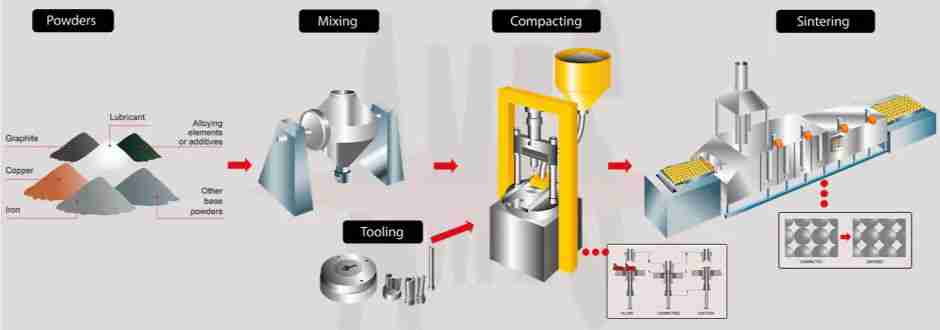
Sintered metal partsare manufactured by compressing metal powder at 400-800 MPa into a desired shape, then heating to 1120°C (below melting point) to fuse particles through solid-state diffusion. This process creates parts with 85-95% material density, leaving controlled residual porosity.
Machined partsare produced by removing material from near-full density wrought stock using CNC cutting tools. The subtractive process creates precise geometry with maximum density and predictable wrought properties.
The fundamental difference:Sintering builds parts from powder with inherent porosity; machining carves parts from solid metal. This distinction determines cost structure, mechanical performance, and design constraints.
At-a-Glance Comparison
| Factor | Machined Parts | Sintered Parts (Standard) | Sintered Parts (Advanced) |
|---|---|---|---|
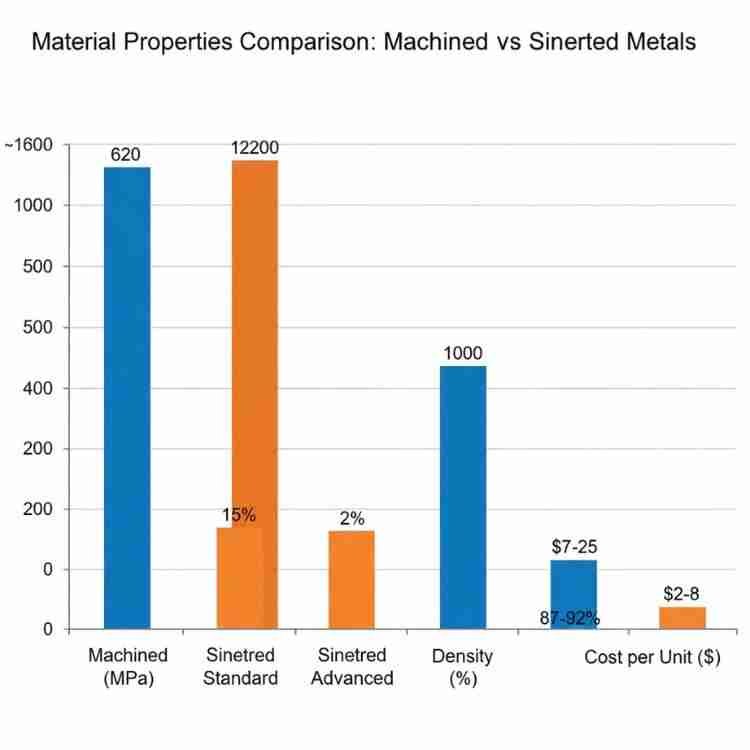
| Material density | 100% (7.85 g/cm³ steel) | 87-92% (6.8-7.2 g/cm³) | 96-98% (7.5-7.7 g/cm³) |
| Tensile strength | 570-700 MPa (AISI 1045) | 480-520 MPa | 1,000-1,200 MPa |
| Elongation | 12-18% | <2% | 2-3% |
| Fatigue endurance ratio | ~50% of UTS | ~35-40% of UTS | ~40-45% of UTS |
| Cost per unit (high vol) | Higher | Lower | Moderate |
| Tooling investment | Low | Moderate | Moderate to high |
| Break-even volume | N/A (no tooling) | 10K-15K units | 8K-12K units |
| Lead time (initial) | 1-3 weeks | 8-12 weeks | 10-14 weeks |
| Material utilization | 30-50% (high waste) | >95% | >95% |
| Tolerance (as-produced) | ±0.025mm | ±0.05mm | ±0.03mm |
| Geometric freedom | Unlimited (tool access) | Constrained (press direction) | Moderate |
| Self-lubrication | Not possible | Achievable (oil impregnation) | Limited (low porosity) |
| Best applications | Prototypes, critical parts, low volume | High-volume gears, bearings, complex shapes | Aerospace, medical, high-performance |
Understanding the Manufacturing Fundamentals
Machined Parts: Subtractive Manufacturing
Machining creates geometry through controlled material removal from wrought feedstock (7.85 g/cm³ for steel). A hardened cutting tool applies shear stress exceeding the material's yield strength, causing localized plastic deformation and fracture to form a chip.
Key characteristic:near-full density material with predictable linear elastic behavior and high ductility (12-18% elongation). Fatigue strength is typically 50% of ultimate tensile strength.
Sintered Parts: Powder Metallurgy
Standard Powder Metallurgy (PM) constructs components from metal powders through compaction and thermal consolidation.
Compaction:Metal powders (50-100 μm particle size) are compressed at 400-800 MPa. Particles deform at contact points, creating mechanical interlocks in a "green part."
Sintering:The green part is heated to 1120°C (2050°F) for ferrous materials. Solid-state diffusion causes atoms to migrate across particle boundaries, fusing particles together. A typical PM part achieves density of 6.8-7.2 g/cm³ (87-92% of wrought steel).
Key characteristic:Residual porosity (8-15% by volume) defines mechanical properties—from lubrication retention to fatigue crack initiation sites.
Material Properties: Beyond Simple Comparisons
Standard Grades Comparison
AISI 1045 (Machined Carbon Steel):
- Ultimate Tensile Strength: 570-700 MPa
- Yield Strength: 310-490 MPa
- Elongation: 12-18%
- Density: 7.85 g/cm³ (near-full density wrought stock)
- Fatigue endurance: ~310 MPa (50% of UTS)
FC-0208-60 (Sintered Iron-Copper-Carbon):
- Ultimate Tensile Strength: 480-520 MPa
- Yield Strength: ~410 MPa
- Elongation: <2%
- Density: 6.8-7.0 g/cm³ (87-89% theoretical)
- Fatigue endurance: ~175-200 MPa (35-40% of UTS)
The critical difference:Standard sintered steel delivers 85-90% of machined steel's tensile strength, butsintered parts lack ductility and fracture rather than yield plastically. This behavior stems from porosity acting as pre-existing crack initiation sites.
Advanced Sintering Grades
FL-5008 and Astaloy CrM (Sinter-Hardened Grades):
- Ultimate Tensile Strength: 1,000-1,200 MPa
- Yield Strength: 900-1,000 MPa
- Hardness: 30-38 HRC as-sintered
- Density: 7.0-7.3 g/cm³
- Fatigue endurance limit: 350-370 MPa (with surface densification)
These materials achieve tensile strengths exceeding many standard wrought carbon steels while maintaining PM's economic advantages.
The persistent trade-off:Elongation remains below 3% even in advanced grades. Ductility is sacrificed for strength.
Density's Non-Linear Effect on Performance
Properties scale non-linearly with porosity reduction:
Impact energy comparison (Charpy V-notch):
- 6.8 g/cm³: 5-8 Joules
- 7.0 g/cm³: 10-15 Joules
- 7.2 g/cm³: 18-25 Joules
- 7.85 g/cm³ (wrought): 40-60 Joules
A density increase from 6.8 to 7.2 g/cm³ (5% improvement) candouble impact resistance.
Economic Analysis: Total Cost of Ownership
Cost comparisons depend heavily on part geometry, material, annual volume, tooling life, and secondary operations. Sintering generally becomes attractive at medium-to-high volumes where tooling can be amortized and material utilization is high. Machining is usually more economical for low volumes, prototypes, or parts requiring very tight tolerances. A detailed quote from each supplier is the only reliable way to compare total cost of ownership.
Frequently Asked Questions
Q: What volume makes sintering cost-effective?
Simple geometry (washers, spacers) breaks even at 5,000-10,000 units; moderate complexity (bushings, gears) at 1,000-3,000 units; high complexity (multi-level parts) at 500-1,500 units. Below these thresholds, tooling amortization of the substantial upfront tooling investment makes sintering uneconomical. Above 10,000 units, the per-piece cost advantages become substantial and dominate.
Q: Can sintered gears handle the same torque as machined gears?
Yes, with proper design. Sinter-hardened grades (FL-5008, Astaloy CrM) routinely handle equivalent torque through wider face widths, optimized tooth profiles, and surface rolling to densify tooth surfaces to near-wrought fatigue resistance. Automotive transmissions worldwide use sintered gears with 500,000+ cycle durability matching OEM requirements.
Q: Are sintered parts as strong as machined parts?
Standard sintered parts achieve 85-91% of comparable machined steel tensile strength. Advanced sinter-hardened grades reach 95%+ and can exceed 1,200 MPa. The key limitation is ductility, not ultimate strength — sintered parts exhibit less than 2% elongation versus 12-18% for wrought steel, meaning they fracture rather than yield plastically under impact or shock loading.
Q: How tight are tolerances with sintered versus machined parts?
As-sintered PM achieves ±0.05mm on diameters and ±0.15mm on lengths. Secondary sizing after sintering achieves ±0.025mm, matching standard CNC capabilities. For hybrid approaches, critical features are machined after sintering to ±0.01mm or tighter. Surface finish is comparable: Ra 0.8-1.6 μm sintered versus Ra 0.8-3.2 μm machined.
Q: What are the main disadvantages of sintered metal parts compared to machined parts?
The three primary limitations are: (1) low ductility — elongation below 2% means sintered parts fracture rather than yield under impact loads, making them unsuitable for shock-loaded safety-critical applications; (2) geometric constraints — axial die pressing prevents undercuts, transverse holes, and complex 3D features without secondary machining; (3) high upfront tooling investment that requires volume above 1,000-10,000 units to amortize economically.
Q: What is the hybrid sintered and machined approach and when should I use it?
The hybrid approach sinters the near-net-shape base geometry (90-95% of material volume) then machines only precision features (5-10% of surfaces). A typical workflow: press and sinter outer diameter and rough bore, then CNC machine the bore to ±0.015mm, face both ends for flatness, and steam treat for corrosion resistance. This achieves 92% material utilization versus 35% for fully machined parts, reducing total cost to 40-45% of a fully machined equivalent while delivering identical functional performance on precision surfaces.
Application Selection Framework
Decision Tree: Sourcing Logic
START: Component sourcing decision
- 1. VOLUME GATE (Annual production quantity?)
- < 1,000 units:Machine
- 1,000 - 10,000 units:Calculate Both(Break-even analysis required)
- > 10,000 units:Continue to Geometry Gate
- 2. GEOMETRY GATE (Can part eject from single-axis die?)
- Yes (Symmetrical, uniform):Press & Sinter PM
- No (Undercuts, complex 3D):Machine(Note: If part <100g with extreme complexity, consider Metal Injection Molding)
- 3. PERFORMANCE GATE (Mechanical requirements?)
- Impact/shock loading critical:Machine
- Extreme fatigue (>10⁶ cycles, high stress):Machine(or High-Density PM + Surface Treatment)
- Self-lubrication needed:PM with Oil Impregnation
- Standard structural loads:Standard PM Sufficient
- 4. PRECISION GATE (Tolerance requirements?)
- ±0.01mm or tighter:Machine
- ±0.05mm acceptable:PM(As-sintered or Sized)
- ±0.1mm acceptable:PM
Hybrid Approach Strategy:Sinter near-net-shape + machine precision features.
Result: Delivers 50-60% cost savings vs. fully machined parts.
Application-Specific Recommendations
- Automotive Powertrain
- Transmission gears (high volume): Sinter-hardened PM + surface rolling + bore machining
- Connecting rods (high stress): Powder forging (near-full density) or machined forging
- Oil pump rotors: Standard PM with infiltration for pressure integrity
- Industrial Bearings
- Self-lubricating bushings: Low-density PM (6.0-6.5 g/cm³) + oil impregnation
- High-load bearings: Machined bronze or high-density sintered bronze with surface densification
- Medical Devices
- Surgical instruments (complex, small): Machined or MIM for extreme complexity
- Hip/knee implants (critical): Machined titanium with full traceability
- Aerospace Components
- Structural parts (safety-critical): Machined from certified wrought stock
- Actuator components (moderate stress): High-density PM with NDE verification
Case Study: Transmission Gear Comparison
A hybrid approach—sintering the base gear geometry and machining only critical features—can combine the material-efficiency advantages of powder metallurgy with the precision of machining. This strategy is common when a part needs both cost-effective volume production and tight tolerances on selected surfaces.
The Hybrid Manufacturing Strategy
Strategy:Sinter near-net-shape (90-95% of material volume) + machine precision features (5-10% of surfaces)
Example workflow for bushing:
- Press and sinter outer diameter, length, and basic bore
- CNC machine bore to ±0.015mm tolerance
- Face both ends for flatness specification
- Steam treat for corrosion resistance
Economic result:
- Material utilization: 92% (versus 35% fully machined)
- Total cost: 40-45% of fully machined equivalent
- Performance: Identical (precision surfaces are machined)
Common Engineering Misconceptions
Misconception 1: "Sintered parts are inherently weak"
Reality:Density determines strength—not the manufacturing process. High-density PM (>7.2 g/cm³) approaches wrought properties within 5-8%. Sinter-hardened grades achieve 1,000-1,200 MPa tensile strength, exceeding many standard carbon steels.
The actual limitation:Ductility, not strength. Sintered parts exhibit <3% elongation. They fracture rather than yield plastically.
Misconception 2: "You can't achieve precision with powder metallurgy"
Reality:As-sintered tolerances of ±0.05mm are standard. Secondary sizing achieves ±0.025mm—matching standard CNC capabilities.
For hybrid approaches:Critical features are machined after sintering to ±0.01mm or tighter.
Misconception 3: "Porosity means poor corrosion resistance"
Reality:Surface treatments effectively manage corrosion:
- Steam treatment: Basic indoor corrosion protection
- High-density sintering: Parts at >7.4 g/cm³ have minimal surface-connected porosity
- Infiltration: Resin or copper infiltration eliminates porosity completely
Conclusion
The selection between sintered and machined metal parts requires synthesizing material science, manufacturing constraints, economic realities, and application-specific performance requirements.
Machining deliversnear-full density materials with maximum ductility (12-18% elongation), superior impact resistance (40-60 J Charpy), and unlimited geometric freedom. Best for prototypes, low-volume production (<1,000 units), and safety-critical applications.
Powder metallurgyhas evolved into a high-performance technology capable of producing components with tensile strengths above 1,200 MPa. The economic case becomes compelling above 10,000-15,000 units annually, with 60-75% cost reduction and >95% material utilization.
The hybrid approachincreasingly represents optimal strategy: sintering complex base geometry combined with selective machining of precision features delivers 50-60% cost reduction versus fully machined components.
The decision framework:
- Volume establishes economic feasibility
- Geometry determines process compatibility
- Performance requirements set material and process combinations
- Precision needs dictate finishing strategy
Both machining and sintering have earned their positions in contemporary manufacturing. When properly leveraged, each process delivers components at the optimal intersection of performance, quality, and economy.
Precision Metal Parts from Emitech
Nanjing Emitech delivers MIM, CNC machining, and custom metal parts. MIM services · Request a quote
Last updated: 2026-06-24
Continue reading
- Fe50Co Metal Injection Molding for Advanced Electronic Applications
- FeNi36 Alloy: Low Expansion Characteristics and Applications in Precision Instruments
- High-Precision Gears: Manufacturing Methods, Types, and Industrial Applications
- MIM 4340 Steel: Engineering Guide to Properties, Processing & Performance