
FeNi36 (Invar) is an iron-nickel alloy known for its uniquely low coefficient of thermal expansion (1.2 ppm/°C). It maintains exceptional dimensional stability from cryogenic temperatures to 230°C, making it essential for precision instruments, aerospace tooling, and optical systems requiring zero thermal drift.
Key Takeaways
- ✓Ultra-Low Expansion:CTE is only 1/10th that of steel (approx. 1.2 × 10⁻⁶/°C), eliminating thermal drift.
- ✓Curie Point Limit:The "Invar Effect" only works below230°C; above this, expansion spikes to steel-like levels.
- ✓Cryogenic Toughness:Unlike ceramics, FeNi36 retains ductility and strength at temperatures as low as -162°C.
- ✓Mandatory Processing:Post-fabrication heat treatment is required to relieve stresses and achieve specified CTE performance.
- ✓Cost vs. Value:High material cost (5-10× steel) is justified by eliminating active temperature control and preventing scrap.
When your satellite's optical system drifts out of alignment at 0.5 micrometers per degree Celsius, or your metrology standard expands 12 micrometers per meter with temperature changes, precision becomes impossible. FeNi36 alloy solves this problem with a thermal expansion coefficient one-tenth that of steel, enabling dimensional stability where conventional materials fail.
What is FeNi36 and Why It Matters for Precision Instruments
FeNi36, commercially known as Invar (from "invariable"), is an iron-nickel alloy containing36% nickel and 64% iron. Discovered by Swiss physicist Charles Édouard Guillaume in 1896, this material earned him the Nobel Prize in Physics in 1920 for solving a century-old problem: how to build instruments that maintain their dimensions despite temperature fluctuations.
The core advantage:FeNi36's coefficient of thermal expansion (CTE) is approximately1.2 × 10⁻⁶/°Ccompared to steel's 12 × 10⁻⁶/°C. For a 1-meter precision instrument:
- Steel expands/contracts12 micrometersper °C
- FeNi36 changes only1.2 micrometersper °C
This tenfold reduction in thermal expansion is the difference between functional precision instruments and expensive failures in applications from astronomical telescopes to semiconductor manufacturing equipment.
Understanding FeNi36's Low Expansion Properties
The Invar Effect: What Makes FeNi36 Different
Most materials expand when heated because atomic vibrations increase. FeNi36 behaves differently: below230°C, it's ferromagnetic, and magnetic forces create a contraction effect that nearly cancels out normal thermal expansion. This phenomenon, called the Invar effect, produces near-zero net expansion.
Critical limitation:Above 230°C (Curie temperature), FeNi36 loses its magnetic properties and expands like ordinary steel. This isn't just a specification—it's an absolute operational ceiling for precision applications.
Understanding Invar Alloy Properties (Video)
Professional explanation of Invar 36 (FeNi36) properties and applications (5:39) - Michlin Metals
Temperature-Dependent Performance
| Temperature Range (°C) | CTE (×10⁻⁶/°C) | Application Suitability |
|---|---|---|
| -100 to 0 | 1.8 | Cryogenic systems |
| 0 to 100 | 1.2 | Most precision instruments |
| 100 to 200 | 2.5 | Acceptable for many uses |
| Above 230 | 7.8+ | Invar effect lost—unsuitable |
Design engineers must select the appropriate CTE value for their operational temperature range. The commonly cited "1.2 ppm/°C" only applies to 20-100°C.
Key Material Properties for Instrument Design
Physical Properties:
- Density:8.05 g/cm³
- Thermal conductivity:10.5-13.5 W/(m·K)(low—affects thermal response time)
- Curie temperature:230-280°C(operational ceiling)
- Magnetic: Ferromagnetic below Curie temperature (important for magnetically sensitive applications)
Mechanical Properties:
- Tensile strength:400-550 MPa(adequate for structural loads)
- Excellent ductility and toughness, retained at cryogenic temperatures
- Young's modulus:140-144 GPa
The combination of low expansion, adequate strength, and cryogenic toughness is unique. Ceramics may have lower CTE but lack ductility. Composites are anisotropic. Only FeNi36 provides isotropic, metallic properties with minimal thermal expansion.
Critical Applications in Precision Instrumentation
Optical and Laser Systems: Maintaining Sub-Micron Alignments
Astronomical Telescopes:
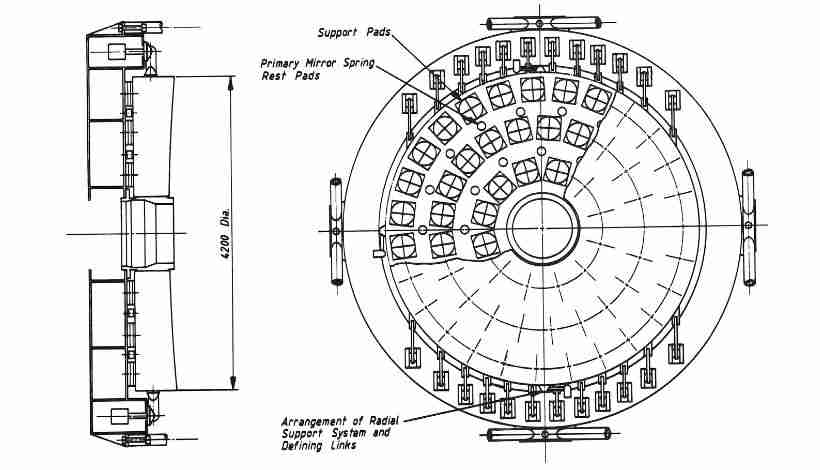
Large telescopes like the Very Large Telescope (VLT) use FeNi36 structural components to support primary mirrors weighing several tons. During night-long observations, ambient temperature can drop 10-15°C.
Performance comparison:
- Steel structure:10-meter support contracts 1.2 mm → mirror misalignment destroys image quality
- FeNi36 structure:Contraction reduced to 0.12 mm → optical alignment maintained throughout observation
This 10× improvement enables long-exposure astrophotography and spectroscopy that would be impossible with conventional materials.
Ring Laser Gyroscopes:
Inertial navigation systems use ring laser gyroscopes where laser cavity dimensions determine output frequency. For a 30 cm cavity operating from -40°C to +70°C:
- Required dimensional stability:±0.3 micrometers for 10⁻⁸ frequency stability
- FeNi36 performance:Achieves required stability without active temperature control
- Steel alternative:Would produce 10× larger dimensional changes, requiring complex active compensation
Interferometry and Optical Metrology:
Interferometers measuring at wavelength scales (0.5-1.5 micrometers) require optical bench stability of λ/10 to λ/20 (50-75 nanometers) across typical laboratory temperature variations of ±2°C. FeNi36 optical benches, mirror mounts, and beam splitter housings provide this stability. Steel or aluminum would require active temperature control, significantly increasing system complexity and cost.
Metrology and Measurement Standards
Gauge Blocks and Length Standards:
National metrology institutes maintain length standards traceable to the SI meter definition. Gauge blocks must maintain dimensions to:
- Tolerance:±0.05 micrometers(Grade 0)
- Temperature range: 15-25°C (laboratory variation)
- Temporal stability: decades without dimensional drift
FeNi36 gauge blocks achieve this. Steel blocks would require constant temperature compensation or frequent recalibration, making them impractical for primary standards.
Precision Coordinate Measuring Machines (CMM):
High-accuracy CMMs use FeNi36 for scale bars, reference structures, and probe mounting assemblies. This ensures measurement accuracy remains valid despite shop floor temperature variations (typically ±5°C). For quality control in precision manufacturing, this eliminates the need for expensive temperature-controlled metrology rooms.
Geodetic Surveying:
First-order leveling rods and baseline measurement tapes use Invar to eliminate thermal expansion errors. For 100-meter baseline measurements with ±10°C temperature variation:
- Steel tape error:±12 mm
- Invar tape error:±1.2 mm
- Accuracy improvement:10× for critical surveys establishing national geodetic networks
Aerospace and Satellite Instrumentation
Composite Tooling for Aircraft Manufacturing:
The largest modern application of FeNi36 is autoclave tooling for carbon fiber composite parts. Aircraft fuselages, wings, and structural panels are laid up and cured on massive Invar tools.
Why this matters:Carbon fiber composites have CTE of 1-2 ppm/°C, closely matching FeNi36. During autoclave curing at 180°C (160°C temperature rise), a 10-meter wing panel experiences:
| Tool Material | CTE (ppm/°C) | Expansion (mm) | Result |
|---|---|---|---|
| Aluminum | 23 | 36.8 | Part distortion → scrap |
| Steel | 12 | 19.2 | Still unacceptable |
| FeNi36 | 1.2 | 1.9 | Within tolerance |
For large commercial aircraft, a single wing tool can cost millions of dollars, but one FeNi36 tool produces thousands of dimensionally accurate parts. The alternative—scrap rates from using steel tooling—would cost far more than the Invar investment.
Satellite Optical Instruments:
Earth observation satellites experience extreme thermal cycling: -150°C in eclipse to +120°C in sunlight. FeNi36 is used for:
- Telescope and camera mounting structures:Maintain optical alignment through 270°C thermal cycles without active control
- Antenna positioning systems:Ensure pointing accuracy for communications despite thermal stress
- Sensor platforms:Stabilize IR detectors, spectrometers, and imaging systems
Alternative: Active thermal control (heaters/coolers) would add mass, power consumption, complexity, and failure modes. Passive thermal stability through material selection is more reliable and enables longer mission lifetimes.
Laser Communication Systems:
Satellite-to-satellite laser communication requires beam pointing accuracy of microradians. FeNi36 optical benches and mounting hardware maintain alignment without active correction across orbital thermal cycles.
Semiconductor and Display Manufacturing
OLED Display Production:
Fine Metal Masks (FMM) for OLED vacuum deposition are made from thin FeNi36 sheet, precision-etched with micrometer-scale pixel patterns. During vacuum deposition:
- Mask temperature rises 50-100°C
- Pattern accuracy requirement:±2-5 micrometers
- Steel masks:Distort, causing pixel misalignment and yield loss
- FeNi36 masks:Maintain pattern accuracy, enabling high-resolution OLED production
This application produces millions of smartphone and TV displays. The yield improvement from using Invar masks pays for the higher material cost within the first production runs.
Wafer Processing Equipment:
Semiconductor fabrication at 5nm and 3nm nodes requires nanometer-scale dimensional control. FeNi36 is used for reticle stages, mask holders, and optical column structures in lithography and inspection systems, working alongside active temperature control to achieve required stability.
Cryogenic Systems: The Unique Advantage
Liquefied Natural Gas (LNG) Transport:
FeNi36 dominates LNG carrier membrane systems because it uniquely satisfies two simultaneous requirements:
- Low thermal expansion:Manages thermal stress during cooldown from +20°C to -162°C (182°C differential)
- Cryogenic toughness:FCC crystal structure doesn't become brittle at low temperature
Why alternatives fail:
- Materials with low CTE but poor low-temperature toughness (some ceramics) → crack from thermal shock
- Materials with good toughness but high CTE (most steels) → fail from thermal stress
- Only FeNi36satisfies both requirements simultaneously
For a global LNG fleet transporting trillions of dollars in energy annually, FeNi36 is the enabling material that makes safe, economical LNG shipping possible.
When to Choose FeNi36: Decision Framework for Instrument Designers
Selection Criteria
Choose FeNi36 when your precision instrument requires:
- Dimensional stabilityacross temperature variations of ±5°C or more
- Operational rangefrom cryogenic temperatures to200°C
- Isotropic properties(uniform expansion in all directions)
- Metallic characteristics(weldability, electrical conductivity, structural capability)
- Long-term stabilitywithout active thermal control
Cost justification:FeNi36 costs 5-10× more than equivalent steel components (material + fabrication). This is justified when:
- Thermal expansion with conventional materials causes instrument failure
- Active thermal control would be more expensive, complex, or unreliable
- Dimensional accuracy directly impacts measurement validity or product value
- Mission-critical applications where failure is unacceptable (aerospace, metrology standards)
Material Alternatives and Trade-offs
| Material | CTE (ppm/°C) | Best For | Not Suitable For |
|---|---|---|---|
| FeNi36 | 1.2 | General precision, cryogenic to 200°C, need ductility | Above 230°C, magnetic sensitivity |
| Super Invar | 0.72 | Ultra-precision in narrow range (25-96°C) | Cryogenic use, wide temperature range |
| Zerodur | ~0 | Ultimate precision, observatory mirrors | Need ductility, impact loads, high cost acceptable |
| Carbon Fiber | 1-2 | Aerospace, lightweight critical | Anisotropy problematic, need conductivity |
| Titanium | 8.6 | Corrosion resistance, strength/weight | CTE 7× higher than Invar |
Essential Design Considerations
Composition Requirements:FeNi36 requires precise composition control (36% Ni ±1%). Verify composition certification from suppliers. The Invar effect is extremely sensitive to nickel content—deviations of 2-3% dramatically increase thermal expansion.
Heat Treatment is Mandatory:All FeNi36 components for precision use require post-fabrication heat treatment to remove stresses that degrade dimensional stability. This is not optional—without stress relief, you cannot expect theoretical CTE performance. Factor both time and cost into project schedules.
Magnetic Properties:Below 230°C, FeNi36 is ferromagnetic. For magnetically sensitive applications (electron microscopes, particle accelerators, magnetic resonance systems), you must use non-magnetic alternatives like Zerodur or ALLVAR alloys. This is a common design error.
Corrosion Protection:FeNi36 rusts in humid environments. Nickel plating is the standard protection method. For outdoor or marine applications, protective coating is mandatory and must be included in dimensional tolerances.
Common Design Errors to Avoid
Designing FeNi36 components for >230°C service. Above the Curie temperature, CTE increases dramatically and the material expands like steel. Use different materials or redesign thermal management to keep Invar below its operational ceiling.
Expecting purchased FeNi36 to automatically provide low CTE without proper heat treatment. Fabrication stresses must be removed through controlled thermal processing. Budget for this essential step.
Using FeNi36 in magnetically sensitive instruments without considering ferromagnetic properties. This is particularly problematic in electron beam systems, magnetic resonance equipment, and precision magnetic field measurements.
Budgeting only for material costs. Total component cost includes specialized machining (work-hardening makes FeNi36 difficult to machine), mandatory heat treatment cycles, and protective coatings. Realistic cost is 5-10× equivalent steel part.
Bolting FeNi36 to aluminum or steel structures without accounting for differential expansion. This induces stresses that distort the entire assembly, negating the benefit of using Invar.
Emerging Applications in Next-Generation Instruments
Quantum Technology Platforms
Quantum computers and atomic clocks require ultra-stable platforms at cryogenic temperatures (millikelvin range). FeNi36's combination of low expansion and cryogenic toughness makes it valuable for:
- Qubit chip mounting structures maintaining alignment through cooldown
- Cryogenic optical systems for quantum communication
- Vibration isolation platforms stable from room temperature to 4 K
Precision Micro-Instrumentation
As MEMS devices and micro-optical systems operate over wider temperature ranges, thin-film FeNi36 enables thermally stable microstructures for precision microsensors and microactuators in harsh environments.
Frequently Asked Questions
Q: What exactly is FeNi36 and why is it called Invar?
FeNi36 is an iron-nickel alloy with 36% nickel and 64% iron, discovered in 1896 by Charles Édouard Guillaume. He named it "Invar" from "invariable" because its dimensions remain nearly constant across temperature changes. The coefficient of thermal expansion (1.2 ppm/°C) is one-tenth that of steel, making it essential for precision instruments where dimensional stability is critical. Other designations include Invar 36 and UNS K93600.
Q: Why does FeNi36 stop working above 230°C?
At 230°C (Curie temperature), FeNi36 transitions from ferromagnetic to paramagnetic.The Invar effect depends on magnetic forces contracting the lattice to counteract thermal expansion. Above the Curie temperature, magnetic ordering disappears and the alloy expands like ordinary steel (7-8 ppm/°C). This makes 230°C an absolute operational limit—not a recommended maximum, but a physical boundary where the material fundamentally changes behavior.
Q: Can FeNi36 be used in magnetic field-sensitive applications?
No. Below 230°C, FeNi36 is ferromagneticand will interact with magnetic fields. For magnetically sensitive precision instruments (electron microscopes, particle accelerators, magnetic resonance systems, precision magnetometers), you must use non-magnetic alternatives like Zerodur glass-ceramic or ALLVAR titanium alloys. This is a common specification error—assuming Invar is suitable simply because it has low CTE without considering magnetic properties.
Q: How does FeNi36 compare to carbon fiber for thermal stability?
Carbon fiber composites have similar CTE (1-2 ppm/°C) to FeNi36 (1.2 ppm/°C), which is why they're thermally compatible—this compatibility is exploited in composite tooling where Invar tools cure carbon fiber parts. However, composites are anisotropic (different properties along fiber direction vs. perpendicular), while FeNi36 is isotropic. For precision instruments requiring uniform dimensional stability in all directions, electrical conductivity, or weldability, FeNi36 is preferred. For aerospace structures where weight is critical, composites excel.
Q: Why is FeNi36 significantly more expensive than steel?
FeNi36 material costs 3-5× more than steeldue to high nickel content and tight compositional tolerances. Fabrication costs add 2-4× more due to: (1) difficult machining from work-hardening behavior; (2) mandatory post-fabrication heat treatment to restore low-expansion properties; (3) protective coatings for corrosion resistance. Total component cost is typically 5-10× equivalent steel part. This is justified only when thermal expansion with conventional materials would cause instrument failure or unacceptable performance.
Q: What happens if I skip heat treatment on FeNi36 components?
You will not achieve the theoretical 1.2 ppm/°C thermal expansion.Every fabrication step—machining, forming, welding—introduces internal stresses that disrupt the Invar effect. Without stress relief heat treatment (typically 315-550°C), dimensional stability is degraded, sometimes dramatically. This is the most common reason for FeNi36 components failing to meet specifications. Heat treatment is not optional or "recommended"—it is mandatory for precision applications. Budget both time and cost for this essential process.
Q: When should I choose FeNi36 over alternatives like Zerodur or Super Invar?
ChooseFeNi36when you need: wide temperature range (cryogenic to 200°C), metallic properties (ductility, weldability), structural capability, and isotropic expansion. ChooseSuper Invarwhen you need 40% lower CTE but only operate in narrow range (25-96°C) in controlled laboratory conditions. ChooseZerodurwhen you need ultimate precision for optical substrates, cost is secondary, and loads are minimal (it's brittle). The decision depends on your specific requirements for temperature range, mechanical properties, precision level, and budget.
Q: What's the best corrosion protection for FeNi36 precision instruments?
Nickel plating (electrolytic or electroless) is the standard protection—it's durable and adds only 5-25 micrometers thickness. For instruments operating in controlled indoor environments, this is sufficient. For outdoor aerospace or marine applications, nickel plating is mandatory. Include coating thickness in dimensional tolerances during design. For temporary protection during storage, light oil coating works. Critical instruments may also use environmental control (dehumidification) alongside surface treatment.
Conclusion: FeNi36's Role in Enabling Precision Instrumentation
FeNi36 alloy has enabled precision instrumentation for over 125 years by providing dimensional stability that conventional materials cannot achieve. Its thermal expansion coefficient—one-tenth that of steel—results from a magnetic phenomenon that counteracts normal thermal expansion below230°C.
This material is highly specialized, not a universal solution. It requires careful composition control, mandatory heat treatment, protective coatings, and costs 5-10× more than steel equivalents. Its ferromagnetic properties and operational temperature ceiling make it unsuitable for some applications.
Yet for precision instruments where dimensional accuracy is non-negotiable—astronomical telescopes maintaining micron-scale alignments across night-long observations, aerospace composite tooling producing billion-dollar aircraft with zero defects, LNG transport systems safely operating at -162°C, semiconductor equipment controlling nanometer-scale processes, metrology standards maintaining accuracy for decades—FeNi36's unique combination of low expansion, metallic ductility, and cryogenic toughness remains irreplaceable.
For precision instrument designers, understanding when FeNi36 is the optimal choice versus when alternatives like Zerodur, carbon fiber, or conventional materials with active thermal control are more appropriate is critical to successful design. The material's high cost is justified only when thermal expansion with conventional materials would cause instrument failure or unacceptable performance degradation.
When temperature threatens to destroy your instrument's dimensional accuracy, FeNi36 provides the passive stability that enables precision where conventional materials fail.
Precision Metal Parts from Emitech
Nanjing Emitech delivers MIM, CNC machining, and custom metal parts. MIM services · Request a quote
Last updated: 2026-06-24
Continue reading
- 17-4 PH Used In Metal Injection Molding: Technical Guide for Design Engineers
- 17-4 PH Stainless Steel Properties: The Ultimate Guide for Engineers
- 4140 Steel: The Complete Engineering Guide to Properties, Heat Treatment & Applications
- 17-4PH Stainless Steel: Properties, Heat Treatment, and Applications