
Atomization in Powder Metallurgy
Dimensional variation in your metal powder directly translates to defects in final parts. If you're experiencing inconsistent flow rates, unexpected oxygen contamination, or poor sphericity in additive manufacturing, your atomization method is the root cause. This guide breaks down the technical parameters that determine powder quality for your specific application.
We source gas- and water-atomized powders for custom MIM parts production — send your drawing for material recommendations.
Understanding Atomization Fundamentals
Atomization converts molten metal into powder particles through controlled fragmentation. The physics governing this process—surface tension forces, momentum transfer coefficients, and thermal gradients—determine your final powder characteristics. You need to understand these mechanisms to troubleshoot quality issues and optimize your powder specifications.
The Atomization Process: Three Critical Stages
Stage 1: MeltingYour metal reaches complete liquefaction at temperatures specific to alloy composition (1375-1400°C for 316L stainless steel, 1660°C for Ti-6Al-4V). Crucible material selection matters here—graphite contamination introduces 50-200 ppm carbon into iron-based alloys, while ceramic crucibles minimize this but cost 3-5× more.
Stage 2: FragmentationThe molten stream encounters your atomization medium (gas, water, plasma, or mechanical force). The Weber number (We = ρv²L/σ) governs droplet formation, where:
- ρ = medium density
- v = relative velocity
- L = characteristic length
- σ = surface tension
You need We > 12 for effective atomization. Higher Weber numbers produce finer particles but require more energy input.
Stage 3: SolidificationCooling rates determine particle morphology. Gas atomization achieves 10³-10⁴ K/s, producing spherical particles. Water atomization reaches 10⁴-10⁵ K/s, creating irregular shapes due to rapid quenching before surface tension can spheroidize the droplets.
Gas Atomization: Technical Parameters and Control Variables
[caption id="attachment_15389" align="aligncenter" width="780"]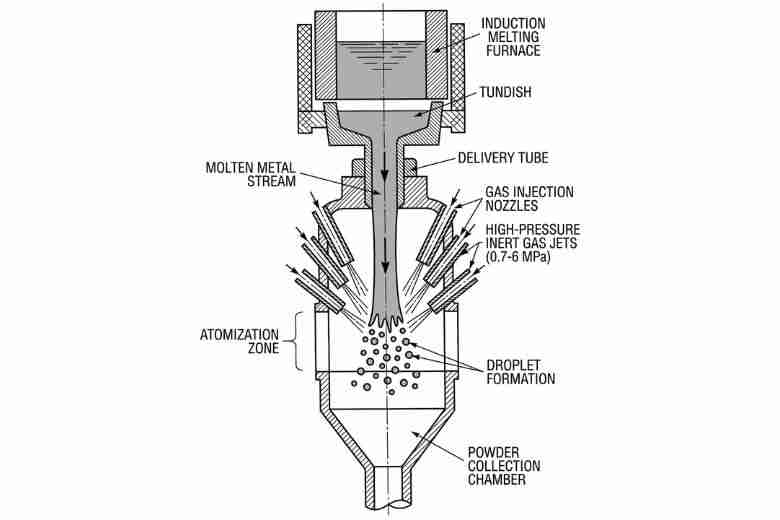 Gas atomization uses high-pressure inert gas jets to break molten metal into spherical powder particles[/caption]
Process Configuration
You'll encounter two primary nozzle designs:
Confined (Close-Coupled) Atomization
- Gas-to-metal contact within 2-5 mm of nozzle exit
- Gas pressures: 0.7-6 MPa
- Achieves finer particle size distribution (D₅₀ = 15-45 μm)
- Higher gas consumption: 1.5-2.5 kg gas per kg metal
Free-Fall Atomization
- Gas jets contact metal stream 50-200 mm below nozzle
- Gas pressures: 2-8 MPa
- Coarser distribution (D₅₀ = 40-100 μm)
- More economical: 0.8-1.5 kg gas per kg metal
Critical Operating Parameters
| Parameter | Range | Effect on Powder Quality |
|---|---|---|
| Gas pressure | 0.7-6 MPa | +1 MPa reduces D₅₀ by 10-15% |
| Melt superheat | 50-200°C above liquidus | +50°C improves sphericity by 3-5% |
| Gas/metal mass ratio | 0.8-2.5 | Higher ratio = finer powder but exponential cost increase |
| Nozzle angle | 15-45° | 30° typically optimal for sphericity |
Material-Specific Considerations
Reactive Metals (Ti, Al, Zr)
- Argon or helium required (oxygen content <5 ppm in gas)
- Chamber oxygen must stay below 100 ppm
- Skull melting or cold crucible induction preferred
Iron-Based Alloys
- Nitrogen acceptable (lower cost than argon)
- Can tolerate 200-500 ppm oxygen in powder
- Water-cooled copper crucibles sufficient
Nickel Superalloys
- Argon or helium mandatory
- Vacuum induction melting pre-atomization
- Target oxygen <150 ppm in final powder
Water Atomization: High-Volume Production Strategy
Pressure-Particle Size Relationship
Your water pressure selection determines production economics:
| Water Pressure | Median Particle Size | Application | Energy Cost |
|---|---|---|---|
| 3.5-10 MPa | 80-150 μm | Press & sinter PM | Baseline |
| 10-50 MPa | 30-80 μm | Metal injection molding | 2-3× baseline |
| 50-150 MPa | 10-30 μm | Fine MIM powders | 5-8× baseline |
Oxygen Content Management
Water atomization inherently produces higher oxygen content (1000-5000 ppm vs. 200-500 ppm for gas). You can reduce this through:
- Deaeration: Vacuum degas water to <2 ppm dissolved oxygen (reduces powder oxygen by 30-40%)
- pH Control: Maintain pH 9-10 with sodium hydroxide (prevents acidic corrosion)
- Reducing Atmosphere Drying: Hydrogen atmosphere at 150-300°C post-atomization
Particle Morphology Control
[caption id="attachment_15390" align="aligncenter" width="780"]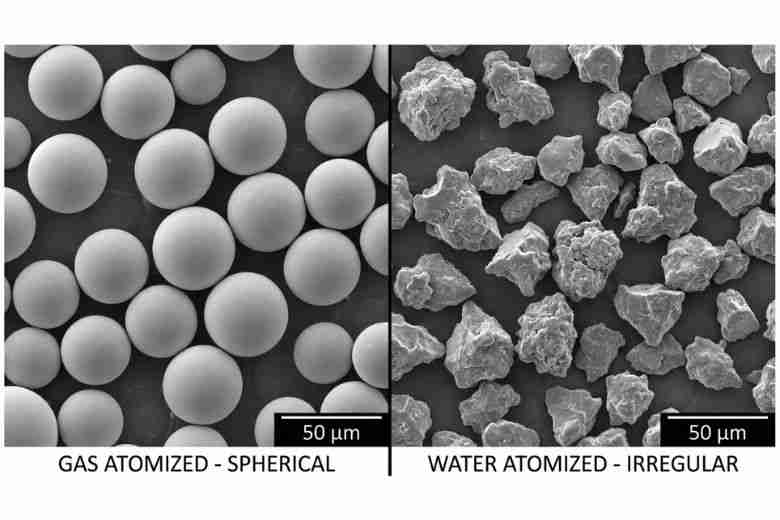 Particle morphology varies significantly between atomization methods: gas atomization produces spherical particles (left) while water atomization creates irregular shapes (right)[/caption]
Irregular particles from water atomization provide advantages for conventional PM:
- Higher green strength (30-50% better than spherical)
- Better powder-to-powder friction for stable pressing
- Enhanced sintered neck formation
For applications requiring improved flow, you can post-process water-atomized powder through:
- Mechanical rounding (increases apparent density 15-25%)
- Annealing (reduces work hardening from atomization impact)
Plasma Atomization: Premium Quality Specifications
Process Economics
Plasma atomization costs 5-10× more than gas atomization, justified only when you need:
- Oxygen content <100 ppm (critical for titanium aerospace parts)
- Sphericity >99% (essential for selective laser melting)
- Minimal satellite particles (<1% by volume)
- Extremely tight size distribution (D₉₀/D₁₀ <2.0)
Wire Feedstock Requirements
You're limited to materials available as wire:
- Titanium and titanium alloys
- Nickel-based superalloys
- Cobalt-chrome biomedical alloys
- Some specialty steels
Wire must meet strict tolerances (±0.05 mm diameter variation) or you'll get inconsistent powder production.
Production Rate Constraints
| Material | Typical Production Rate | Limiting Factor |
|---|---|---|
| Ti-6Al-4V | 8-12 kg/hr | Wire feed stability |
| Inconel 718 | 10-15 kg/hr | Plasma power capacity |
| CoCrMo | 6-10 kg/hr | Wire mechanical properties |
Centrifugal Atomization: Controlled Distribution Method
Disk Speed-Particle Size Correlation
Your disk rotational speed follows the relationship:
D₅₀ ≈ K(σ/ρω²r)^(1/2)
Where:
- K = empirical constant (3-6)
- σ = surface tension
- ρ = liquid density
- ω = angular velocity
- r = disk radius
Practical implications:
- Doubling disk speed reduces particle size by ~30%
- Disk diameter increase of 50% reduces throughput capacity by 40%
Narrow Distribution Benefits
You achieve D₉₀/D₁₀ ratios of 1.5-2.0 (compared to 2.5-4.0 for gas atomization), meaning:
- More efficient powder utilization (less sieving waste)
- Predictable packing density in additive manufacturing
- Consistent flow rates batch-to-batch
Application-Specific Powder Selection Matrix
Laser Powder Bed Fusion (L-PBF)
Critical Requirements:
- Sphericity: >95%
- D₁₀-D₉₀: 15-45 μm (for 30 μm layer thickness)
- Hall flowability: <20 s/50g
- Apparent density: >55%
- Oxygen: <500 ppm (Ti), <800 ppm (steel)
Recommended Method:Gas or plasma atomization
Reject plasma if:Your part tolerates 300-500 ppm oxygen and budget constraints exist. Gas atomization at 2-4 MPa nitrogen produces acceptable powder at 40-60% of plasma cost.
Metal Injection Molding (MIM)
Critical Requirements:
- D₅₀: 8-15 μm
- Particle shape: Irregular to spherical acceptable
- Apparent density: 40-55%
- Oxygen: <1500 ppm (stainless steel), <3000 ppm (low-alloy steel)
Recommended Method:High-pressure water atomization (50-150 MPa) or fine gas atomization
Cost optimization:Water atomization reduces powder cost by 50-70% with acceptable performance for most MIM applications.
Press & Sinter PM
Critical Requirements:
- Particle size: 45-150 μm
- Irregular morphology preferred
- Green strength: >15 MPa
- Oxygen: Material dependent (iron: <3000 ppm acceptable)
Recommended Method:Water atomization (3.5-50 MPa)
Avoid:Gas atomization—spherical particles reduce green strength and increase cost without performance benefit for this application.
Advanced Process Control and Optimization
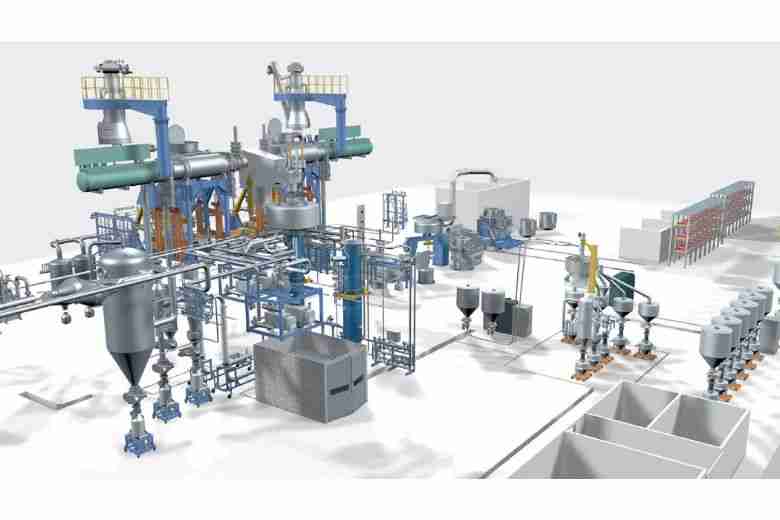
Real-Time Monitoring Systems
Modern atomization plants implement:
In-Process Sensors:
- Melt temperature: Pyrometers (±2°C accuracy)
- Gas/water pressure: Digital transducers (±0.5% accuracy)
- Flow rates: Mass flow controllers (±1% accuracy)
- Particle size: Laser diffraction (real-time D₅₀ monitoring)
Feedback Control Benefits:You reduce batch-to-batch variation by 40-60% through closed-loop control of:
- Melt superheat (adjusts pouring rate)
- Atomization pressure (compensates for viscosity changes)
- Gas composition (maintains oxygen targets)
Process Modeling and Simulation
Computational fluid dynamics (CFD) modeling helps you:
- Predict particle size distribution before production trials
- Optimize nozzle geometry for specific alloys
- Reduce development iterations by 50-70%
- Minimize gas consumption by 15-25%
Sustainability and Waste Reduction
Closed-Loop Water Systems:
- Reduces water consumption by 85-95%
- Filtration removes fines for recycling
- Temperature control maintains consistent atomization
Gas Recovery:
- Argon recovery systems capture 90-95% of atomization gas
- Payback period: 18-24 months for high-volume operations
- Reduces operating cost substantially per kg of powder produced
Powder Recycling:You can recycle off-spec powder through:
- Re-melting and re-atomization (oxygen pickup: +100-200 ppm per cycle)
- Blending into less critical applications
- Mechanical treatment for morphology improvement
Quality Control and Testing Protocols
Essential Powder Characterization
Particle Size Distribution (PSD):
- Laser diffraction: ISO 13320 standard
- Report D₁₀, D₅₀, D₉₀ values
- Critical for process repeatability
Flowability Testing:
- Hall flowmeter: ASTM B213 (target <25 s/50g for AM)
- Carney funnel: ASTM B964 (for coarser powders)
- Failure to flow indicates need for process adjustment
Morphology Analysis:
- SEM imaging: Minimum 500 particles per sample
- Automated image analysis for sphericity quantification
- Satellite particle percentage determination
Chemical Analysis:
- Oxygen/nitrogen: Inert gas fusion (±10 ppm accuracy)
- Carbon/sulfur: Combustion analysis
- Metallic composition: ICP-OES or XRF
Batch Acceptance Criteria
| Test | Specification | Rejection Consequence |
|---|---|---|
| D₅₀ deviation | ±10% from target | Resieve or blend |
| Oxygen content | Per application limits | Scrap or downgrade |
| Sphericity | >90% for AM applications | Resieve fines or reprocess |
| Hall flow | <20 s/50g for L-PBF | Mechanical treatment |
Troubleshooting Common Atomization Defects
Satellite Particles
Root Causes:
- Insufficient gas pressure (low Weber number)
- Excessive melt superheat (>150°C)
- Chamber turbulence during solidification
Solutions:
- Increase gas pressure by 0.5-1 MPa
- Reduce superheat to 75-125°C above liquidus
- Improve chamber flow design
Acceptable Limits:<3% satellites for critical AM applications, <10% for MIM
Irregular Morphology in Gas Atomization
Root Causes:
- Low melt temperature (insufficient fluidity)
- Insufficient atomization energy
- Oxygen contamination promoting oxide formation
Solutions:
- Increase superheat to 100-150°C
- Raise gas pressure or reduce nozzle distance
- Improve gas purity to <10 ppm oxygen
Excessive Oxygen Content
| Atomization Type | Typical Issue | Correction Strategy |
|---|---|---|
| Gas | Crucible contamination | Switch crucible material or skull melting |
| Gas | Chamber leakage | Pressure test chamber, replace seals |
| Water | Dissolved oxygen | Deaerate water, add reducing agents |
| Water | Post-atomization oxidation | Dry in reducing atmosphere immediately |
Frequently Asked Questions
Q: What atomization method produces the finest particle size?
Ultrasonic atomization generates the finest particles (20-100 nm), but production rates remain impractical for commercial use (0.1-1 kg/hr). For scalable production, high-pressure water atomization (100-150 MPa) achieves D₅₀ of 10-15 μm at 20-50 kg/hr, making it the most viable option for fine powder requirements in metal injection molding.
Q: How does gas selection affect atomization costs and powder quality?
Your gas choice creates significant cost and quality trade-offs. Air (1× cost) leaves 1000-3000 ppm oxygen and is best for low-alloy steels and cost-critical parts. Nitrogen (3-5× cost) leaves 300-800 ppm oxygen, suitable for stainless and tool steels. Argon (15-25× cost) leaves 150-400 ppm oxygen, ideal for reactive metals and premium applications. Helium (80-120× cost) leaves 100-300 ppm oxygen, used for research and specialized titanium alloys. For titanium atomization, argon is mandatory despite higher cost—using nitrogen produces titanium nitride contamination exceeding 2000 ppm, rendering the powder unusable for aerospace applications.
Q: Can you mix powders from different atomization methods?
Mixing different atomization method outputs creates unpredictable results. Water-atomized irregular particles and gas-atomized spherical particles exhibit non-uniform packing density (variation >15%), inconsistent flow behavior, differential sintering rates, and unpredictable mechanical properties. If cost reduction is your goal, blend batches from the same atomization method instead. This maintains morphology consistency while averaging minor batch variations.
Q: What causes the "Christmas tree" effect in gas atomization?
Metal solidification on the atomization nozzle creates a cone-shaped buildup that deflects the melt stream (increases particle size by 20-40%), produces coarse satellites, and eventually falls into powder causing contamination. Prevention strategies include maintaining nozzle temperature 50-100°C above melt liquidus using induction heating, increasing gas flow rate during startup by 20-30%, using sacrificial nozzle tips for reactive metals, and implementing automated nozzle cleaning between batches.
Q: How many times can you recycle atomized powder in additive manufacturing?
Powder recycling depends on application criticality. For aerospace-grade titanium (FAA oversight), allow a maximum of 3-5 reuse cycles, expect an oxygen pickup of +30-50 ppm per cycle, and perform mandatory chemical analysis each cycle. For industrial stainless steel parts, 10-15 reuse cycles are acceptable; monitor flowability degradation (typically 3-5% per cycle) and refresh with 20-30% virgin powder when flow exceeds 25 s/50g. For research and prototyping, 20+ cycles are possible with careful handling, prioritizing flowability over chemistry.
Q: Why is plasma atomization unsuitable for steel powders?
Plasma atomization works poorly for standard steels because of wire feedstock limitations (most steel grades aren't available as consistent-quality wire), a cost-performance mismatch (steel powders tolerate 300-500 ppm oxygen, which gas atomization easily achieves at 20% of plasma cost), and insufficient production rates (plasma's 5-15 kg/hr doesn't meet the typical 500+ kg/hr steel powder market demand). Reserve plasma atomization for materials where its advantages justify the premium, such as titanium, tantalum, niobium, and reactive metal alloys.
Q: How does particle size distribution affect powder bed density in additive manufacturing?
Your PSD directly determines powder bed packing. A narrow distribution (D₉₀/D₁₀ = 1.5-2.0) results in lower packing density (55-60%), better layer uniformity, more predictable melting behavior, and higher powder consumption per part. A bimodal distribution (designed mix of sizes) yields higher packing density (62-68%) and reduced powder consumption (15-25%), but carries a risk of segregation during spreading and requires careful process optimization. For critical aerospace parts, choose a narrow distribution despite higher powder cost. For industrial production where cost matters, bimodal distributions reduce material usage without compromising part quality.
Q: What's the relationship between atomization cooling rate and powder microstructure?
Cooling rate during atomization determines your powder's metallurgical state. Gas atomization at 10³ K/s creates a dendritic, conventional microstructure with standard properties. High-pressure gas atomization at 10⁴ K/s yields refined dendrites and a 10-15% strength increase. Water atomization at 10⁵ K/s produces a cellular/equiaxed structure with homogeneous composition. Ultrasonic atomization at 10⁶ K/s can achieve amorphous states with unique properties for research only. For precipitation-hardening alloys, rapid solidification can supersaturate solid solution, improving heat treatment response by 20-30%.
Q: How do you prevent oxidation during atomization of reactive metals?
Reactive metal atomization (Ti, Al, Zr) requires multi-layer protection. For the chamber atmosphere, maintain<50 ppm oxygen (10 ppm preferred), use only argon or helium, and continuously purge at 2-5 chamber volumes per hour. Melting protection involves skull melting (water-cooled copper crucible) or vacuum induction melting with argon transfer, plus pre-melt chamber evacuation to <0.1 Pa. Post-atomization handling requires transferring powder in an argon atmosphere, drying at <100°C in a vacuum or reducing atmosphere, and packaging immediately in vacuum-sealed containers. These precautions increase production cost by 40-80% compared to steel atomization but are mandatory for aerospace-quality reactive metal powders.
Conclusion
Your atomization method selection determines most of your final powder characteristics and manufacturing success. Gas atomization delivers spherical morphology for additive manufacturing at moderate cost. Water atomization provides economical high-volume production for conventional powder metallurgy. Plasma atomization offers premium quality when your application justifies 5-10× higher costs.
Focus on matching atomization parameters to your specific requirements rather than seeking a universal "best" method. A well-optimized water atomization process producing 500 ppm oxygen powder outperforms poorly controlled gas atomization yielding 800 ppm oxygen—process control matters more than method selection.
The industry continues advancing toward closed-loop systems with real-time monitoring, reducing batch variation and environmental impact. If you're scaling production, invest in automated controls and in-process measurement rather than simply pursuing larger equipment. The return shows up in consistent quality, reduced waste, and lower total cost per kilogram of specification-compliant powder.
Precision Metal Parts from Emitech
Nanjing Emitech delivers MIM, CNC machining, and custom metal parts. MIM services · Request a quote
Last updated: 2026-07-23