
Powder Metallurgy Explained: Benefits, Drawbacks, and When to Use It
What is Powder Metallurgy?
Powder metallurgy (PM) is a metal-forming process that creates precise parts by compacting metal powders and heating them below their melting point. This method has gained popularity in manufacturing because it allows for complex shapes with tight tolerances while minimizing waste.
The basic process involves four key steps:
- Creating metal powders
- Mixing powders with additives
- Compacting the mixture into a shape
- Sintering (heating) to bond particles together
Advantages of Powder Metallurgy: Data-Backed Benefits
Material Efficiency: 95%+ Utilization Rate
Traditional machining wastes 30-70% of material as chips and scrap. In contrast, powder metallurgy achieves over 95% material utilization. This difference can save thousands of dollars in materials per production run for expensive metals like titanium.
Production Speed Comparison
| Manufacturing Method | Parts Per Hour | Setup Time | Material Waste |
|---|---|---|---|
| Powder Metallurgy | 1,800 | 2-4 hours | 3-5% |
| CNC Machining | 20-60 | 1-2 hours | 30-70% |
| Die Casting | 60-120 | 6-24 hours | 10-20% |
| Forging | 40-100 | 8-48 hours | 15-30% |
Dimensional Precision Without Secondary Operations
PM delivers impressive dimensional accuracy directly after sintering:
| Dimension Range | Standard Tolerance | Enhanced Tolerance (After Sizing) |
|---|---|---|
| 0-25mm | ±0.075mm (IT8-9) | ±0.015mm (IT6-7) |
| 25-50mm | ±0.100mm (IT8-9) | ±0.025mm (IT6-7) |
| 50-75mm | ±0.150mm (IT9-10) | ±0.040mm (IT7-8) |
Energy Consumption Comparison
Powder metallurgy requires significantly less energy than competing processes:
| Manufacturing Process | Energy Consumption (kWh/kg of finished part) |
|---|---|
| Powder Metallurgy | 4-8 |
| Die Casting | 8-15 |
| Forging | 12-25 |
| CNC Machining | 15-30 |
Complex Features Made Simple
PM can create intricate internal passages, precise holes, and complex geometric features in a single operation. This capability makes it ideal for components like:
- Oil-impregnated bearings with controlled porosity
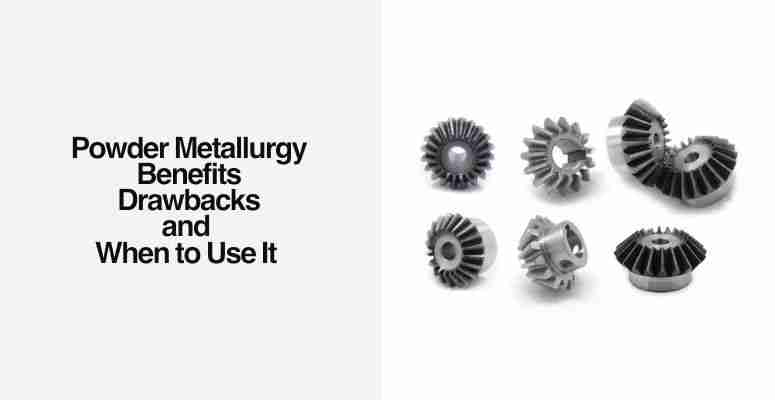
- Gears with precise teeth profiles
- Structural components with internal channels
- Filters with uniform pore distribution
Material Versatility Beyond Conventional Methods
PM works with materials that are challenging or impossible to process with traditional methods:
| Material Type | Melting Point (°C) | Machinability Rating | PM Suitability |
|---|---|---|---|
| Tungsten | 3,422 | Poor (20) | Excellent |
| Molybdenum | 2,623 | Poor (25) | Excellent |
| Titanium | 1,668 | Fair (50) | Good |
| Copper | 1,085 | Excellent (90) | Excellent |
| Tool Steel | 1,370-1,430 | Fair (45) | Excellent |
Environmental Impact Reduction
PM manufacturing produces fewer emissions and waste:
| Environmental Factor | Powder Metallurgy | Traditional Manufacturing |
|---|---|---|
| CO2 Emissions | Lower | Higher |
| Water Usage | Low | Moderate to High |
| Hazardous Waste | Minimal | Significant |
| Recyclability | High (>90%) | Moderate (40-70%) |
Real-World Applications: Where PM Excels
Automotive Industry
- Connecting Rods: PM connecting rods reduce weight by 20-30% compared to forged alternatives while maintaining 85-90% of the strength. This weight reduction directly improves engine efficiency.
- Camshaft Lobes: PM allows variable density distribution with harder wearing surfaces (92-95% density) where needed, extending component life by 30-40%.
- Transmission Components: PM gears operate with 3-5dB less noise than machined gears due to vibration-dampening porosity, improving driver comfort.
- Self-lubricating Bearings: PM bearings retain 15-25% oil by volume, extending maintenance intervals by 300-500% in demanding applications.
Aerospace Applications
- Turbine Engine Components: PM superalloy parts reliably operate at temperatures up to 1100°C with excellent oxidation resistance in critical engine sections.
- Structural Brackets: PM titanium brackets achieve 40% weight reduction versus aluminum while maintaining strength requirements - critical for fuel efficiency.
- Heat Shields: PM heat shields with controlled porosity provide 30% better thermal insulation while resisting temperatures up to 1400°C for spacecraft re-entry.
- Filter Elements: PM filters for hydraulic and fuel systems achieve 99.9% filtration efficiency while maintaining flow rates 15% higher than alternatives.
Medical Devices
- Implantable Devices: PM titanium implants with controlled porosity (250-500μm pore size) demonstrate 40-60% better bone integration, improving patient outcomes.
- Surgical Instruments: PM stainless steel instruments combine complex geometries with precision, reducing manufacturing steps by 35-40%.
- Dental Restorations: PM cobalt-chrome frameworks achieve marginal fits of <25μm while reducing production costs by 25-35%.
- Drug Delivery Systems: PM components with graduated porosity allow for controlled medication release rates, maintaining therapeutic levels longer.
Consumer Electronics
- Heat Sinks: PM copper/aluminum heat sinks with engineered thermal pathways dissipate 20-30% more heat, enabling smaller product dimensions and preventing overheating.
- EMI Shielding: PM soft magnetic components achieve 35-45dB electromagnetic shielding while forming complex shapes that eliminate assembly steps.
- Electrical Contacts: Silver-based PM contacts maintain high conductivity while extending service life by 25-40% through optimized material distribution.
- Haptic Feedback Components: PM tungsten vibration weights provide 40% more inertial mass in 60% less space, enhancing mobile device tactile feedback.
Power Tools and Equipment
- Gears and Transmissions: PM helical gears withstand 30% higher torque loads while operating 5-8dB quieter in professional power tools.
- Motor Components: Soft magnetic PM components increase motor efficiency by 5-8%, extending battery life in cordless tools.
- Clutch Mechanisms: PM friction materials with embedded lubricants extend service intervals by 40-60% in high-use environments.
- Structural Components: PM tool housings combine reinforcing ribs with mounting features to reduce assembly steps by 30-50%.
Comparison: PM vs. Traditional Manufacturing for Key Applications
| Application | PM Advantage | Quantifiable Benefit | Key Performance Factor |
|---|---|---|---|
| Automotive Gears | Single-step manufacturing | 30-40% cost reduction | Higher hardness through carbon control |
| Hydraulic Components | Complex internal channels | 25-35% weight reduction | Pressure resistance up to 35 MPa |
| Electrical Contacts | Material gradient capability | 20-30% longer service life | Optimized density zones in one component |
| Structural Brackets | Net-shape forming | 45-60% reduced machining | Tight tolerances across high volumes |
| Self-lubricating Bearings | Controlled porosity | 3-5× longer lubrication intervals | 15-25% oil retention by volume |
Selection Guide: When to Choose PM Manufacturing
| Application Type | Recommended for PM? | Decision Factors |
|---|---|---|
| High-volume identical parts (>10,000) | ✓ Highly recommended | Tooling cost amortization, consistent quality |
| Complex internal features | ✓ Highly recommended | Eliminates multiple machining operations |
| Self-lubricating components | ✓ Highly recommended | Controlled porosity for lubricant retention |
| Magnetic components | ✓ Highly recommended | Customizable magnetic properties |
| Large structural components (>250mm) | ✗ Not recommended | Size limitations of PM equipment |
| Ultra-high strength applications | ✗ Use with caution | Porosity impacts mechanical properties |
| Low-volume production (<500 units) | ✗ Not recommended | High tooling costs not justified |
| Medical implants | ✓ Recommended with HIP | Enhanced properties with secondary processing |
| Thermal management components | ✓ Highly recommended | Customizable thermal conductivity |
| High-precision mechanical components | ✓ Recommended | Tight tolerances maintained at high volumes |
Limitations of Powder Metallurgy: Important Considerations
Size Constraints
Unlike some manufacturing methods, PM has practical size limitations:
| Dimension | Typical PM Limit | Practical Maximum | Alternative Process |
|---|---|---|---|
| Diameter | 100mm | 250mm | Casting/Forging |
| Height | 50mm | 75mm | Machining |
| Weight | 1kg | 2.5kg | Casting |
Cost Analysis for Different Production Volumes
The economics of PM change significantly based on production volume:
| Production Volume | PM Cost Efficiency | Initial Tooling Cost | Break-Even Point |
|---|---|---|---|
| <500 units | Poor | Varies by part complexity | Not recommended |
| 500-5,000 units | Fair | Varies | ~3,000 units |
| 5,000-50,000 | Good | Varies | ~2,000 units |
| >50,000 units | Excellent | Varies | ~1,000 units |
Mechanical Property Limitations
PM parts typically have 85-95% of the density of wrought materials, affecting performance:
| Property | PM (% of Wrought) | PM with Hot Isostatic Pressing |
|---|---|---|
| Tensile Strength | 80-90% | 95-99.5% |
| Yield Strength | 85-95% | 95-99.5% |
| Elongation | 50-70% | 80-95% |
| Fatigue Strength | 60-80% | 85-95% |
| Impact Strength | 50-70% | 80-90% |
Shape Complexity Limitations
While PM excels at certain geometries, others present challenges:
| Feature Type | PM Capability | Alternative Process |
|---|---|---|
| Simple to moderate shapes | Excellent | Any process |
| Deep undercuts | Poor | Investment casting |
| Very thin walls (<0.5mm) | Fair | Metal injection molding |
| Internal threads | Poor | Machining |
| Complex 3D contours | Limited | Additive manufacturing |
Frequently Asked Questions
Q: How does powder metallurgy compare to 3D printing metal parts?
While both create parts from metal powders, traditional PM uses molds and is more cost-effective for higher volumes. 3D printing offers greater design freedom but costs significantly more per part and is slower. PM is better for >1,000 identical parts, while 3D printing excels for customized or highly complex single components.
Q: Can powder metallurgy parts be welded?
Yes, but with special considerations. The porosity in PM parts can trap gases that cause welding defects. Pre-treating parts through infiltration or hot isostatic pressing to increase density before welding often yields better results. Laser and electron beam welding typically perform better than traditional arc welding for PM components.
Q: What metals work best with powder metallurgy?
Iron, steel, copper, aluminum, and their alloys are most common. Specialty metals like tungsten, molybdenum, and titanium also work well but cost more. Refractory metals that are difficult to process through conventional methods are particularly well-suited to PM.
Q: How long do powder metallurgy tooling and dies last?
PM tooling typically produces 500,000 to 1,000,000 parts before requiring replacement or significant refurbishment. This durability helps amortize the initial tooling cost over large production runs. Using tungsten carbide instead of tool steel can extend die life by 2-3 times, though at higher initial cost.
Q: Can powder metallurgy achieve near-full density parts?
Standard PM processes typically achieve 85-95% theoretical density. Secondary operations like hot isostatic pressing (HIP), where parts are subjected to high temperature and pressure simultaneously, can increase density to 98-99.5%, approaching the properties of wrought metals.
Q: Is powder metallurgy cheaper than machining?
A: Above a volume threshold, usually yes: press-and-sinter amortizes tooling across the run and wastes little material, while machining pays per part for machine time. Below that threshold, or when geometry is simple, machining stays cheaper. The economics hinge on volume, complexity and tolerance burden together.
Q: What are the biggest limitations of powder metallurgy?
A: Conventional press-and-sinter PM is shape-limited by uniaxial die compaction, carries density gradients through the part, and delivers tensile and fatigue properties below wrought equivalents — which is why critical highly stressed parts go to forging or machining instead. Design must respect die ejection and compaction limits.
Q: When should I choose MIM instead of conventional PM?
A: Choose MIM when the geometry is genuinely three-dimensional and intricate, when higher density and mechanical properties matter, or when the part is small enough that MIM economics close. The full comparison — density, geometry freedom, cost drivers — is on the MIM vs powder metallurgy page.
Decision Guide: Is Powder Metallurgy Right for Your Project?
PM might be your best option if:
- You need complex shapes with precise dimensions
- Your production volume exceeds 1,000 identical parts
- Material cost savings are important
- Your part size is under 100mm in diameter
- Moderate mechanical properties are acceptable
Consider alternative methods if:
- You need extremely large parts
- Production volume is under 500 units
- Maximum mechanical properties are essential
- Your design has deep undercuts or very complex 3D geometry
- Your budget can't accommodate initial tooling costs
Conclusion
Powder metallurgy offers substantial advantages in material efficiency, production speed, and complexity capabilities that make it ideal for many manufacturing scenarios. However, its limitations in size, mechanical properties, and initial investment cost must be carefully considered.
By weighing these factors against your specific requirements, you can determine if PM provides the optimal balance of quality, cost, and performance for your manufacturing needs. For high-volume production of complex parts with moderate mechanical requirements, powder metallurgy often represents the most economical and efficient manufacturing solution available today.
Powder Metallurgy & MIM from Emitech
From compaction and sintering to finishing, Emitech produces complex PM and MIM parts in high volumes. Custom MIM parts · Get a quote
Last updated: 2026-06-26