
MIM Copper Alloy Parts

Copper Alloy MIM Data
| Grade | Chemical Composition | Sintering Temperature (°C) | Density (g/cm³) | Yield Strength | Hardness | ASTM Specification | Typical Applications |
|---|---|---|---|---|---|---|---|
| Pure Cu | Cu ≥99.5% | 900–1,050 | 8.9 | 150–250 MPa | 40–60 HV | ASTM B152 | Heat sinks, bus bars, RF contacts |
| Cu-Ni-Sn C72900 | Cu/Ni/Sn | 900–1,050 | 8.7 | 700–900 MPa | 200–260 HV | ASTM B740 | High-strength connectors, springs |
| Cu-Cr-Zr | Cu/Cr/Zr | 900–1,050 | 8.6 | 400–600 MPa | 100–140 HV | ASTM B887 | Welding electrodes, resistance contacts |
| Cu-W | Cu 10-30% / W 70-90% | 1,100–1,200 | 14.5–17.0 | 200–400 MPa | 200–300 HV | ASTM B702 | Arc contacts, EDM electrodes |
Introduction to Copper Alloy MIM
Copper and copper alloys offer unmatched thermal and electrical conductivity, making them essential for heat sinks, electrical contacts, and RF components. Through Metal Injection Molding, Emitech produces complex copper alloy parts with near-full density, combining the design freedom of MIM with the conductivity properties traditionally limited to machined or cast copper components.
Copper MIM is especially valuable when part geometry includes internal cooling channels, complex RF shapes, or fine features that would be expensive or impossible to machine from solid copper. The process delivers consistent material properties and dimensional accuracy across medium to high production volumes.
By selecting the appropriate copper alloy and sintering conditions, Emitech balances conductivity, strength, and corrosion resistance to match each application. Our engineering team reviews your thermal or electrical requirements before recommending a specific grade and processing route.
Material Characteristics
Copper alloys processed by MIM retain the properties that make copper indispensable in electrical and thermal engineering:
- High thermal conductivity — Pure copper reaches approximately 390 W/m·K; alloys range from 100 to 350 W/m·K.
- Excellent electrical conductivity — Up to 100% IACS for pure copper MIM after optimized sintering.
- Good corrosion resistance — Stable in atmospheric, marine, and many industrial environments.
- Antimicrobial properties — Natural bacterial suppression for medical and food-contact applications.
- Easy to plate and solder — Compatible with tin, nickel, silver, and gold finishes.
Available Copper Alloys
| Alloy | Cu Content | Conductivity (%IACS) | Applications |
|---|---|---|---|
| Cu (Pure) | ≥ 99.5% | 90 – 100 | Heat sinks, bus bars, RF contacts |
| Cu-Ni-Sn (C72900) | Balance | 15 – 20 | High-strength connectors, springs |
| Cu-Cr-Zr | Balance | 80 – 85 | Welding electrodes, resistance contacts |
| Cu-W | 10 – 30% | 30 – 50 | Arc contacts, EDM electrodes |
MIM Processing of Copper Alloys
Copper MIM requires careful atmosphere control because copper oxidizes readily at elevated temperatures. Sintering is typically performed in hydrogen or cracked ammonia atmospheres to reduce oxides and maximize conductivity. Oxygen levels must be kept low to prevent embrittlement and preserve electrical performance.
Feedstock formulation is also critical. The binder system must burn out cleanly without leaving carbon residue, which would reduce conductivity. Emitech uses fine copper powder, often with particle sizes below 20 microns, to achieve high green density and uniform sintering shrinkage.
Shrinkage during sintering is typically 15–20% by volume, and tooling must be scaled accordingly. Our engineers use material-specific shrinkage data and simulation tools to ensure that final dimensions fall within specified tolerances.
Applications
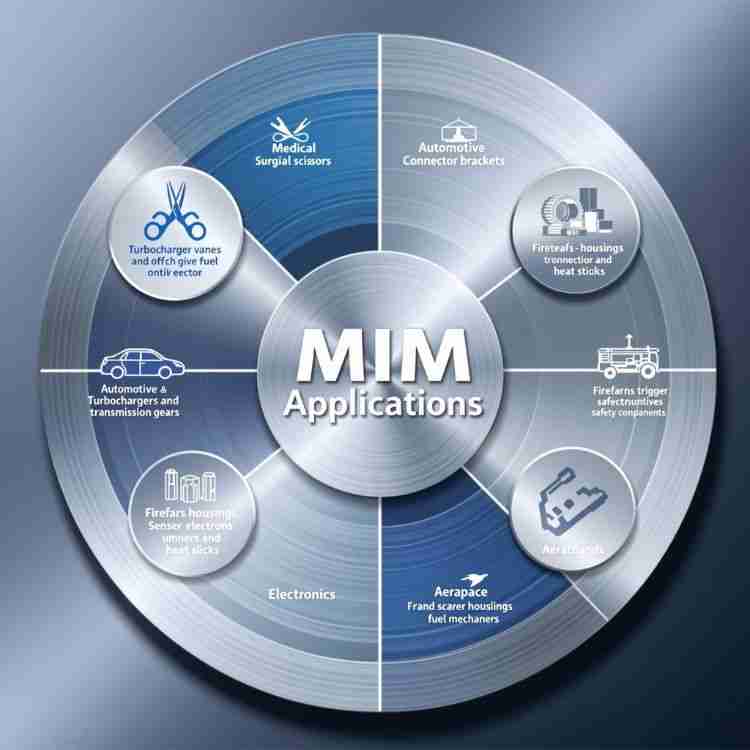
Copper alloy MIM parts are found wherever heat or electricity must be managed efficiently in a compact space. The ability to produce complex shapes in a single operation eliminates assembly steps and improves thermal and electrical pathways.
- Thermal management — Heat sinks, heat spreaders, and cold plates for power electronics.
- Electrical contacts — Connectors, terminals, and bus bars for high-current applications.
- RF components — Waveguides, antenna elements, and coaxial connectors.
- Medical devices — Antimicrobial instrument components and conductive hardware.
- Welding equipment — Electrodes, nozzles, and contact tips requiring conductivity and wear resistance.
- Decorative hardware — Architectural fittings and luxury consumer goods.
Why Emitech for Copper MIM?
- Controlled atmosphere — Hydrogen sintering prevents oxidation and maximizes conductivity.
- Conductivity testing — Eddy current verification of electrical properties.
- Complex cooling channels — Internal geometries impossible with machining.
- Plating expertise — Nickel, silver, gold, and tin plating for enhanced performance.
- Dimensional accuracy — Tight tolerances on critical electrical and thermal interfaces.
Design Considerations
Copper MIM parts should be designed with wall thickness between 0.5 mm and 12 mm for uniform shrinkage. Because copper has high thermal conductivity, mold cooling must be carefully controlled to avoid sink marks and warpage. Designers should also consider that pure copper is soft and may require nickel underplating or protective coatings for wear-prone surfaces.
Electrical contact surfaces should be specified with appropriate plating thickness. Common choices include 1–3 μm of nickel as a diffusion barrier followed by 0.5–2 μm of gold for high-reliability contacts. Silver plating is used where maximum conductivity and solderability are required.
For thermal management parts, designers should maximize contact area and minimize thermal interface resistance. Internal channels and fins can be integrated into the MIM design to improve heat dissipation without assembly operations.
Quality Standards
Emitech follows Documented quality management practices for copper MIM production. Inspection includes dimensional checks, density measurement, hardness testing, and electrical conductivity verification. Material certificates and test reports are available upon request.
For high-reliability applications, we perform additional testing such as thermal cycling, adhesion testing of plated layers, and cross-sectional metallography. These tests confirm that parts meet both mechanical and electrical specifications under expected operating conditions.
Pure Copper MIM: C11000 and C10200
Pure copper is the conductivity benchmark of the copper MIM family. With fine gas-atomized powder and a tightly controlled sintering atmosphere, MIM pure copper reaches 95–99% of theoretical density and retains 95–100% IACS electrical conductivity — close enough to wrought C11000 that it can replace machined copper in most current-carrying hardware. The advantage over machining is geometric: pin arrays, thin fins, internal channels, and blind features come out of the mold instead of a CNC spindle.
MIM Bronze and Brass
Bronze (Cu-Sn) is the most forgiving copper alloy in MIM. Tin lowers the sintering temperature and promotes liquid-phase densification, so bronze MIM achieves high density and good wear performance — a natural fit for small bushings, wear components, and porous structures where oil retention matters.
Brass (Cu-Zn) is feasible but demands process discipline: zinc begins to volatilize well below copper's melting point, so peak temperature, heating rate, and atmosphere flow must be tuned to keep the alloy in specification. Where zinc loss cannot be tolerated, Hot Isostatic Pressing closes residual porosity and stabilizes properties. For decorative and lock hardware, brass MIM offers the color and machinability of wrought brass at near-net shape.
Applications of Copper MIM Parts
- Electrical connectors: pins, sockets, terminals, and busbar components where complex contact geometry meets high conductivity.
- Thermal management: heat sinks, heat spreaders, and vapor-chamber structures for power electronics and LED modules.
- EV and power systems: current-carrying hardware, sensor housings, and shielding components.
- Wear and decorative: bronze wear components and brass lock or luxury hardware.
Processing Challenges in Copper MIM
Copper's high sintering temperature — close to its 1083 °C melting point — leaves little margin for error. Oxygen is the enemy: even trace oxidation on the powder surface blocks neck formation, so dewpoint and atmosphere purity decide whether a lot reaches full conductivity. Feedstock must be compounded to high solids loading to keep shrinkage predictable, and sintering setters must support thin sections through the long hot zone. These controls are routine in our production, but they are the reason copper MIM projects should always start with a DFM review.
Frequently Asked Questions
Q: What is the electrical conductivity of MIM pure copper?
Near-full density MIM pure copper achieves 90–95% IACS conductivity, compared to 100% IACS for wrought OFHC copper. The slight reduction is due to residual porosity and grain boundary effects. Post-sintering annealing can improve conductivity to 97% or higher IACS.
Q: Can copper MIM parts be soldered?
Yes, MIM copper parts accept all standard soldering processes including reflow, wave, and hand soldering. We recommend nickel underplating to prevent solder leaching in high-temperature applications. Silver plating provides optimal solderability for critical joints.
Q: How does MIM copper compare to machined copper?
For complex geometries with internal features, MIM copper is typically 30–50% less expensive than machining at volumes above 5,000 pieces. Machining remains more economical for simple shapes. MIM also produces finer surface finishes than cast copper.
Q: What is the typical density of copper MIM parts?
Copper MIM parts typically reach 96–99% of theoretical density. Higher densities improve both thermal and electrical conductivity. Hot Isostatic Pressing can be applied for applications requiring maximum density and performance.
Q: Can pure copper be processed with metal injection molding?
A: Yes. Pure copper MIM (C11000/C10200 feedstock) sinters to near-full density and retains 95–100% IACS electrical conductivity, making it suitable for complex electrical connectors, terminals, and thermal management parts that cannot be stamped or machined economically.
Q: Which copper alloys can be MIM processed?
A: Beyond pure copper, the practical MIM copper family includes bronze (Cu-Sn), brass (Cu-Zn, with sintering controls for zinc loss), copper-nickel, and tungsten-copper composites. Each trades a little conductivity for strength, wear resistance, or thermal expansion matching.
Q: Can you MIM bronze or brass parts?
A: Yes, with caveats. Bronze MIM is well established for small wear parts and porous structures. Brass is trickier because zinc volatilizes during sintering; it needs lower peak temperatures, atmosphere control, and sometimes HIP to close residual porosity. Both are viable for connectors, lock hardware, and decorative parts.
Q: What are copper MIM parts used for?
A: The largest uses are electrical and thermal: connector pins and sockets, busbar components, heat sinks and vapor chamber structures, RF shielding, and current-carrying hardware in EV and power electronics. Copper MIM wins when the part is small, geometrically complex, and must move current or heat.
Request a Copper MIM Quote
Need complex copper components for thermal or electrical applications? Contact our engineering team for material selection, design review, and quotation. We can recommend the right copper alloy and finishing approach based on your conductivity, strength, and corrosion requirements. Send us your drawing or 3D model to get started.
Email mim@mikeshoppingroom.com or message us on WhatsApp. Explore our MIM services or custom MIM parts page for more capabilities.
Source Custom MIM Parts from Emitech
Nanjing Emitech delivers MIM from tooling through sintering and finishing. Custom MIM parts · MIM services · Request a quote
Last updated: 2026-09-08