Consolidating a multi-part assembly into a single MIM component can eliminate assembly labor, reduce inventory SKUs, and remove potential failure points.
MIM Parts Consolidationreplaces multi-part assemblies with single Metal Injection Molding components. This works when you have 2-5 small metal parts, annual volume above 20,000 units, and all components can use the same alloy. The decision hinges on volume economics and technical feasibility, not just per-part cost.
Quick Assessment
Your assembly is a strong consolidation candidate if ALL these apply:
- Currently 2-5 separate metal parts requiring assembly operations
- Annual production above 20,000 units (or above 10,000 for complex assemblies)
- Total assembly weight under 100 grams
- All parts can use the same material (316L, 17-4PH, tool steel, or titanium)
- Design is stable with no frequent changes expected
Why MIM Enables Consolidation
Metal Injection Molding creates complex 3D geometries in metal—comparable to plastic injection molding. This enables internal passages, undercuts, and as-molded threads that would require multiple machined parts. Wall thickness goes as thin as 0.5mm with features impractical to machine.
The economic model differs from machining. MIM complexity is built into the mold, so a highly complex part costs essentially the same to produce as a simple one once tooling is cut. This rewards consolidation rather than penalizing it. Material utilization reaches 95-98% versus 60-70% for machining—critical when working with expensive alloys like titanium or tool steels.
[caption id="attachment_15071" align="aligncenter" width="1365"]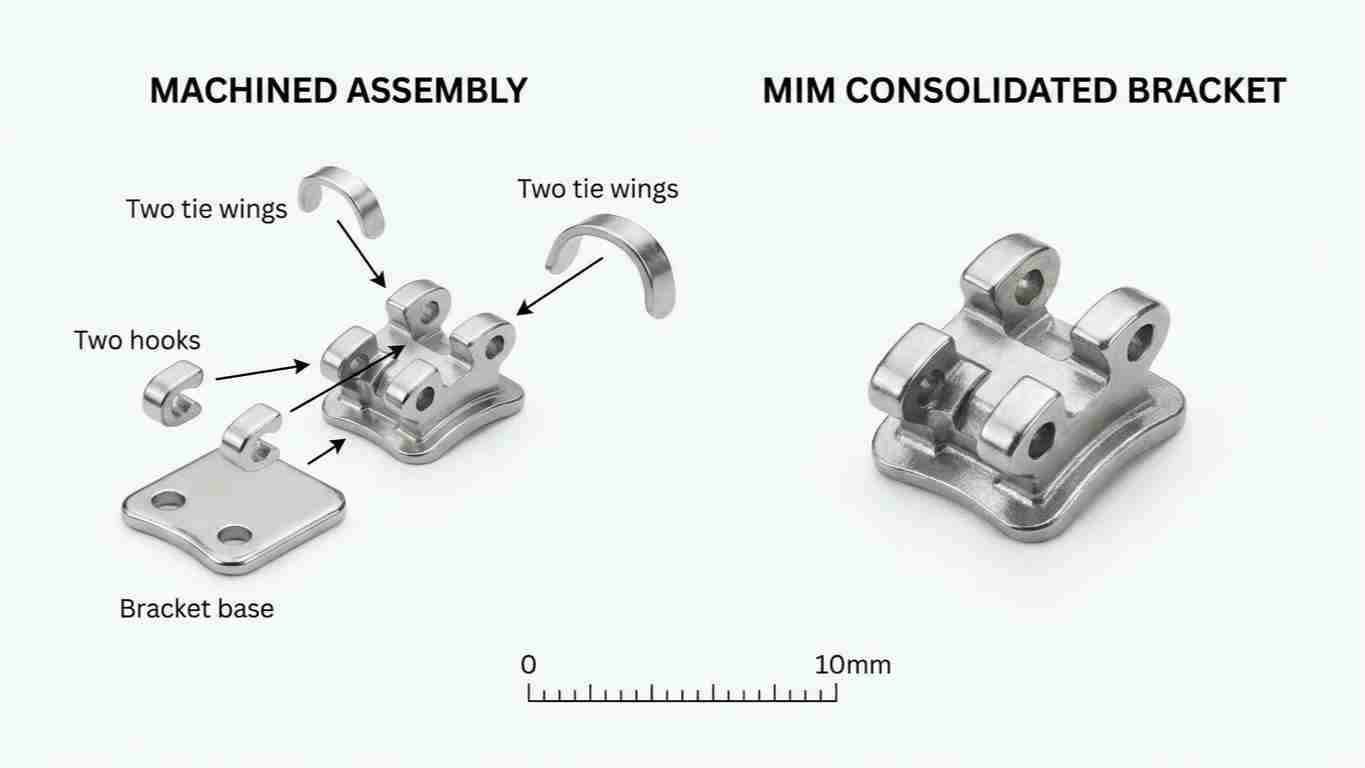 MIM consolidation reduced assembly from 5 brazed components to 1 monolithic part, cutting costs 73% and eliminating joint failure risk[/caption]
Is Your Product Suitable for Consolidation?
Consolidation only works when volume economics justify tooling investment and technical constraints allow single-material integration. Run through this evaluation:
Volume Economics Come First
MIM tooling represents a significant upfront investment depending on complexity. Calculate your break-even point: Break-Even Volume = Tooling Cost ÷ (Current Assembly Cost - Projected MIM Cost per Unit).
Example: Compare your current assembly cost (parts + assembly) against the projected MIM cost per unit. Divide the tooling investment by the per-unit savings to estimate break-even volume, then multiply annual savings by projected volume to evaluate long-term value.
Volume thresholds work like this: below about 10,000 units annually, consolidation rarely makes economic sense unless your current assembly has severe quality issues or extremely high costs. Between 10,000-20,000 units, the decision depends on cost differential and complexity. Above 20,000 units, many consolidations deliver payback within one to two years. Above 50,000 units, evaluate every multi-part assembly.
Technical Feasibility Check
Four technical requirements determine whether consolidation is physically possible:
Material Compatibility:All parts must work in a single alloy. MIM handles stainless steels (316L, 17-4PH), low-alloy steels, tool steels (M2, D2), titanium alloys (Ti-6Al-4V), and nickel superalloys. Assemblies requiring different material properties—like magnetic plus non-magnetic sections—cannot consolidate. Many assemblies use different materials for manufacturing convenience rather than functional necessity. Evaluate whether 17-4PH stainless could replace both 316L and hardened steel components after heat treatment.
Size and Mass Limits:Keep total assembly weight under 100 grams for optimal results. Parts up to 250 grams work but require careful process control. Maximum wall thickness should stay under 6-8mm in any section. Thicker sections don't sinter reliably and cause warping.
Tolerance Requirements:MIM delivers ±0.3-0.5% dimensional tolerance as-sintered. Tighter tolerances require secondary machining, which adds cost but may still justify consolidation by eliminating tolerance stack-up. A four-part assembly with ±0.05mm tolerance on each component accumulates ±0.20mm total error, while a single MIM part maintains ±0.08mm on the same overall dimension.
Design Stability:Consolidation requires stable geometry. Tooling modifications add cost and take several weeks. Don't consolidate assemblies that change frequently during development or have uncertain requirements. Wait for design maturity.
Disqualifying Factors
Some assemblies should not be consolidated regardless of volume. Incompatible material requirements are absolute—MIM produces single-alloy parts. Assemblies where serviceability demands component replacement lose value when consolidated into monolithic parts. Products with annual volume below 5,000 units rarely justify tooling investment. Rapidly evolving designs face expensive tooling rework with each change.
Proven Consolidation Examples
Three documented cases show how consolidation works across different applications and volume ranges:
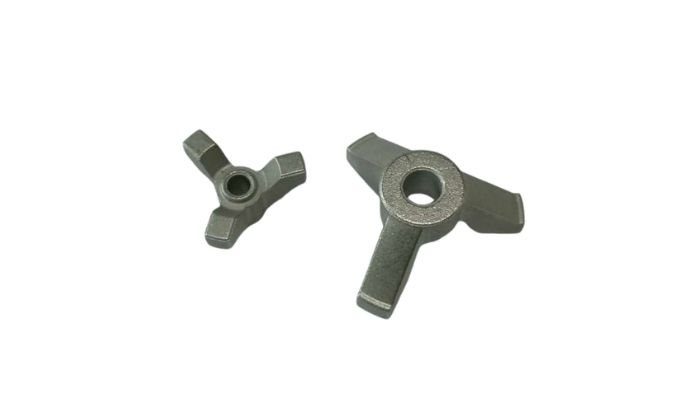
Consolidated MIM medical components demonstrating complex integrated geometries
Medical device assemblies such as jaw mechanisms often combine several machined parts. Consolidating them into a single MIM part can eliminate assembly steps, reduce supply-chain complexity, and remove potential failure points. Actual savings depend on part geometry, material, and annual volume.
Automotive turbocharger vanes and similar high-volume components have been produced through consolidated MIM designs. The process can integrate mounting features and optimize airfoil geometry in difficult superalloys, though specific savings depend on the application and supplier.
Implementation Realities
Timeline: 4-6 Months Typical
Moderately complex consolidations take 4-6 months from decision to production-qualified parts: 4-8 weeks for design optimization with your MIM partner, 8-12 weeks for tooling fabrication, 4-6 weeks for process development and first articles, and 2-4 weeks for production qualification. Highly complex designs requiring significant geometry optimization can extend to 6-9 months. Budget for 2-3 tooling iteration cycles—first articles rarely meet all specifications without minor mold adjustments.
Partner Selection Matters
Work with MIM manufacturers who have documented experience in your industry and can show similar consolidation case studies. Vertical integration matters—partners who compound their own feedstock, design and build tooling in-house, and operate integrated debinding and sintering typically deliver better outcomes and faster problem resolution. Verify documented quality practices: lot-level traceability and material certificates as a baseline, plus industry-specific requirements such as ISO 13485 for medical. Have them review your consolidation concept before committing to tooling.
Frequently Asked Questions
Q: What production volume justifies consolidation?
The typical threshold is thousands to tens of thousands of units annually for payback on tooling investment. However, break-even depends on your specific cost differential. Calculate it: divide tooling cost by per-unit savings. Highly complex assemblies with expensive machining can justify consolidation at lower volumes. Simple two-part assemblies with low assembly cost may need higher volumes. Projects with severe quality or warranty issues may justify lower volumes if consolidation eliminates those problems.
Q: What if parts currently use different materials?
Single-material limitation is the most common barrier. MIM produces parts from one alloy—you cannot consolidate magnetic plus non-magnetic sections or components needing substantially different hardness. However, many assemblies use different materials for manufacturing convenience rather than functional necessity. Evaluate whether one alloy works for all functions. For example, 17-4PH stainless can sometimes replace both 316L and hardened tool steel after heat treatment. Have your MIM partner's materials team assess whether a compromise alloy meets requirements.
Q: Can MIM match machined assembly tolerances?
MIM delivers ±0.3-0.5% dimensional tolerance as-sintered, wider than precision CNC machining. However, consolidated parts often achieve better overall accuracy by eliminating tolerance stack-up. A four-part assembly with ±0.05mm per component accumulates ±0.20mm total error, while a single MIM part maintains ±0.08mm on the same dimension. For ultra-tight tolerances on specific features, use hybrid manufacturing: MIM creates the complex near-net shape, then targeted CNC machining addresses critical surfaces.
Q: How long does development take?
Expect 4-6 months from design freeze to production-qualified parts for moderate complexity. Highly complex consolidations can extend to 6-9 months. This includes design optimization (4-8 weeks), tooling fabrication (8-12 weeks), first article refinement (4-6 weeks), and production qualification (2-4 weeks). Budget for 2-3 tooling iteration cycles since first articles rarely meet all specifications without mold adjustments. This timeline is longer than CNC machining but shorter than developing new assembly processes.
Q: What are the biggest consolidation risks?
Three risks dominate: underestimating tooling refinement cycles leads to budget overruns—plan for 2-3 iterations. Inadequate design optimization causes problems when engineers simply merge existing geometries rather than redesigning for MIM process physics like uniform wall thickness. Volume projection errors hurt ROI if actual production falls significantly below forecast. Mitigate through experienced MIM partner selection, rigorous design review, and conservative volume assumptions. Include contingency in both budget and schedule.
Making the Decision
MIM consolidation can deliver significant cost reduction when applied to the right candidates. The decision hinges on three factors: production volume high enough to justify tooling investment, technical feasibility within single-material constraints, and stable design that won't require frequent modifications.
Start by evaluating your product portfolio. Strong candidates have 2-5 small metal parts with total weight under 100 grams, all workable in a single alloy. Calculate break-even: divide your tooling cost estimate by per-unit savings. At sufficient annual volume with meaningful per-unit savings, you can break even in the first year and continue saving annually thereafter.
Work with an experienced MIM partner to validate technical feasibility before committing. Have them review your assembly design, assess whether a single material works for all components, and provide realistic cost projections including tooling. Don't consolidate based on rules of thumb—run the numbers for your specific application.
Precision Metal Parts from Emitech
Nanjing Emitech delivers MIM, CNC machining, and custom metal parts. MIM services · Request a quote
Last updated: 2026-06-24