
When you're evaluating manufacturing processes for stainless steel components, the question isn't whether stainless steel can be sintered—it absolutely can. The real question is whether sintering represents your optimal pathway for achieving the density, complexity, and corrosion resistance your application demands. This guide provides the decision frameworks, process parameters, and troubleshooting protocols you need to make that determination.
Executive Summary: The Definitive Answer
Yes, stainless steel can be sintered, and it is widely sintered.Sintering is a mature global manufacturing technology serving as a foundational process for high-volume production of stainless steel components across automotive, biomedical, aerospace, and industrial sectors.
Core Process:Sintering transforms compacted metal powders into dense, solid components by heating to 1180-1390°C (below melting point), enabling atomic diffusion and particle bonding.
Critical Challenge:Managing chromium oxide (Cr₂O₃) surface layers that prevent particle bonding—solved through atmosphere selection (H₂, N₂, Ar, or vacuum).
Three Manufacturing Platforms:
- Conventional Powder Metallurgy (PM): 80-95% density, lowest cost for high volume
- Metal Injection Molding (MIM): 96-99% density, extreme geometric complexity
- Additive Manufacturing (AM): Tool-free prototyping with same sintering fundamentals
Quick Process Selection Matrix
Process selection depends on your primary constraint: production volume, part complexity, density requirement, and budget. Conventional press-and-sinter PM suits simple, high-volume parts; MIM suits complex, high-precision geometries; additive manufacturing suits prototyping; HIP can be added when full density is required.
Use this table to identify your optimal pathway in 30 seconds:
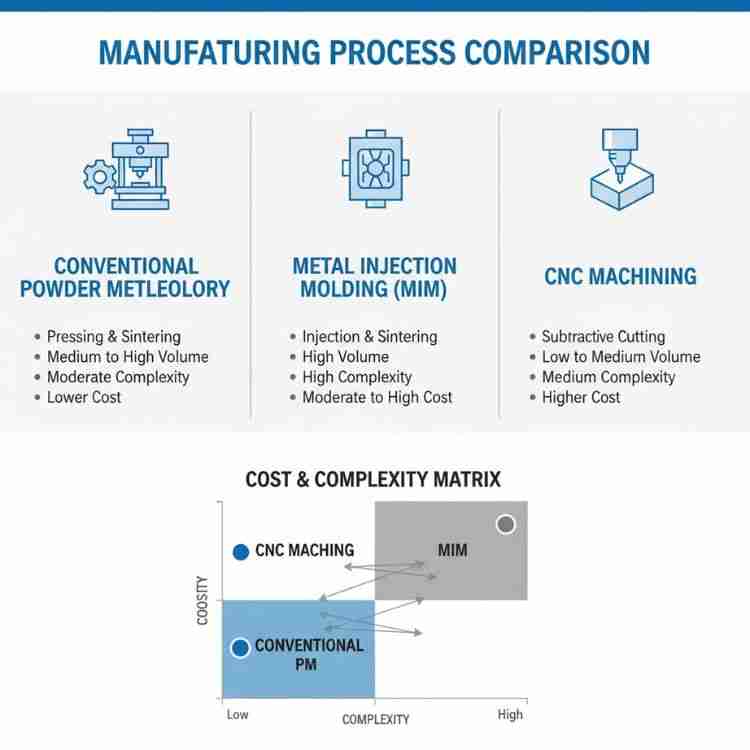
Decision Rule:Match your primary constraint (volume, complexity, or budget) to the row above. If unsure, MIM offers the best balance for most applications.
Atmosphere Selection: 4-Step Decision Framework
Step 1: Identify Your Primary Objective
Atmosphere Selection Decision Tree
→ UseH₂ (Hydrogen)
Cost: High | Safety: Complex | Result: Best
Cost: Low | Safety: Simple | Result: Good
→ UseVacuum + Partial Pressure Backfill
Cost: Very High | Result: Excellent
→ UseArgon(expect 2-4% lower density)
Step 2: Atmosphere Performance Comparison
Hydrogen provides active oxide reduction and generally yields the highest density and corrosion resistance for austenitic and precipitation-hardening grades. Nitrogen is cost-effective for ferritic grades but requires fast cooling to avoid chromium nitride sensitization in austenitic grades. Argon and vacuum are used for titanium and nitrogen-sensitive alloys.
Step 3: Calculate Your Total Cost of Ownership
Total cost includes powder, atmosphere gas, energy, tooling amortization, safety equipment, and any secondary operations. Hydrogen atmospheres add cost but can improve density and corrosion resistance. The right choice balances performance requirements against budget.
Decision Rule:If your application justifies a per-part premium for performance (aerospace, medical, marine), choose H₂. For cost-sensitive automotive applications with moderate corrosion requirements, N₂ is sufficient.
Step 4: Nitrogen Atmosphere Safety Protocol (CRITICAL)
⚠️ CATASTROPHIC FAILURE MODE WARNING
Using N₂ atmosphere withslow coolingcauses chromium nitride (CrN) precipitation, leading to chromium-depleted grain boundaries andtotal loss of corrosion resistance.
- Cooling rate:>100°C/minfrom sintering temperature
- Install quench gas jets or rapid cool zones
- Verify with metallography (no CrN precipitates)
If you cannot achieve fast cooling, DO NOT use nitrogen atmosphere. Switch to H₂ or vacuum.
Material Grade Selection: Performance vs. Cost Analysis
Quick Reference: The Three Main Families
TL;DR Summary:
- 316L (Austenitic):Best corrosion resistance, lowest strength, highest ductility, premium price
- 409L (Ferritic):Cost-effective workhorse, good high-temp properties, moderate everything
- 17-4 PH (Precipitation Hardening):3-4x stronger than 316L, requires heat treatment, moderate corrosion
Detailed Performance Comparison
316L offers the best corrosion resistance and ductility but lower strength. 409L is a cost-effective ferritic grade with good high-temperature oxidation resistance. 17-4 PH provides much higher strength after aging heat treatment but requires more processing control.
Grade Selection Decision Matrix
Choose 316L for corrosion-critical and non-magnetic applications. Choose 409L for cost-sensitive, high-temperature automotive applications. Choose 17-4 PH when high strength and hardness are required and post-sinter heat treatment is available.
Temperature Optimization: The Central Trade-Off
Higher temperature = higher density and strength, but also more shrinkage and grain growth. Your optimal temperature balances these competing factors based on your dimensional tolerance requirements.
Temperature Effects: Quantified Data
Higher sintering temperatures generally increase density and strength but also increase shrinkage and grain growth. The optimal temperature is the lowest value that meets your minimum density and property requirements.
Case Study: 15-5PH Stainless Steel (Metal FDM Process)
Key Insight:90°C temperature increase delivers 35% strength gain but increases shrinkage by 2.3 percentage points.
Temperature Selection Framework
For maximum density, use the upper end of the recommended range for each alloy. For tight dimensional tolerance, use lower temperatures or warm compaction and accept some density trade-off. Always validate with first-article measurements.
Temperature Decision Protocol
- 316L: Use1250-1280°C(upper range)
- 409L: Use1280-1300°C
- 17-4 PH: Use1370-1390°C
Result: 96-99% density, but 15-20% shrinkage
- Use warm compaction at 100°C to boost green density
- 316L: Use1180-1220°C(lower range)
- 409L: Use1250-1270°C
- 17-4 PH: Use1340-1360°C
Result: 90-94% density, but only 12-16% shrinkage
If your furnace max is 1280°C but you need 17-4PH properties:
- Option A:Accept 92-94% density (15-20% strength loss)
- Option B:Extend dwell time (4hr → 8hr) for partial gain
- Option C:Outsource to MIM bureau or add HIP post-process
Engineering Reality Check: Temperature vs. Dimensional Control
Options for tight tolerances include warm compaction, lower sintering temperature, post-sinter sizing or coining, and tooling compensation based on measured shrinkage. The most economical approach depends on volume and tolerance requirements.
Problem:Your part spec requires ±0.2% dimensional tolerance, but standard sintering produces ±1.5-3% variation.
Solution Hierarchy:
- Warm Compaction (Most Effective)— Heat powder and tooling to 100°C during pressing. Achieves 0.2 g/cm³ higher green density. Result: 316L shrinkage reduced from -3.06% to -1.84%. Cost impact: heated tooling system investment.
- Reduce Sintering Temperature by 50-80°C— Trade-off: accept 5-8% lower final density. Suitable for non-critical structural applications. Cost impact: none (actually saves energy).
- Add Post-Sinter Sizing Operation— Re-press or coin critical features after sintering. Achieves ±0.1% on sized dimensions. Cost impact: per-part processing cost.
- Design Compensation— Engineer tooling 15-20% larger to account for shrinkage. Requires accurate shrinkage characterization (10-20 trial runs). Cost impact: extended development time (2-4 weeks).
Decision Rule:For volumes >50,000 units with tight tolerances, warm compaction ROI is achieved in 1-2 years. For lower volumes, post-sinter sizing is more economical.
Process-Specific Guidelines
Conventional PM: Achieving 7.2 g/cm³ for Automotive Applications
Automotive exhaust components in ferritic grades typically target minimum 7.2 g/cm³ density for oxidation resistance. Warm compaction, controlled atmosphere, and optimized sintering parameters help reach this density with good dimensional control.
Automotive exhaust components require minimum 7.2 g/cm³ density to prevent oxidation failure. Warm compaction is the most reliable path to achieve this with good dimensional control.
Performance Gain:Same final density at 20°C lower temperature. 32% reduction in shrinkage improves dimensional control. Energy savings: ~8% per cycle.
MIM: Achieving 96-99% Density with Isotropic Shrinkage
MIM's key advantage is uniform 15-20% shrinkage in all directions, enabling complex geometries. Success depends on complete debinding before sintering.
Critical Process Windows:
Common MIM Failure Modes:
Troubleshooting Guide: Diagnosing Sintering Failures
Quick Diagnostic Chart
Common sintering defects include cracking, low density, poor corrosion resistance, dimensional variation, and surface blisters. Root causes usually involve thermal profile, atmosphere quality, green density uniformity, or debinding completeness.
Detailed Failure Mode Analysis
Failure Mode 1: Chromium Nitride Sensitization (CRITICAL)
Description:Parts sintered in N₂ atmosphere with slow cooling develop chromium-depleted regions at grain boundaries, causing catastrophic corrosion resistance loss.
How to Detect:
- Visual:Part develops rust spots within weeks when 316L should be corrosion-resistant
- Electrochemical:Pitting potential drops from +400mV to <0mV (vs. Ag/AgCl)
- Metallography:Optical microscopy reveals grain boundary precipitates (etch with oxalic acid)
Root Cause:CrN precipitates form when cooling rate <50°C/min from 1200-800°C temperature range.
Prevention Protocol:
- Install rapid cooling system: forced gas quench jets (100-200 m/min gas velocity); target >100°C/min from 1250°C to 800°C
- Verify cooling profile with thermocouples placed inside representative part cavity; record actual cooling rate (not furnace control temp)
- Metallographic validation (first article): etch grain boundaries with 10% oxalic acid; examine at 400× magnification; accept = clean grain boundaries, no precipitates; reject = dark grain boundary networks = CrN present
- Corrosion testing (batch validation): salt spray test (ASTM B117) min 500 hours no rust; electrochemical: pitting potential >+300mV
Corrective Action if Detected:
- Switch to H₂ atmosphere (eliminates nitrogen source)
- OR install/upgrade cooling system to achieve >100°C/min
- Scrap affected parts (cannot be salvaged)
Failure Mode 2: Low Density Due to Oxide Barrier
Description:Parts fail to achieve target density despite adequate temperature and time, remaining at 85-92% density when >95% expected.
How to Detect:
- Archimedes density measurement:Actual density 3-8% below theoretical
- Visual:Dull, porous surface (should be metallic and shiny)
- Mechanical:Tensile strength 30-50% below datasheet values
Diagnostic Protocol:
- Verify atmosphere purity: oxygen sensor reading must be <10 ppm O₂; dewpoint must be <-40°C; pressure-test furnace for air leaks
- Verify reducing potential (if using H₂): H₂ concentration must be >95%; check H₂ flow rate — minimum 5 L/min per kg of parts
- Check for moisture contamination: powder storage must be dry (<0.1% moisture); MIM debinding must remove ALL binder residue
Corrective Action:
- Immediate:Switch to pure H₂ atmosphere at 1.5× normal flow rate
- Short-term:Increase sintering temperature by 30-50°C
- Long-term:Upgrade furnace seals; install oxygen/moisture monitoring
Failure Mode 3: Warping and Dimensional Distortion
Description:Parts emerge from furnace with twisted, bent, or non-uniform geometry despite accurate tooling.
How to Detect:
- Dimensional:CMM or caliper measurements show >±1% variation
- Visual:Part doesn't sit flat on surface inspection plate
- Fit-check:Mating features don't align with counterparts
Warping Root Cause Diagnosis
- Cause:Furnace thermal profile non-uniform → Map furnace temperature with multi-point thermocouples; adjust heating elements; optimize load arrangement
- Cause:Part design has asymmetric features → Add balance features or support ribs to equalize thermal mass
- Cause:Non-uniform green density → Improve powder flow; check die filling consistency; verify compaction pressure uniformity
- Cause:Differential cooling (MIM) → Optimize part orientation on setter; reduce cooling rate to <80°C/hr
- Cause:Gravity sag at sintering temperature → Use support structures (setter plates); orient part to minimize cantilever; consider segmenting into smaller parts
Optimizing for Specific Applications
Automotive Exhaust Components (409L, 434L)
Requirements:
- Minimum density: 7.2 g/cm³ (non-negotiable for oxidation resistance)
- Operating temperature: 650-900°C continuous
- Cost target: depends on volume and specification
- Dimensional tolerance: ±0.5% acceptable
Quality Control Checkpoints:
- Green density: 6.95-7.05 g/cm³
- Sintered density: 7.20-7.30 g/cm³
- High-temp oxidation test: 900°C for 100 hours, max 2 mg/cm² scale
Medical/Surgical Components (316L, 17-4 PH)
Requirements:
- Biocompatibility: ISO 10993 compliant
- Corrosion resistance: Must pass 168-hour salt spray (ASTM B117)
- Density: >98% (minimal porosity for sterilization/cleaning)
- Surface finish: Ra <1.6 μm
- Traceability: Full lot documentation required
Critical Control Points:
- Powder purity:Medical-grade 316L only
- Debinding completeness:Carbon content must be <0.03%
- Surface cleanliness:Passivation in 20% HNO₃ to optimize passive layer
- Documentation:Full traceability (powder lot, process parameters, test results)
Filtration Elements (Porous 316L)
Requirements:
- Pore size: 10-100 μm (application-dependent)
- Porosity: 30-40%
- Permeability: >50 L/min/cm² at 1 bar
- Mechanical strength: >150 MPa tensile
Advanced Solution: Hot Isostatic Pressing (HIP)
HIP is a post-sintering process that eliminates ALL residual porosity, producing 100% dense parts with wrought-equivalent properties. Required for safety-critical aerospace and medical implants.
When You Need HIP
HIP Process Parameters
HIP applies elevated temperature and isostatic gas pressure for a controlled hold time. Parameters are material-specific and generally set below normal sintering temperature to avoid excessive grain growth.
Pre-Requisites:
- Parts must already be sintered to >94% density
- All pores must be CLOSED (isolated, not interconnected)
- If pores are open to surface, HIP will collapse part geometry
Standard HIP Cycle (316L):
- Pressurization: 100-150 MPa (15,000-22,000 psi) Argon gas
- Temperature: 1150-1200°C (held at pressure)
- Hold Time: 2-4 hours at temperature and pressure
- Cooling: Slow furnace cool under pressure
- Result: 100% theoretical density
Performance Improvement: Before vs. After HIP
HIP increases density and generally improves ductility, fatigue resistance, and corrosion performance versus as-sintered MIM. The degree of improvement depends on alloy, starting density, and HIP parameters.
Cost Impact:HIP adds processing cost and cycle time. It is most often justified for safety-critical or high-value parts.
Frequently Asked Questions
Q: What is the optimal sintering temperature for 316L stainless steel?
A: For conventional PM (press-and-sinter): 1180-1220°C for low-density applications (85-90%); 1240-1280°C for high-density automotive (>90%) using H₂ atmosphere. For MIM targeting 96-97% density: 1280-1320°C; for 98-99% density: 1350-1380°C with 2-4 hour dwell. Each +20°C increase adds +1-2% density but +0.3-0.5% more shrinkage. Select the lowest temperature that meets your minimum density requirement to minimize dimensional change.
Q: How does sintering atmosphere affect final corrosion resistance?
A: Hydrogen atmosphere at 1280°C+ produces best corrosion resistance by actively reducing Cr₂O₃ surface oxides, enabling a clean, high-quality passive layer. In ASTM B117 salt spray testing at 168 hours: H₂ atmosphere passes with zero rust; N₂ with slow cooling (<50°C/min) fails at 24 hours due to CrN precipitation; N₂ with fast cooling (>120°C/min) passes. If cooling rate cannot be guaranteed above 100°C/min, use H₂ or vacuum — the risk of chromium nitride sensitization causing total corrosion resistance failure is too high.
Q: Can sintered stainless steel match wrought material properties?
A: Yes, with MIM + HIP. Standard MIM achieves 96-98% of wrought UTS and 80-90% of elongation. Conventional PM achieves 70-85% of wrought properties. MIM + HIP at 100% density matches or exceeds wrought in all properties. The gap exists because pores act as stress concentrators (Kt = 2-4) that initiate cracks under cyclic loading. For static applications, MIM alone is adequate. For high-cycle fatigue (rotating components, aerospace structural, load-bearing medical implants), specify MIM + HIP.
Q: What causes dimensional change during sintering, and how can it be controlled?
A: Dimensional shrinkage occurs as pores close during densification. Conventional PM shrinks 2-5% linearly (6-15% volumetrically, anisotropic). MIM shrinks 15-20% linearly (38-49% volumetrically, isotropic). Control methods: (1) Warm compaction at 100°C reduces PM shrinkage by 30-40% — 316L shrinkage drops from -3.06% to -1.84%; (2) Lower sintering temperature by 50-80°C reduces shrinkage at the cost of 5-8% lower density; (3) Post-sinter sizing re-presses critical features to ±0.1% tolerance; (4) Tool compensation oversizes cavities by the predicted shrinkage factor.
Q: Why is 17-4 PH stainless steel more difficult to sinter than 316L?
A: Three reasons. First, BCC martensitic crystal structure has 30-40% slower atomic diffusion than FCC austenite, requiring 100-150°C higher temperature (1340-1390°C vs 1180-1280°C) to achieve equivalent densification. Second, the 3-5% copper content has a 1085°C melting point — sintering above 1400°C risks localized Cu melting and non-uniform microstructure. Third, 17-4PH requires mandatory post-sinter heat treatment: solution anneal at 1040°C → quench → age harden at 480-620°C for 1-4 hours. Without aging, as-sintered 17-4PH delivers only 60-70% of potential strength (700-800 MPa UTS vs 1,190 MPa after H900 aging). Total processing cost is 2.6× higher than 316L.
Q: What density is required for automotive exhaust applications?
A: Minimum 7.2 g/cm³ for ferritic grades (409L, 434L), corresponding to >92% theoretical density. Below this threshold, porosity is interconnected — hot exhaust gases penetrate into pores and cause internal oxidation, generating volume-expanding oxide scale that creates internal stress and cracks. At 7.2 g/cm³ (409L, 850°C service): oxidation resistance is adequate for typical automotive exhaust duty. At 6.8 g/cm³: oxidation resistance is substantially worse. Warm compaction at 100°C is the enabling technology — it achieves 7.20-7.35 g/cm³ with 30-40% less shrinkage than standard room-temperature compaction.
Q: How does pore size distribution affect filtration performance?
A: Pore size is approximately 0.3-0.5× powder particle size. Select powder particle size to target your required filtration rating: 45 μm powder → 15-25 μm average pore size; 90 μm powder → 30-45 μm pores; 150 μm powder → 50-75 μm pores. Finer pores give better filtration but lower permeability and higher pressure drop. At 40% porosity (316L): 5 μm pores flow 10-20 L/min/cm² at 1 bar; 40 μm pores flow 120-200 L/min/cm²; 100 μm pores flow 400-700 L/min/cm². For applications needing both high flow and fine filtration, use a graded multi-layer structure with coarse outer layer (pre-filter) and fine inner layer (final filtration).
Q: What is the cost crossover point between PM and machining?
A: For simple geometries: crossover at 5,000-10,000 units/year. For complex geometries: crossover at 1,000-3,000 units/year. The decision framework by volume: below 500 units — always machine (tooling cannot be amortized); 500-3,000 units — machine for low complexity, evaluate PM/MIM for high complexity; 3,000-20,000 units — PM for low-medium complexity, MIM for high complexity; above 20,000 units — PM or MIM almost always wins unless geometry is trivially simple. Part complexity dramatically shifts the crossover: complex parts may favor MIM at lower volumes, while simple parts require higher volumes to justify PM.
Conclusion: Strategic Implementation Guidance
Yes, stainless steel can absolutely be sintered, and sintering represents a strategic manufacturing technology when properly matched to your application. This guide has provided decision frameworks for atmosphere selection, material grade selection, and process pathway selection; quantified performance data on temperature effects, density requirements, and cost trade-offs; troubleshooting protocols for the three most critical failure modes; and application-specific optimization for automotive, medical, and filtration components.
Critical success factors:
- Atmosphere control is non-negotiable:Poor atmosphere is the #1 cause of sintering failures
- Green density drives everything:Higher green density = less shrinkage + better properties
- Porosity has two faces:Defect for structural parts, feature for functional parts
- Temperature is a balance:Higher = better density but worse dimensional control
- Volume determines economics:<1,000 units = machine it, >10,000 units = sinter it
Material & Manufacturing Support from Emitech
Emitech offers MIM, CNC machining, and material selection support for precision metal parts. MIM services · Contact us
Last updated: 2026-06-24