
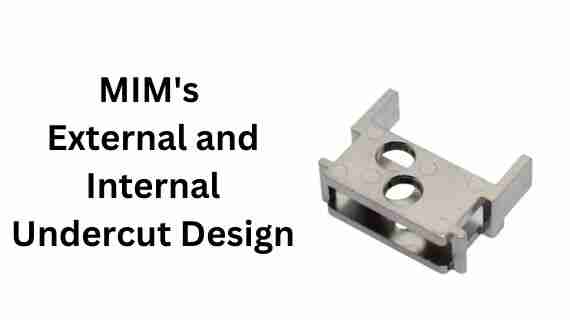
Cross-sectional view showing external and internal undercut features achievable with MIM tooling using side slides and collapsible cores
Key Takeaways
- An undercut is any feature that blocks straight ejection — side holes, O-ring grooves, snap-fit hooks, internal threads, and cross-bores all qualify. The geometry is usually functional, so the engineering question is which process absorbs it cheapest.
- Plastic molds get four escape routes; MIM gets three. Flexible plastics can strip shallow undercuts off the core, but a brittle MIM green part cannot — every MIM undercut needs a mechanically retracted tool element.
- External undercuts take side slides. Side action tooling is mature and reliable; the trade is a one-time tooling premium and a witness line at each slide shut-off.
- Internal undercuts take collapsible cores or lifters. Commercial collapsible cores run 6, 8, or 12 segments and release bores from roughly 6 mm inside diameter upward.
- Undercut cost lives in the tool, not the part. Complex side-action molds run $20,000-$50,000+, but per-piece cost stays nearly flat, so molding the feature beats machining it at volumes above roughly 10,000 parts per year.
- Design rules are about the green state. Generous root radii, 0.5°-2° draft, uniform walls in the 0.5-6 mm window, and grooves no deeper than they are wide prevent cracks, flash, and sintering distortion.
- Early DFM review is the cheapest insurance. A 24-hour design review catches crack roots, slide shut-off placement, and weld lines while changes still cost nothing.
Metal Injection Molding (MIM) delivers high-precision, high-strength metal components while accommodating both external and internal undercuts. Thoughtful MIM undercut design is what turns that capability into savings: the feature is tooled once, molded hundreds of thousands of times, and never machined. This guide explains how the MIM process produces undercut features, how undercut injection molding in metal compares with plastics and CNC machining, and which design rules keep undercut geometry producible and economical.
What Is an Undercut in Part Design?
An undercut is any feature that prevents a molded part from releasing along the primary mold-opening direction — the draw axis. In practical terms, if you project the part silhouette along the direction the mold opens and any metal hides behind other metal, that hidden geometry is an undercut. The mold must either move a tool element out of the way or the part cannot eject.
Undercuts are rarely design mistakes. They are usually the point of the part:
- Cross-holes carry pins, shafts, or fluid paths perpendicular to the parting plane.
- O-ring grooves wrap 360° around a wall to seal a mating face.
- Internal threads fasten a mating component by helical engagement, which mechanically locks the part onto the core.
- Snap-fit hooks and bayonet features capture a mating part by facing back against the ejection direction.
- D-flats, side slots, and side ports locate or vent on radial faces.
None of these can be formed by two mold halves pulling straight apart. The table below shows typical examples, why each is an undercut, and what it costs to make in a conventional machined-from-solid route.
| Feature | Why it is an undercut | Cost in a conventional route |
|---|---|---|
| Cross-hole through a boss | Hole axis is perpendicular to the draw direction; no straight pull releases the pin | Drill and deburr every part, with a fixture per orientation |
| External O-ring groove | Groove wraps fully around a side wall | Second lathe setup or thread-grooving insert per part |
| Internal thread | Helix locks the part onto the core until it is screwed off | Tapping operation, tap breakage risk, per-part labor |
| Snap-fit hook | Hook lip faces back toward ejection | Formed in a secondary bend or trim operation |
| D-flat or side slot on a hub | Flat or slot sits on a radial face | Milling setup and cycle time per part |
Undercut design, done well, is about choosing the manufacturing route that absorbs these features most cheaply — and that is where MIM changes the math.
MIM Process Overview
MIM combines metal powder with a thermoplastic binder, injects the feedstock into precision molds, then removes the binder and sinters the part to near-full density. The process excels at producing small, geometrically complex metal parts withtolerances down to ±0.3%of nominal dimensions — as-sintered MIM typically holds ±0.3% to ±0.5%, and tighter requirements are reached with secondary CNC work (full data on our MIM tolerances page). Sintering runs at roughly 1,100-1,400 °C in vacuum or hydrogen and densifies the part to 95-99% of theoretical density; the mechanics of that step are covered in our guide to how sintering works. Because the part shrinks 15-20% linearly during sintering, every cavity dimension — including slides and cores — is scaled up by the shrinkage factor at tool design.
Undercut design touches all four stages of the process, not just molding:
- Tooling:Slides, lifters, and collapsible cores are built into the mold to resolve undercuts; their parting faces and shut-offs define where witness lines land.
- Molding:Slides must lock against 800-1,200 bar injection pressure and retract cleanly; green parts must eject without cracking at undercut roots.
- Debinding:Binder removal time scales with section thickness, so undercut features that create thick local sections slow the whole batch.
- Sintering:Non-uniform sections around undercuts shrink unevenly, driving distortion that must be managed with setters and sintering profiles.
Undercuts: MIM vs. Plastic Injection Molding vs. CNC
Engineers who know undercut injection molding from plastics will find the tooling vocabulary familiar — side actions, lifters, collapsible cores — but one important option disappears. A flexible thermoplastic can be temporarily stretched or compressed during ejection, so shallow undercuts can be stripped straight off the core. Design guides for flexible resins treat an undercut of roughly 2-5% of the local diameter as strippable without any mechanism at all.
MIM feedstock cannot do that. At ejection the part is a "green" body — metal powder held together by wax and polymer — and it is brittle. It will not stretch over a hook or swell through a groove; it will crack. Every MIM undercut therefore needs a mechanically retracted tool element, exactly as a rigid engineering resin would.
CNC machining sits at the other extreme: it can cut any undercut, but it pays for every one, on every part, forever. External grooves need lathe or multi-axis milling passes, internal threads need tapping, and cross-holes need re-fixturing. Where MIM front-loads undercut cost into the tool and then amortizes it, machining distributes it across the entire production run.
| Aspect | Plastic injection molding | Metal injection molding | CNC machining |
|---|---|---|---|
| How undercuts are released | Slides, lifters, collapsible cores, plus forced ejection on flexible resins | Slides, lifters, collapsible cores only — no stripping (brittle green part) | Not applicable — the feature is simply cut |
| Where cost lands | Upfront tooling, near-flat unit cost | Upfront tooling, near-flat unit cost | Unit cost grows with every feature and setup |
| Shallow-undercut shortcut | ~2-5% of diameter can strip on flexible resins | None — hard retraction required | None needed |
| Practical feature floor | Very small (caps and closures) | ~6 mm ID floor for commercial collapsible cores; small cross-holes via slides | No floor, but each feature adds cycle time |
| Best fit | High-volume flexible or rigid plastic parts | Complex metal parts, roughly 0.1-200 g, above ~10,000 units/year | Prototypes, low volumes, tolerances tighter than as-sintered MIM |
The practical consequence: if a part is metal, complex, and produced in volume, MIM is usually the only route where undercut molding does not tax every unit. If it is a 50-piece prototype run, machining undercuts directly is almost always cheaper.
External Undercuts: Side Slides
External undercuts use mechanical side slides integrated into the mold base. During injection, the slides remain closed to form the undercut geometry. Upon part solidification, actuators retract the slides perpendicular to the parting line, allowing clean ejection. Three drive mechanisms cover most designs:
- Angle-pin (cam) slides:An angled pin in the mold base converts the mold-opening motion into slide travel. Simple, self-timing, and limited to short travels — the pin angle and mold stroke set the limit.
- Hydraulic slides:Cylinder-driven, timed independently of mold opening. Used for long travels, deep undercuts, or when the slide must move before the mold cracks open.
- Spring or wedge-actuated strippers:For shallow features, where a few millimeters of travel frees the geometry.
A well-designed slide locks against a heel surface — not against its actuator — while the cavity fills, so 800-1,200 bar of injection pressure cannot push it open. This is standard side action injection molding practice, and the same rules apply to metal feedstock as to plastic, with one addition: because MIM feedstock is heavily filled with metal powder, it is abrasive, so slide gib surfaces and shut-offs need hardened, well-maintained steel to hold the shut-off tight for hundreds of thousands of cycles.
Design rules for side-action features:
- Slide travel must exceed feature depthplus a clearance margin, so the slide fully clears the part envelope before ejection. Deep side features grow the mold footprint.
- Keep each undercut resolvable by one slide.A feature straddling two slide partings gets two witness lines and a fit-up tolerance stack between them.
- Plan the witness line.Every slide leaves a shut-off line; place it on a non-cosmetic, non-sealing face during DFM, not after the tool is cut.
- Watch flash.The slide shut-off is the most common flash site on MIM parts; a maintained, hardened shut-off plus a light tumbling operation keeps it cosmetic.
Traditional machining methods requirepost-process deburring and secondary millingto create undercut features, adding significant time to total manufacturing time. MIM molds with side slides eliminate these operations entirely. Once tooling is amortized over production volume, per-part costs remain nearly identical to non-undercut geometries.
Internal Undercuts: Collapsible Cores
Internal undercuts require collapsible cores or loose inserts that contract radially inward after molding. These mechanisms use segmented mandrels held in the expanded position by an external sleeve during injection. After the green part solidifies, the sleeve retracts, allowing the core segments to collapse for extraction. Collapsible core injection molding is a mature, catalog-based technology in the plastics closure industry, and the same components translate to MIM tooling: commercial collapsible cores are built with 6, 8, or 12 segments, release internal features on bores from roughly 6 mm inside diameter upward, and use hardened tool-steel sleeves (typically 55-60 HRC) that stand up to abrasive MIM feedstock.
For shallow internal features — windows, dimples, keyways a few tenths of a millimeter deep — angle lifters (angled ejectors) are often simpler. The lifter rides at an angle to the ejection stroke, moving sideways as it pushes the part off. Working angles run about 5° to 15°, with 12° or less preferred on high-volume tools because side thrust wears guides and can bend the lifter. The useful lateral travel is ejection stroke times the tangent of the lifter angle, so a deep internal undercut demands a long stroke — one reason lifters suit shallow features and collapsible cores suit deep ones.
Internal threads are the classic internal undercut. Three routes exist, and the volume/thread-size trade-off decides:
- Collapsible cores:Fast and automatic, but the segment split lines leave slight witness flats on the thread flanks. Functional classes fit; sealing-critical threads often get chased with a tap afterward.
- Unscrewing mechanisms:Rack-and-gear drives rotate the part or core off the helix, producing clean threads at the cost of the most complex — and most expensive — tooling in common use.
- Tapping after sintering:For fine threads (M2.5 and smaller) or volumes below roughly 10,000 units, a tapping operation is cheaper than any core mechanism.
Internal undercuts add significant tooling complexity but remain feasible with proper core design and material selection. Early collaboration with MIM engineers is critical to validate core strength and ejection mechanics.
Comparison: External vs. Internal Undercuts
The two undercut classes differ in mechanism, cost profile, and the dimensional risks they introduce. Use this matrix to sort a new drawing before requesting a quote.
| Feature Type | Mold Solution | Tooling Cost Impact | Cycle-Time Impact | Dimensional Effect | Typical Applications |
|---|---|---|---|---|---|
| External Undercut | Side slides / cams | Moderate — pushes tooling from the straight-pull tier ($3,000-$6,000 single cavity) toward the side-action tier ($20,000-$50,000+) | Adds slide-actuation seconds to each cycle | Witness line at each slide shut-off; ±0.3-0.5% as-sintered tolerance applies across the feature | O-ring grooves, side ports, D-flats, snap ribs, cross-holes |
| Internal Undercut | Collapsible cores / lifters / unscrewing | Highest — segmented core sets and unscrewing drives sit at the top of the tooling range | Adds collapse-and-stroke time, or full unscrewing time | Segment witness flats on threads; core deflection sets bore concentricity | Internal threads, radial pin bores, internal keyways, valve seats |
| Hybrid (both classes) | Slides + collapsible core | Compounding — each mechanism adds its own premium | Longest cycle of the three cases | Both effects; register features to a common datum early | Connector shells, valve bodies, lock mechanisms |
Undercut Design Rules and Practical Limits
Most undercut problems trace back to a handful of geometric decisions. The rules below are stated as working ranges with the conditions that justify them; treat them as the starting point for a DFM conversation, not as hard walls.
- Wall thickness:Keep walls in the 0.5-6 mm window, with 0.5-3 mm the most reliable band. Undercut features should not create local thick sections — debinding time scales roughly with the square of wall thickness, so a chunky groove boss slows binder removal for the whole part.
- Groove depth vs. width:Favor grooves whose depth does not exceed their width. Deep, narrow grooves fill hesitantly, vent poorly, and concentrate green strength stress at the root. If a deep groove is unavoidable, open the root with a radius and widen the mouth.
- Draft:Apply 0.5°-2° per side on walls parallel to draw, and more on deep cores and long draws. Undercut-forming surfaces benefit from draft wherever the function allows — it reduces ejection friction on a green part that has almost no tolerance for it.
- Root radii:Never leave a knife-sharp internal corner at the base of an undercut. Radii as generous as the function allows distribute the ejection load and survive sintering shrinkage without cracking.
- Venting and flow:Prefer through-features over blind pockets. A blind pocket under a slide or core traps air and leaves low-density zones; a through-hole vents naturally and debinds evenly.
- Parting line placement:Decide deliberately where slide shut-offs and core split lines land. Cosmetic and sealing faces should carry no witness lines.
- Feature scale floors:Collapsible cores become fragile below roughly 6 mm inside diameter at MIM injection pressures; below that scale, plan a secondary machining operation or redesign the feature as an external one.
| Parameter | Working range | Why the limit exists |
|---|---|---|
| Wall thickness | 0.5-6 mm; 0.5-3 mm most reliable | Debinding time scales with thickness squared; thick sections trap binder and distort in sintering |
| Draft on undercut walls | 0.5°-2° per side; more on deep draws | Green parts gall and crack on undrafted long draws |
| Groove proportion | Depth no greater than width | Deep-narrow grooves hesitate flow and crack at the root |
| Collapsible core bore | ≥~6 mm ID | Segment strength against 800-1,200 bar injection pressure |
| Lifter angle | 5°-15°; ≤12° for long-life tools | Side thrust wears guides and bends lifters |
| As-sintered tolerance | ±0.3-0.5% of dimension | Uniform-shrinkage assumption breaks down across moving tool elements |
Cost Impact of Undercuts in MIM
Undercut economics in MIM have a clean shape: a one-time step in tooling cost, then a nearly flat per-part line. Tooling tiers from our MIM cost guide frame the step:
| Mold class | Typical tooling cost | Typical lead time |
|---|---|---|
| Simple single-cavity (straight pull) | $3,000-$6,000 | 15-20 days |
| Multi-cavity production mold | $8,000-$15,000+ | 4-6 weeks |
| Complex mold with side actions / collapsible cores | $20,000-$50,000+ | 4-6 weeks |
A side action or collapsible core is usually what moves a project from the first tier to the last. What it does not do is change the per-part cost materially: slide actuation adds seconds to a cycle measured in tens of seconds, and the mechanisms are maintained as part of normal mold service. The amortized tooling line shrinks with every shipment — at the $20,000-$50,000+ tier, the arithmetic looks like this:
| Annual volume | Tooling cost per part ($30,000 side-action mold, first year) |
|---|---|
| 10,000 | $3.00 |
| 25,000 | $1.20 |
| 50,000 | $0.60 |
| 100,000 | $0.30 |
| 250,000 | $0.12 |
Set that against the alternative. A single secondary milling or threading operation at 5-15 minutes per part will, at any realistic shop rate, cost more than the entire amortized tooling premium within the first few thousand parts — and then keep costing it on every unit for the life of the program. That is why the crossover sits where it does: compared to machining the same undercut features, MIM molding wins for production volumes exceeding roughly 5,000-10,000 units, and the more undercuts the drawing carries, the faster the crossover arrives.
Complexity Without Cost Penalties
MIM inverts the traditional manufacturing cost equation. In conventional machining, each additional feature (thread, slot, groove) adds setup time and tool wear. In MIM, geometric complexity is locked into the mold design. Once tooling is validated, producing a part with six undercuts costs the same per-unit as producing one with zero undercuts.
This cost structure makes MIM ideal for consolidating assemblies. A design requiring three machined components with fasteners can often be collapsed into a single MIM part with integrated undercuts serving as snap-fit features or alignment bosses.
The "complexity is free" logic has one boundary worth respecting: free applies to the unit cost, not to the tooling risk. Every slide, lifter, and core is a moving component with its own wear parts and maintenance interval. Complexity that consolidates an assembly — removing fasteners, brackets, and leak paths — repays its tooling many times over. Complexity for its own sake buys nothing. The honest version of the rule is: complexity is free per part, but each mechanism in the tool should still earn its place.
Material choice rarely changes the undercut conversation — slides and cores work the same across the common MIM alloys — but it does change core wear, sintering behavior, and cost per part. Our MIM material selection guide covers that dimension separately.
Eliminating Secondary Operations
External undercuts formed with side slides require no post-molding work. The part ejects with the feature fully formed to net shape. Traditional methods would require:
- CNC milling:5-15 minutes per part for complex geometries
- Manual deburring:3-8 minutes labor per part
- Quality inspection:Additional sampling to verify dimensional conformance
Each eliminated operation also removes its failure modes: drill breakout into an adjacent wall, tap breakage inside a finished part, deburr gouges on a cosmetic face. At MIM volumes these risks are not statistical noise — they are per-part costs and scrap generators that disappear when the feature simply comes out of the mold.
Some secondary work usually survives the transition, and it is worth knowing which. Sealing threads often get a chase tap. Bearing bores and seating faces that need better than as-sintered tolerance go to a quick reaming or grinding pass — planned for at the quoting stage, with tolerances allocated per our MIM tolerance data. The goal is not zero secondary operations; it is making sure every remaining one is there by choice. Even internal undercuts requiring collapsible cores typically cost less than machining equivalent features from solid bar stock, especially at volumes exceeding10,000 units annually.
Defect Risks and How to Control Them
Undercut features concentrate MIM defect risk in predictable places. Each risk maps to a tooling or process control:
| Defect | Root cause | Control |
|---|---|---|
| Green cracks at undercut roots | Sharp internal corners plus brittle green ejection | Generous root radii, draft on undercut walls, polished slide shut-offs, parallel ejection |
| Flash at slide parting lines | Worn shut-offs or gibs letting 800-1,200 bar find a path | Hardened slide steel, scheduled shut-off maintenance, light tumble deburr |
| Sintering distortion near undercut sections | Uneven sections shrink at different rates; gravity and friction during densification | Uniform walls, ceramic setters, tuned sintering profiles |
| Short fill or binder-rich streaks in deep grooves | Flow hesitation in deep-narrow geometry; poor venting | Groove depth no greater than width, gate placement review, flow simulation on borderline features |
| Weld lines behind cores | Flow fronts rejoin downstream of every core pin | Place cross-holes and cores away from high-stress zones; verify weld-line location on the DFM drawing |
| Core wear or fracture | Small collapsible cores surviving full injection pressure | Respect the ~6 mm ID floor, hardened sleeves, preventive core replacement intervals |
Two of these deserve emphasis. First, weld lines: every hole and core pin splits the melt front and forces it to rejoin; the rejoin line is a genuine mechanical weak point, so cross-holes belong away from bending and fatigue paths. Second, distortion: an undercut that doubles the local section changes how that region shrinks at 1,100-1,400 °C. Uniform walls through undercut features do more for dimensional stability than any post-process correction.
Design Validation: Early Supplier Involvement
Engage MIM suppliers during the concept phase to validate undercut feasibility. Engineers will assess:
Critical Design Parameters:
- Core diameter and wall thickness ratios (avoid ratios below 3:1 for collapsible cores)
- Draft angles on undercut surfaces (minimum1-2°recommended)
- Gate placement to avoid weld lines at undercut intersections
- Parting line location to minimize slide complexity
A structured DFM review catches most undercut issues on the drawing, before steel is cut. The checklist our engineers walk through on an undercut-bearing part:
- Every undercut identified and classified external (slide) or internal (core/lifter) on the drawing
- Slide travel and ejector stroke checked against feature depth
- Witness and parting lines located off cosmetic and sealing faces
- Wall sections verified uniform through every undercut feature
- Gate and weld-line map reviewed against load paths
- Thread specification resolved: molded on a collapsible core, unscrewed, or tapped after sintering
- Tolerance stack agreed across slide faces, against the ±0.3-0.5% as-sintered baseline
- Material data confirmed against MPIF Standard 35, ISO 22068:2012, and ASTM B883
Material properties for MIM alloys are standardized in MPIF Standard 35 and ISO 22068:2012, with ASTM B883 covering the material specification side — quoting against those standards keeps first-article expectations aligned between customer and supplier. General DFM principles that apply alongside this checklist are collected in our DFM guidelines, and the part-level starting points in the MIM design guide.
Optimizing these parameters upfront prevents costly mold revisions and improves first-article yield rates.
Conclusion
Undercuts are where MIM either proves its promise or loses the project — and the difference is almost always tooling decisions made early. External undercuts resolve reliably with side slides; internal undercuts yield to collapsible cores, lifters, or unscrewing mechanisms; and neither class carries a per-part penalty once the tool exists. The cost of undercut injection molding in metal is a tooling decision, not a production decision: pay the $20,000-$50,000+ side-action tier when the part justifies it, and every unit thereafter carries the undercut for pennies instead of minutes of machine time.
The green state is what makes MIM unforgiving and knowable at once. No stripping, no shortcuts, no flexible-material tricks — but also no ambiguity: a drawing whose undercuts have radii, draft, uniform walls, and planned witness lines will tool cleanly. Emitech has tooled MIM components with external and internal undercuts from its Nanjing plant since 1995 under ISO 9001:2015, with DFM feedback and quotes returned within 24 hours. Send the drawing before the tool is designed — that is when an undercut costs nothing to change.
Frequently Asked Questions
Q: What is an undercut in MIM design?
An undercut is any feature (hole, slot, thread, or protrusion) that prevents direct ejection along the primary mold opening direction. MIM handles these using:
- Side Slides:Mechanical actuators for external features (grooves, bosses)
- Collapsible Cores:Segmented mandrels for internal features (threads, radial holes)
Q: Can MIM produce internal threads?
Yes, but the cost-optimal method depends on production volume and thread specification.
Molded Threads:Viable for coarse threads (M3 and larger) using unscrewing mechanisms or collapsible cores. Requires high tooling investment (substantial additional cost) but eliminates per-part tapping labor.
Tapped Threads:More economical for fine threads (M2.5 and smaller) or low volumes (<10,000 units). Adds moderate per-part cost in secondary operations but avoids complex core mechanisms.
Q: Does adding undercuts increase the cost of MIM parts?
Undercuts increase theinitial tooling cost substantially, depending on complexity (side slides vs. collapsible cores). However, per-part cost increases are minimal—typically a modest premium to cover additional cycle time for slide actuation.
Compared to machining the same undercut features, MIM remains significantly cheaper for production volumes exceeding5,000-10,000 units, with break-even points often reached within the first15,000-20,000 parts.
Q: How is an undercut molded in metal injection molding?
The tool resolves the feature mechanically before ejection. External undercuts (side grooves, flats, ports, cross-holes through outer walls) are formed by side slides that lock shut for injection and retract perpendicular to the parting line. Internal undercuts (threads, keyways, radial bores) are formed by collapsible cores — segmented mandrels that collapse radially inward as the ejector strokes — or by angle lifters for shallow internal features.
Straight pull-out is not an option in MIM: the green part is brittle and would crack rather than flex. Every undercut therefore needs a moving tool element designed in from the start.
Q: When does a part need side action versus a collapsible core?
Location decides. Features on the outside of the part — side grooves, external flats, slots, ports — take a side action. Features on the inside — internal threads, keyways, radial undercuts in a bore — take a collapsible core, or an unscrewing mechanism when thread quality justifies it.
Practical limits matter too. Commercial collapsible cores release bores from roughly 6 mm inside diameter upward and leave slight witness flats on thread flanks, while side actions handle almost any external depth within the mold envelope. Coarse internal threads (M3 and larger) usually mold well on collapsible cores; fine or sealing-critical threads push toward unscrewing tooling or post-sinter tapping.
Precision Metal Parts from Emitech
Nanjing Emitech delivers MIM, CNC machining, and custom metal parts. MIM services · Request a quote
Last updated: 2026-09-28